I should say up front that I’m doing fine in the brave new world of basic economy fares. I work for a tiny company, which means that we have some flexibility around our company travel policies. The policy now is basically “do it for cheap, within reason.” In practice, that means the company will reimburse the cost of an economy ticket, so even if I decide to fly first class, I’ll only need to pay the difference. (Instead of the receipt, I just submit what an economy ticket would have cost, and that’s what gets reimbursed.) Same deal if I pay with miles (which can work out pretty well, since I’ll end up getting cash back). It’s one of the reasons I like working for my current company: the upper management (which includes me – although that’s not much of a brag in a 5-person company) tends to follow reason and common sense.
I can’t say that for all companies, unfortunately. The last place I worked was a mid-size business with offices on the east and west coasts, meaning there was a lot of travel between the two. The rule was to find the lowest cost flight at all times – anything else got zero reimbursement. Paying for first class meant you get nothing. I usually would buy extra legroom seats on my own dime, although that meant that I could only fly airlines that sold extra legroom as a separate buy-up option. Virgin America only sells it as part of Main Cabin Select, which (as a separate fare class) wouldn’t get reimbursed at all. Delta Comfort+ would be the same under those rules, although C+ wasn’t a separate fare class while I worked there.
Policies like this aren’t uncommon, since most accounting departments will only reimburse expenses that match an actual receipt. Flying in a premium cabin produces a receipt that isn’t reimbursable, and based on the accounting department’s rules, they can’t reimburse part of the flight. (Despite making sense on paper, policies like this make me crazy with their inflexibility, which is why I was so happy to quit and go work for a smaller company where people acted like humans instead of robots.)
However, with the advent of basic economy, rigid travel policies like this are worse than ever. Under that policy, since basic economy is the cheapest option (except on United when it’s not), it’s the only one that qualifies for reimbursement. Whereas the company used to cover a fare that included seat assignments and carry-on bags, now the employees would have to pay for those extras out of their own pockets. (In fairness to my prior employer, I don’t know that they have handled the rollout of basic economy this way, although it fits with how they handled employee travel in general.) If I still worked there, there’s a good chance I would have spent a not-insignificant chunk of my own money to cover extras that used to be included in economy, unless I wanted to be stuck in the middle seat of the back row on 5-6 hour flights every couple months.
Has anyone dealt with anything like this? It seems like an unintended consequence of basic economy – providing more choice for consumers who only want the lowest fare while unintentionally enabling corporate travel policies to shift the cost of travel onto their employees (unless the employees want to be miserable every time they travel for work).
After writing about American’s problem with phantom availability on Finnair, I thought I had found more of the same tonight on Delta. Delta.com is my favorite SkyTeam search engine, so I was going to be super bummed if the award prices displayed on the 5-week calendar were no longer accurate. Turns out it’s a little more complicated than that, but let me back up a little bit first and show you what I’m talking about.
Here’s a screen-shot of the award calendar for my search (ORD-AMS):
Delta routinely shows the lowest price available on any given day, and if any of the flights displayed above were priced at the lowest possible price, they’d be highlighted in orange. In this case, the lowest price (70,000 miles) isn’t available. You get 85k, which is the lowest price for a partner award, and then 87.5k, which is Delta’s “level 2” price, according to their non-existent award chart. So given that 85k is the best I’m gonna do in this particular week, I check out what’s available on 4/29. Here’s what I get:
Sorting by price, the best option is 137,500 miles. What gives? Where’s my 85k award? Extra points if you already know what’s going on here (you can skip the next few screenshots, in that case). I tried scrolling to the bottom of the page, but all the flights were over 100k.
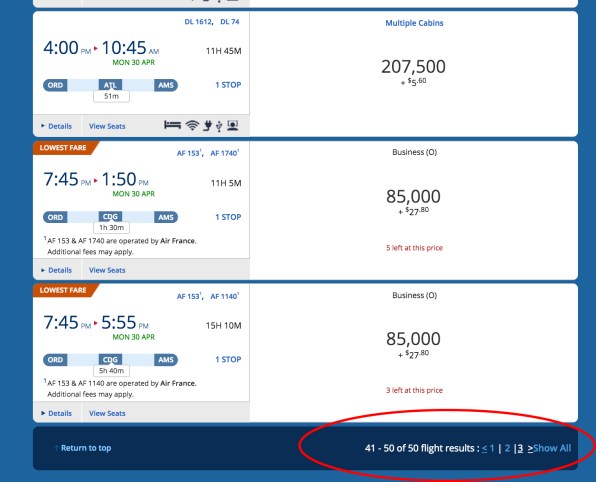
So I skipped to the very end of the list, and there they were, chilling at the very bottom:
I tried monkeying around with other searches and other days, trying to figure out what was going on. Was Delta intentionally burying partner redemptions and trying to steer people into more costly redemption on Delta? Whether sorting by price or by “Best Match” (which is the default sorting option), the partner flights were always at the bottom.
It took me a minute, but I eventually got there… it’s the taxes and fees! It’s pretty misleading, but Delta’s award calendar shows you the cheapest option in terms of miles. However, when you sort the flights by price, it sorts them based on the cash price, and since Air France charges more taxes and fees than Delta does, the Air France flights fall to the bottom. For whatever reason, “Best Match” seems to prioritize the taxes and fees above all other criteria as well. If you try sorting by duration, on the other hand, the flights will sort as expected, with the 11h5m Air France flight near the top.
I’ve used Delta’s award search engine a lot, and I can’t remember coming up against this problem before. In fact, I’m absolutely sure I’ve booked partner award flights through Delta.com when Delta flights were also available, and I never had to dig through the search results to find them. I don’t think it’s a conscious effort on Delta’s part to obscure partner awards, though, since there are times when the taxes/fees on Delta are higher than on partners, and in those cases the partners come up first.
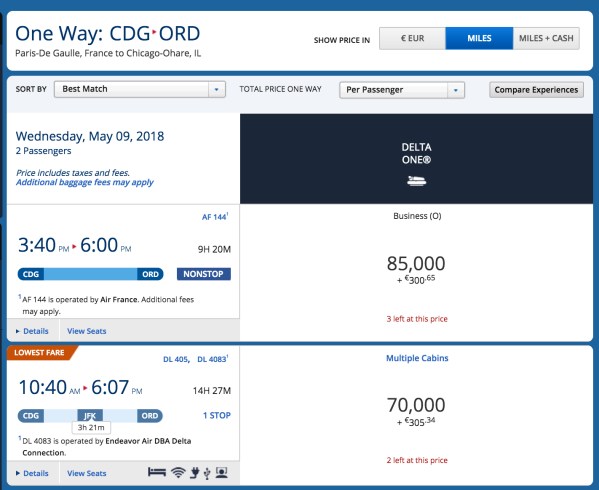
In this example, the Delta flight is the lowest fare in miles, but because it costs an extra 5 euros, it drops to second place.
One could certainly argue that Delta’s “Sort by Price” option should put the flight tagged “Lowest Fare” at the top of the search results. It does seem very Delta that “fare” and “price” mean two different things on their website. Of course, the more opaque the loyalty program, the harder it is to understand the search results, the more idiosyncrasies they can cram in there… it’s all toward the goal of preventing their overall customer base from wringing maximum value out of the program (while dubiously claiming to be America’s favorite loyalty program). Every program toes that line between making the program attractive enough to bring in customers and not making it so attractive that it loses money, and Delta has always been aggressive on the customer-unfriendly side of that line.
In the end, at least Delta’s award calendar is still accurate! Now I know that I just need to dig a little more to find the flights I want. Just Delta bein’ Delta, I guess.
Earlier this year, Star Alliance business class opened way up to Europe, with a veritable bonanza of saver award seats available over the summer from multiple US gateways. Within a couple months, availability had dried back up, which is a reminder to always get in while the gettin’s good. The good news is that it looks like the availability tides have come back in for next spring, as long as you’re flying from O’hare. I was helping my parents research vacation options tonight, and I found a number of routes with great availability. All the below searches are for two seats, by the way.
For instance, here’s Chicago to Zurich on Swiss:
And here’s Chicago to Copenhagen or Stockholm on SAS:
(There’s some journey control going on here, so if you search ORD-ARN, you’ll see one-stop availability via CPH, and if you search ORD-CPH, you’ll see one-stop availability via ARN. The image above is specifically for ORD-ARN, but ORD-CPH was almost exactly the same. Either way, if you’re booking one-way tickets, you can throw away the second segment and effectively fly non-stop to either city.)
Finally, here’s Chicago to Warsaw on LOT:
Pretty good, right? Unfortunately, because United’s domestic availability is so bad, you may have a hard time finding awards via Chicago from your home city — even mixed cabin awards. But, if you don’t mind starting your trip with a cheap flight on Spirit (in a Big Front Seat, of course) to get to ORD, this could end up being pretty useful.
Welp, it’s officially time to pay for my Sapphire Reserve card for another year, and since I got it on the very first day it was offered, I expect a rash of hand-wringing across the blogosphere over the next few weeks as people decided whether to cough up another $450 for their cards. I haven’t yet run the numbers on my card, since there were some extenuating circumstances this year that affected the value that I got out of the 3x bonus categories. Most notably, there was the sign-up bonus on the Amex Blue for Business card that paid 10x on restaurants for the first six months, meaning I didn’t use my Sapphire Reserve on restaurants for half of the year. There were also some travel purchases that I would have put on it that instead went onto my Arrival+ (so they could be reimbursed with the sign-up bonus). Anyway, I still have a gut feeling that the card is worth net $55 more than the Sapphire Preferred (see here to understand how I’m justifying that number), so I decided to keep it for another year. Irrespective of the points earning, the ability to get 1.5 cents per point when redeemed on travel has been really useful to me, and I don’t really want to give it up just yet.
On the other hand, despite my warm fuzzy feelings for the card itself, the authorized user card I got for Justine has been a waste of $75. I thought she’d make use of the Priority Pass membership, but she really hasn’t, and there aren’t any other benefits besides that. Aside from the benefits, though, I also wanted her to have the card for everyday spending, since I figured we’d put a significant amount of spending on this account. However, that flexibility isn’t worth $75 per year to me, so I called up Chase to cancel the authorized user account while keeping my account open.
In the “it never hurts to ask” department, I talked to the Chase rep about how Amex offers a free Gold card to authorized users on the main cardholder’s Platinum account for cases exactly like mine — where you wanted to give someone the ability to spend on the account without getting all the fancy benefits. He said that Chase doesn’t offer anything like that “officially,” but that canceling the authorized user account won’t invalidate the card itself. Wink wink. I probed a little further, and he told me that since the card has the same number and expiration date as my card, it’s basically the same card as far as Chase is concerned. (He also said, “But I didn’t tell you that” – an odd thing to say when calls are monitored or recorded.) The only difference is that the authorized user can’t user their name when making online transactions.
I guess this should have been obvious to me, since Chase (unlike Amex) doesn’t issue separate card numbers for authorized users. Therefore, the authorized user card is basically a duplicate of my card with the name changed. I still assumed that Chase’s superior technology could tell the difference and would either cancel the card when the account went away, or at least be able to recognize and reject the card at point of sale, though.
This isn’t really that different that getting a duplicate of a card by saying that your card broke in half (since the bank won’t issue a new card number in that case) – the main difference is that the card does have the right name on it (which is helpful in the exceedingly rare case that the cashier actually asks for Justine’s ID). In the end, I think this post falls under the “This might already be common knowledge, but I didn’t know about it, so I’m writing this post for the one or two people who maybe also didn’t know about it” category.
Bottom line: if you want another card on your Sapphire Reserve account but don’t want to pay extra for the Priority Pass benefit, just add an authorized user, wait for the card to arrive, and then cancel the account. You won’t have to pay the fee since you canceled right away, and the card will continue to work until it expires (or the main account number changes).
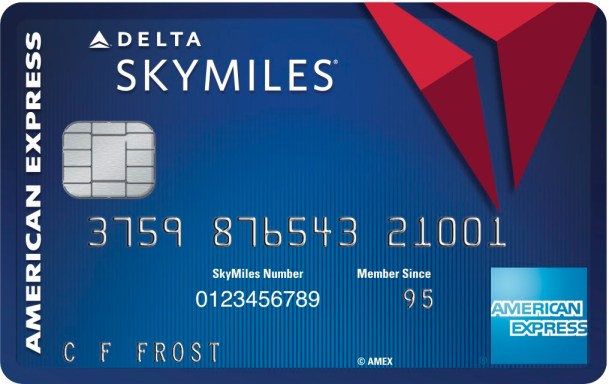
Amex has just released a new no-annual-fee Delta card, and it’s not that great. Apparently it’s for millennials, so they offer double Sky Miles on dining (because millennials want to earn double points on their avocado toast). The sign-up bonus is 10,000 Sky Miles for $500 in spend, which isn’t too bad for a no-fee card. If you can spare the credit inquiry, it’s an easy way to top up your Sky Miles account if you’re close to a redemption and don’t want to transfer points over from Membership Rewards.
I bet C.F. Frost is WAY over 5/24…
There are a couple things about this card that I haven’t seen pointed out yet, although as I said in the title, I haven’t looked that hard. There’s probably already a thread on Reddit about this, now that I think about it. Anyway, I’ve already started writing, so I’ll just keep going.
First – there’s a restriction on the sign-up bonus that I’ve never seen from Amex before.
This has a whiff of Citi’s shitty new “one bonus per card family” restriction, although it only applies on this card. I checked the bonus on the Gold and Platinum Delta cards, and they still show the standard “have or have had” language. I’d keep an eye on the fine print before you apply for one of those cards, though, since that could change at any time. Basically it looks like Amex really wants new customers to get this card, not seasoned Sky Miles collectors who are looking for a quick 10k. Also interesting is that they’re roping in the Options card, which is only available via product change from one of the other Sky Miles cards. I’d be annoyed if I had changed a Gold card to the Options card in the past and then found out later that I was disqualified from the bonus on different card.
Second – this card is not eligible for Delta’s “Pay with Miles” feature. This probably isn’t a deal breaker for most people, since points are only worth a penny when you use them this way. Despite all the devaluations, it’s easy to get more than one cent per point from Sky Miles, even if you’re redeeming for fancy drinks in a Sky Club (or buying a Sky Club membership for that matter). However, I do like the idea of it, because it backstops the value of your Sky Miles. Even if Delta further devalues the shit out of the program, you’re guaranteed a certain value. When I signed up for a couple Delta cards last year, I liked knowing that, at worst, my sign-up bonuses would be worth $1100. Now that I have canceled both cards, I’m more exposed to major devaluations. (I realize Delta could just cancel this program at any time, but it’s still another use for miles, and more uses are better than less.)
However, unlike the Gold, Platinum, and Reserve Delta cards, the Blue card doesn’t activate Pay with Miles in your Sky Miles account. Again, it’s not a huge deal, but it’s something to be aware of, especially if you convert one of the other cards into the Blue card in order to avoid the annual fee.
A new card introduction from Amex is always exciting, but I have a feeling the coverage of this one in the blogosphere is going to die down pretty quick due to the card being kind of a dud. However, I hope the more restrictive sign-up bonus on this card isn’t a portent of things to come, whether it’s added to future new cards or rolled out to existing cards. As if once-per-lifetime isn’t restrictive enough, amirite?
At first, I ignored the Flight Cents program that Barclaycard is rolling out in trial form from October to March. For those that don’t have their noses buried as deep in credit card promotions as I do, Flight Cents is a new program on Barclay’s Aviator Red (American Airlines) credit card. Basically, every transaction is rounded up to the nearest dollar, and you earn AAdvantage miles for the difference. One cent = one mile… so a $3.91 bill at the gas station costs you $4.00 and you earn nine extra miles (plus the four miles you’d normally earn on the purchase).
Of course, underneath all the fancy “rounding up” smoke and mirrors, this is a promotion to sell you miles for one cent per mile. That’s a great price, so either AAdvantage is cutting Barclaycard a deal, or Barclaycard hopes that training customers to use this card for everything will have lasting returns after the promotion ends (not to mention the interchange fees). I’m pretty glad that American Airlines doesn’t have an exclusive agreement with one card issuer, since competition between Barclaycard and Citi is producing some interesting results. Barclaycard is limited to where they can advertise the card, but they’re really going for it where they can. Meanwhile, Citi is increasing the bonus on the AAdvantage cards, Barclaycard is following suit on their card, and now Flight Cents.
Barclaycard charging station/credit card sign-up booth/rest area at ORD
Here’s why I ignored it at first: “round up” programs are really just a way to get you to rationalize spending money on things you otherwise wouldn’t. For example, I used to use a service called Acorns that rounded up all your transactions and deposited them in an investment account for you. The idea was that millennials can’t invest money without an app, and they’re too busy blowing their money on avocado toast to set aside a fixed amount every month – hence the easy-to-rationalize round-ups. It’s really no different that the “for pennies a day you could save a starving child” ads that used to run on TV. Likewise, American would probably have decent success selling a boatload of miles for a penny apiece, but this structure guarantees Barclaycard millions of swipes, so it’s a win-win: they get you to use the card more, and you don’t think about all the money you’re spending on miles because it’s split across many sub-$1 transactions.
The problem, however, is that round-ups don’t work like that in practice. Instead, you set a maximum threshold in your Barclaycard account, and your account keeps track of all your round-ups until the end of the month when they charge you a lump sum. At least, this is how I expect the program to work based on how they’ve described it in the FAQ. When you’re looking at your monthly budget, you’re going to see $80 or $150 (or whatever you set as your threshold) in a single transaction purchasing the miles, and if you haven’t budgeted for it (since you figured a few cents here and there wouldn’t throw off your monthly budget), you’re going to go into debt when it comes time to pay your bill. (Another win for Barclaycard.) Because I’m not planning to spend any money purchasing miles right now, I didn’t really want to get involved.
On the other hand, though, $.01 per mile is a really good deal. That’s at the point where you could come out way ahead even booking AAnytime awards (on some routes, some of the time). So, I may dip my toe in. We’ll see – right now all my spending is going on other cards where I have to hit a minimum spend, but I’ll probably have some opportunity to buy some cheap AAdvantage miles in the next few months.
Now, to my thoughts about the nuts and bolts of the program itself:
The maximum amount you can earn is 50,000 miles per month. Breaking that down, the least you could spend to maximize your miles would probably be around $0.89, which would come out to just over a dollar after tax where I live. (Of course, you’d also need to find a place that didn’t have a credit card minimum.) If you earned 95 miles for each of those $0.89 cent purchases ($1.05 after tax), you’d have to make 526 transactions–and that’s way less than the reality, since it’s unlikely you’d average 95 miles per transaction.
Churners have done crazy things in the past, so I’m sure there are some people out there who will go to Target and stand at a self checkout machine buying 100 individual packs of gum for $1.02 apiece. In that case, however, you’re also stuck with $100 worth of gum, and I’m assuming you don’t need $100 worth of gum. In the end, you spent $100 on useless gum and $98 on miles… AKA you bought miles for 1.98 cents per point, which is more than they cost when American runs promos.
Okay, so the gum is out (unless you really love gum). You know what’s not out, though? This:
I just checked to see if Amazon gift card balance reloads can include cents rather than being in whole dollars, and yep they totally can. (In case you’re curious, $0.50 is the minimum you can reload, so your best return would be with multiple $1.01 reloads.) To max out the promotion, you’d still need you do 505 separate $1.01 reloads, which would take some time. However, you could always set up a daily auto-reload, which would get you to 30 without any recurring effort on your part. (People have been doing this ever since the Amex Everyday Preferred card came out in order to hit the 30 transactions per month threshold.) You could even create multiple Amazon accounts to multiply your daily reloads, although I don’t know how many accounts Amazon would let you set up before they shut you down.
(Oh one other thing: you could always return the gum. Those miles wouldn’t be clawed back in this case, because you already paid for them. Barclaycard confirms as much in the FAQ:
So, if you were exceptionally patient and had extremely low self esteem to the point that you placed almost no value on your time, you could buy the individual packs of gum, keep the receipts, and then return the gum one pack at a time, getting you back to a penny per mile.)
In the end, this is a tough promotion to maximize. I think it’s pretty disingenuous for sites to pitch this as “Buy 300,000 AAdvantage miles for $3000!” (which is basically the tagline of a promoted post on The Points Guy that I saw on Facebook today), since you’d have to spend a fuckload of money and/or a fuckload of time to max it out. And even in the Amazon example, if you hit the maximum, you’d still be buying $3000 in Amazon credit along with $3000 in miles, meaning you have to come up with an extra $1000 per month, less however much you’d normally spend on Amazon. (You can’t use Amazon gift credit to buy Amazon or Visa gift cards that you could then liquidate, so your only option to mitigate the $3000 in Amazon credit would be to get into reselling, which is its own ball of wax.)
In the end, I think it’s a neat idea and certainly innovative. It’s also a great opportunity to earn a modest amount of AAdvantage miles for cheap – just setting up one Amazon reload would get you around 2970 extra miles per month, and you probably spend $30 on Amazon in a month anyway. I’m not sure I’d use my Aviator card for everyday spending, since you run into basically the same opportunity cost whenever you use a proprietary airline card instead of a card that earns flexible points or 2% cash back.
The question then becomes whether it’s worth however many AAdvantage miles you’re buying instead of earning flexible points. As an example, restaurants are a great place to maximize the promotion, since you can add a specific tip to get the final bill to $XX.01. However, they’re also heavily bonused on other cards. Say the bill is $25.01… would I rather earn 75 Ultimate Rewards points via my Sapphire Reserve, or 25 AAdvantage miles and 99 AAdvantage miles for 1 penny each? If the value of Ultimate Rewards points is 1.5 cents apiece, the value of the points I’d earn on this transaction is $1.125. (Full disclosure: I originally said $1.25 because I can’t do math, but then I changed it before anyone could call me out on it.) For discussion’s sake, let’s say AAdvantage miles are worth 2 cents per mile (since, presumably, you’d only want to buy them if you thought they were being sold for less than their value to you). If so, the value of the miles you just gained is $2.48… but you paid 99 cents for the miles, so the net value of your transaction is $1.49. That’s still better than with Chase, but the math changes the higher the dollar amount goes… not to mention the question of whether it’s a good idea in the first place to pay for 125 miles when you could get 75 Chase points for free. (Well, not free because there’s an annual fee and blah blah blah blah… how far in the weeds to you want me to go here?)
So, to make a long story short, in order to maximize the promotion in terms of your everyday spending, you’d want to use the Aviator card for low-dollar transactions that ideally weren’t in other cards’ bonus categories and were just over the nearest dollar. That’s kind of a lot of mental energy, but like I said above, I’m willing to try it and see how it goes.
I know I say this at the bottom of every post, but I’m legitimately curious to hear other people’s thoughts on Flight Cents, as well as strategies I’m sure I didn’t even consider that would help maximize it. Comment away!
I often joke that I love everything about air travel except for actually flying. Airports are one of my favorite parts of traveling, and I get excited whenever my travels take me to a new airport I’ve never flown through before. I still haven’t seen any of the world’s crown jewel airports (Singapore, Seoul-Incheon, Dubai, etc.), although I’m sure I’ll get there eventually. However, before I take a trip to any of those, I want to go to Queen Tamar airport in Georgia, because it’s one of the most bonkers architectural structures I’ve ever seen.
I first read about Queen Tamar airport in a new book about fancy airports, and unlike the bustling transportation hubs that take up most of the book, this one is more or less dormant (it doesn’t even have a three-letter airport code). It doesn’t currently have any commercial flights and is only accessible by seasonal charter flights. It was originally built to spur tourism in the area, but that hasn’t really panned out yet, based on what I’ve read.
Something about an ultra-modern curvy glass airport plunked down into a remote mountain village just seems too crazy to ignore. It would be a hell of a trek to get out there, but this has to be one of the coolest avgeek sites in the world.
This is a screengrab from Google’s photo sphere.
The airport is located in Mestia, a small town that’s home to a UNESCO world heritage site and some jaw-dropping mountain scenery. It definitely looks like a place I’d want to spend a few days hiking around, so it’s not as if I’d only want to go for the airport. That said, there are hundreds of jaw-dropping mountain villages in the world and this is the one I want to go to the most, so clearly the airport is a major draw.
Has anyone been here before? Got any tips on the best way to access it? Are there other crazy airports like this that should be on my radar?
Update #2 (9/4): I don’t know if I should bother continuing to update this, but given my incendiary tone, I feel like it’s only fair to note IHG’s response. So… after waiting over a week, I heard back from IHG that they would credit me points for the first night of my stay, but that the “eligible spend” from that night was $164. I have no idea how they came up with that number, which was less than half of the first night’s total. I didn’t continue to push it, though, since the bonus points I received from the IC Chicago more than made up the difference. As whether the stay will now qualify as a stay: maybe? If I end up earning all of the points I had hoped to earn after all, the moral of this post will change from “Make sure you know what you’re doing” to “be prepared to wrestle with IHG if you’re planning to stack promotions or push the envelope on points earning.”
Update (8/28): After I posted this, the Intercontinental Chicago contacted me on Twitter to get some more information about my stay. (I didn’t tag them when I posted a link to my post, so it must have set off a Google alert or something.) The conversation moved over to email, and they offered me some additional points to compensate for the subpar room. I didn’t ask for any comps when I mentioned the condition of the room at checkout, since I never requested a different room… that would be like eating an entire meal at a restaurant and then asking for a refund because you didn’t like it. Given that they offered the points proactively, I was impressed with the service. As for IHG’s own customer service, they never responded to my emails, although I did get a form letter DM’d to me on Twitter.
Off the top, I’ll admit that the below issue is my fault for not reading terms and conditions carefully enough. It’s still annoying, though, and IHG’s piss-poor customer service (as in, they haven’t responded to multiple emails or tweets) doesn’t make it any better.
Here’s how it happened: Justine and I needed to go back to Chicago on pretty short notice, and looking at the hotels around the Millennium Park area (where my parents live), it seemed like the best deal would be to book the Intercontinental Chicago, renew my Ambassador status, and use the free weekend night certificate for the second night. This, on paper, would also have the benefit of fulfilling two challenges in my IGH Q2 Accelerate promotion: 5000 points for renewing Ambassador status and 3600 points for staying in one of IHG’s big-city markets. Checking off those two would also get me to five total challenges, which would unlock a bonus of 16,400 points plus another 1500 for staying in August. Add to that around 5000 points for the stay itself, and I was going to mine 31,500 points from a single stay. Not bad, right?
It doesn’t look like I’m going to hit any more targets in the next 3 days, unfortunately…
Seasoned IHG members probably know where this is going: since the last time I redeemed an Ambassador free night certificate, IHG has changed the terms of the program so that stays that include a free night no longer count for anything. No points earned, no elite night credits earned, and no Accelerate objectives filled. That hits me pretty hard, since not getting credit for a stay in Chicago means I won’t hit the big city bonus, which in turn leaves me one objective short of the big 16,400-point bonus (in addition to missing the points I’d normally earn for a stay).
To make matters worse, I didn’t check the per-night rate of the hotel, which was another mistake. The average rate was around $300 per night, but the first night was $400 and the second one was $200, meaning the free night certificate didn’t save me nearly as much as I thought it would. I guess I just got sloppy here, but let my fuckup be a lesson here that this kind of shit is exactly how these programs finance perks like this in the first place. My screw-ups are subsidizing your outsized value on your next Ambassador weekend night stay, in other words.
Compounding my irritation, right before our trip, rates at the nearby Hyatt Regency dropped below $200 per night, meaning we could have stayed there for less overall. Sure I now have Ambassador status for another year, but with most of my non-work travel already planned and no Intercontinental stays on the horizon, I’m not really sure how much it benefits me. The goal here was for Ambassador membership to pay for itself in one stay through a combination of money saved on the free night and lots of points earned, and that didn’t happen. (Or, more accurately, that did happen, but the opportunity cost of not staying at a cheaper hotel made it a net loss.)
Here’s what really pisses me off: I paid more than full price for the first night at the hotel. The Ambassador weekend night certificate only works if you book the hotel at the special Ambassador weekend night rate, which is more than the best available rate. Sure I got the second (much cheaper) night for free, but I absolutely should get credit for the first night, since it was a fully paid night. IHG hasn’t responded to me at all, which itself is infuriating, but it’s no secret that IHG also has the worst customer service in the hospitality industry.
As for the Ambassador program in general, I still like the idea in theory. For someone like me who is never going to travel enough to earn top-tier status in a more rewarding program like Hyatt or SPG/Marriott, Ambassador gives me a way to fairly cheaply buy my way into something approximating high-level status. I’ve had good luck with upgrades in every Intercontinental I’ve stayed in – only once was I not upgraded to a suite, and that was at the Venetian, which isn’t really a “full” Intercontinental anyway. The upgrades are only supposed to be for one room category, but in my experience they have usually been better than that, and when I’ve been denied an upgrade due to availability, the hotel went out of its way to comp me all kinds of stuff to make up for it.
Although they don’t give you free breakfast, it’s not like Hyatt or SPG is offering guaranteed upgrades (often to suites) and 4PM late checkout for people who fork over $150 per year. Imagine if Hyatt ran a promotion where you could get upgrades and 4PM checkout for an entire year after only one stay at a Hyatt Regency… The blogosphere would explode. It’s all you’d hear about for months.
So in that sense, I think Ambassador membership can be a fantastic deal if you can use the benefits. The first year I had it, I stayed at Intercontinentals five times, so it really worked out. The second year, I really only wanted it because I was hoping to get a suite upgrade at the Intercontinental Amstel (Amsterdam). Luckily I did – effectively paying $50 per night to upgrade to a room that would have cost around $500 more across three nights. (And that figure even dropped in half when I sold my unused free night certificate on eBay for $75. Unfortunately you can’t do that anymore, since starting this year, your name and member number are printed on the back of the certificate.) This year, I was going to let it lapse, but it all of a sudden made sense given the recent trip to Chicago. Or, it would have if I hadn’t dropped the ball reading the fine print.
(I should note that I didn’t come up empty handed, since renewing at least got me 5000 points through Accelerate and another 10,000 bonus points through the Ambassador program. IHG points are usually worth around a half a cent per point, so those points theoretically will cover half the renewal fee. Still, I’m haunted by what could have been.)
And what about the Intercontinental Chicago, then? Meh. It’s the worst Intercontinental I have been to, but since I’ve been consistently impressed by the quality of their hotels, that’s not to say that the IC Chicago is terrible or anything. The problem is that there are two towers: the recently renovated Executive tower and the threadbare Grand tower. I went out of my way to book a room in the Executive tower, but I was then “upgraded” to a junior suite in the Grand tower. By the time we got up to our room, we were tired after waking up for an early flight and didn’t want to deal with getting our room changed to the other tower.
The problem with the Grand tower is that it’s in incredibly shitty shape for a luxury hotel. All the furniture is scratched up, the carpet is stained, the walls have huge chunks of paint missing, and the bathrooms are on par with what you’d get in a Holiday Inn. The room itself was pretty nice if you ignored all that other stuff – the bed was comfy, there was tons of space, the other furniture was nice for lounging, it had a big desk, etc. The only major defect with the room was that the windows in the living room didn’t have blackout curtains, and since the junior suite only has a half-wall between the living room and the bedroom, you can’t keep the room dark in the morning if you want to sleep in.
I definitely won’t stay here again, given that the area has tons of hotels that are similarly priced but *way* nicer – like the new London House (Hilton Curio), the aforementioned Hyatt Regency, the Radisson Blu, and even the Park Hyatt Chicago, which I have sometimes seen for around the same price as the Intercontinental. It was nice to get upgraded to such a big room, and I always appreciate 4PM checkout (and the free movie), but I’d rather get more limited benefits from my Hilton Gold or Hyatt Discoverax status while staying at nicer (and usually cheaper) hotels.
Bottom line at the end of a long post is that while I still think it’s great that Intercontinental offers Ambassador status, you have to be careful to make sure that the value proposition actually works out in your favor. And if you screw something up like I did, don’t expect a response from IHG to make it right (or really any response at all).
Update #2 (9/4): I don’t know if I should bother continuing to update this, but given my incendiary tone, I feel like it’s only fair to note IHG’s response. So… after waiting over a week, I heard back from IHG that they would credit me points for the first night of my stay, but that the “eligible spend” from that night was $164. I have no idea how they came up with that number, which was less than half of the first night’s total. I didn’t continue to push it, though, since the bonus points I received from the IC Chicago more than made up the difference. As whether the stay will now qualify as a stay: maybe? If I end up earning all of the points I had hoped to earn after all, the moral of this post will change from “Make sure you know what you’re doing” to “be prepared to wrestle with IHG if you’re planning to stack promotions or push the envelope on points earning.” Update (8/28): After I posted this, the Intercontinental Chicago contacted me on Twitter to get some more information about my stay. (I didn’t tag them when I posted a link to my post, so it must have set off a Google alert or something.) The conversation moved over to email, and they offered me some additional points to compensate for the subpar room. I didn’t ask for any comps when I mentioned the condition of the room at checkout, since I never requested a different room… that would be like eating an entire meal at a restaurant and then asking for a refund because you didn’t like it. Given that they offered the points proactively, I was impressed with the service. As for IHG’s own customer service, they never responded to my emails, although I did get a form letter DM’d to me on Twitter.
Off the top, I’ll admit that the below issue is my fault for not reading terms and conditions carefully enough. It’s still annoying, though, and IHG’s piss-poor customer service (as in, they haven’t responded to multiple emails or tweets) doesn’t make it any better.
Here’s how it happened: Justine and I needed to go back to Chicago on pretty short notice, and looking at the hotels around the Millennium Park area (where my parents live), it seemed like the best deal would be to book the Intercontinental Chicago, renew my Ambassador status, and use the free weekend night certificate for the second night. This, on paper, would also have the benefit of fulfilling two challenges in my IGH Q2 Accelerate promotion: 5000 points for renewing Ambassador status and 3600 points for staying in one of IHG’s big-city markets. Checking off those two would also get me to five total challenges, which would unlock a bonus of 16,400 points plus another 1500 for staying in August. Add to that around 5000 points for the stay itself, and I was going to mine 31,500 points from a single stay. Not bad, right?
Seasoned IHG members probably know where this is going: since the last time I redeemed an Ambassador free night certificate, IHG has changed the terms of the program so that stays that include a free night no longer count for anything. No points earned, no elite night credits earned, and no Accelerate objectives filled. That hits me pretty hard, since not getting credit for a stay in Chicago means I won’t hit the big city bonus, which in turn leaves me one objective short of the big 16,400-point bonus (in addition to missing the points I’d normally earn for a stay).
To make matters worse, I didn’t check the per-night rate of the hotel, which was another mistake. The average rate was around $300 per night, but the first night was $400 and the second one was $200, meaning the free night certificate didn’t save me nearly as much as I thought it would. I guess I just got sloppy here, but let my fuckup be a lesson here that this kind of shit is exactly how these programs finance perks like this in the first place. My screw-ups are subsidizing your outsized value on your next Ambassador weekend night stay, in other words.
Compounding my irritation, right before our trip, rates at the nearby Hyatt Regency dropped below $200 per night, meaning we could have stayed there for less overall. Sure I now have Ambassador status for another year, but with most of my non-work travel already planned and no Intercontinental stays on the horizon, I’m not really sure how much it benefits me. The goal here was for Ambassador membership to pay for itself in one stay through a combination of money saved on the free night and lots of points earned, and that didn’t happen. (Or, more accurately, that did happen, but the opportunity cost of not staying at a cheaper hotel made it a net loss.)
Here’s what really pisses me off: I paid more than full price for the first night at the hotel. The Ambassador weekend night certificate only works if you book the hotel at the special Ambassador weekend night rate, which is more than the best available rate. Sure I got the second (much cheaper) night for free, but I absolutely should get credit for the first night, since it was a fully paid night. IHG hasn’t responded to me at all, which itself is infuriating, but it’s no secret that IHG also has the worst customer service in the hospitality industry.
As for the Ambassador program in general, I still like the idea in theory. For someone like me who is never going to travel enough to earn top-tier status in a more rewarding program like Hyatt or SPG/Marriott, Ambassador gives me a way to fairly cheaply buy my way into something approximating high-level status. I’ve had good luck with upgrades in every Intercontinental I’ve stayed in – only once was I not upgraded to a suite, and that was at the Venetian, which isn’t really a “full” Intercontinental anyway. The upgrades are only supposed to be for one room category, but in my experience they have usually been better than that, and when I’ve been denied an upgrade due to availability, the hotel went out of its way to comp me all kinds of stuff to make up for it.
Although they don’t give you free breakfast, it’s not like Hyatt or SPG is offering guaranteed upgrades (often to suites) and 4PM late checkout for people who fork over $150 per year. Imagine if Hyatt ran a promotion where you could get upgrades and 4PM checkout for an entire year after only one stay at a Hyatt Regency… The blogosphere would explode. It’s all you’d hear about for months.
So in that sense, I think Ambassador membership can be a fantastic deal if you can use the benefits. The first year I had it, I stayed at Intercontinentals five times, so it really worked out. The second year, I really only wanted it because I was hoping to get a suite upgrade at the Intercontinental Amstel (Amsterdam). Luckily I did – effectively paying $50 per night to upgrade to a room that would have cost around $500 more across three nights. (And that figure even dropped in half when I sold my unused free night certificate on eBay for $75. Unfortunately you can’t do that anymore, since starting this year, your name and member number are printed on the back of the certificate.) This year, I was going to let it lapse, but it all of a sudden made sense given the recent trip to Chicago. Or, it would have if I hadn’t dropped the ball reading the fine print.
(I should note that I didn’t come up empty handed, since renewing at least got me 5000 points through Accelerate and another 10,000 bonus points through the Ambassador program. IHG points are usually worth around a half a cent per point, so those points theoretically will cover half the renewal fee. Still, I’m haunted by what could have been.)
And what about the Intercontinental Chicago, then? Meh. It’s the worst Intercontinental I have been to, but since I’ve been consistently impressed by the quality of their hotels, that’s not to say that the IC Chicago is terrible or anything. The problem is that there are two towers: the recently renovated Executive tower and the threadbare Grand tower. I went out of my way to book a room in the Executive tower, but I was then “upgraded” to a junior suite in the Grand tower. By the time we got up to our room, we were tired after waking up for an early flight and didn’t want to deal with getting our room changed to the other tower.
The problem with the Grand tower is that it’s in incredibly shitty shape for a luxury hotel. All the furniture is scratched up, the carpet is stained, the walls have huge chunks of paint missing, and the bathrooms are on par with what you’d get in a Holiday Inn. The room itself was pretty nice if you ignored all that other stuff – the bed was comfy, there was tons of space, the other furniture was nice for lounging, it had a big desk, etc. The only major defect with the room was that the windows in the living room didn’t have blackout curtains, and since the junior suite only has a half-wall between the living room and the bedroom, you can’t keep the room dark in the morning if you want to sleep in.
I definitely won’t stay here again, given that the area has tons of hotels that are similarly priced but *way* nicer – like the new London House (Hilton Curio), the aforementioned Hyatt Regency, the Radisson Blu, and even the Park Hyatt Chicago, which I have sometimes seen for around the same price as the Intercontinental. It was nice to get upgraded to such a big room, and I always appreciate 4PM checkout (and the free movie), but I’d rather get more limited benefits from my Hilton Gold or Hyatt Discoverax status while staying at nicer (and usually cheaper) hotels.
Bottom line at the end of a long post is that while I still think it’s great that Intercontinental offers Ambassador status, you have to be careful to make sure that the value proposition actually works out in your favor. And if you screw something up like I did, don’t expect a response from IHG to make it right (or really any response at all).
I was complaining to Justine the other day that the one thing missing in the world of premium travel is reliable access to arrival lounges. It just makes intuitive sense that you’d want a place to freshen up and maybe get a bite to eat after a long flight, especially if the flight arrives in the morning and you can’t check into your hotel until the afternoon. Especially when flying an airline into its hub, this seems like a pretty obvious gap in the luxury experience. I’m not quite ready to choose routes/airlines based on which ones have arrival lounges, but it’s certainly worth considering.
This is relevant right now, because I’m flying to Amsterdam next year and arriving at 9AM, and while Amsterdam Schiphol airport has a giant checkered cube in the arrivals lobby, the cube won’t give you free breakfast or a shower. However, in an article about LAX’s new private terminal (only $10,000 for your first use and $2500 thereafter!), I noticed a line about how these sorts of VIP services are cropping up at airports around the world, including Amsterdam. I wasn’t previously aware of such a service at Schiphol, but a quick search led me to Schiphol’s VIP Terminal, and I have to say… it sounds pretty nice.
Here’s what you get: A representative from the VIP Terminal meets you on the jetbridge and takes you to a black car that drives you across the runway to a separate building, where you get free breakfast and a space to relax and freshen up while you wait for your bags to be delivered to you. You also clear immigration there, meaning you can relax instead of hoofing it through the airport and waiting in line forever at immigration and baggage claim. It sounds a lot like Lufthansa’s famed first class terminal, although of course it isn’t included in the price of your ticket.
The cost is simultaneously less than I would have expected, but more than I’d want to pay: for arrival service, it’s 300 Euros for the first person and 115 Euros additional for a companion. And no, you can’t claim that you and your companion are each other’s companion and get a double companion rate of 230 Euros.
Here’s why it’s stupid to book the VIP Service: for $450-$500 depending on the exchange rate, you could book the night before your flight at just about any luxury hotel in Amsterdam and go straight there when you landed. You could even book it through Fine Hotels & Resorts and get 4PM checkout, free breakfast, and a dining credit to cover your lunch. At that point, all you’re really getting from the VIP service is the benefit of not having to deal with the airport upon arrival. Oh and a fun ride across the tarmac in a fancy car.
The problem, though, is that I’m stupid. I waste enough money on stupid crap that I could see myself paying for this just because it sounds really cool, and it would be a super fun way to start off our trip. I wrote a whole post congratulating myself for not buying a Rimowa suitcase and now I’m thinking of dropping the equivalent amount on something that will last around 90 minutes. At least I have a while to mull it over and talk myself into, out of, back into, and back out of the VIP service. I don’t think I’ll do it, since it’s just too much money. Or maybe I will. I will or I won’t – that much I know. How about you? Has anyone been there before? I saw a thread on Flyertalk with only a few responses, most of which concluded that the service delivers on what it promises. I haven’t found any detailed reviews though, so maybe I could convince myself to do it for the content (since coming up with content for this un-monetized blog is such a good reason for doing anything).












 Windbag Miles