Dear Marc Andreessen, way to prove my point you gasbag

Note: this is the sequel to a post I wrote a few days ago. Read that one first if you haven’t yet.

Before we start, I will admit that I don’t know all that much about Marc Andreessen, and I’m not judging him as much as I’m using a tweet he made as evidence to prove my point about economic marginalization (refracted through the lens of airline and hotel loyalty programs). I also assume that, as a billionaire, Andreessen has a very good track record of philanthropy. I don’t know if that’s true, but I’ll give him the benefit of the doubt on this one. Finally, I don’t know the man’s sense of humor and considered that he may be kidding about all this. I doubt it, but given the absolute batfuck absurdity of his tweet, it’s certainly possible. I hope it’s a joke, honestly.

Okay, so why don’t I get to it and show you this stupid bullshit:

pmarca

So remember what I was saying about how Citizens United codified the capitalization of speech in legal literature, which set the stage for the concept of speech-as-capital promulgating through society? Nowhere is that more evident than in this tweet, in which a multi-billionaire and tech genius has assigned a value to his speech as some sort of philanthropic gesture. Think about it for a minute: rather than just giving a bunch of money to a charity, he’s assigning value to his speech, selling it, and generously donating the proceeds to charity. The wealthy person’s value to society transcends his or her own capital worth: when you’re wealthy, you become a conduit for capital. Rather than giving capital away to charity, you perpetually generate capital which then you direct as you see fit. My head is spinning at how philosophically fucked up this is.

A person who owns $20 and wants to donate it to charity has thousands of options. The idea of donating to a particular charity in exchange for an inducement isn’t new, as landfills full of PBS tote bags will attest. However, the idea that one person’s communication is so important that it should be an inducement to donate to the charity of his choice is new. I suppose it’s not that much different from auctioning off a dinner with a famous celebrity or something, except that in this case, Andreessen is setting a fixed value for his speech, and he isn’t limiting it. A dinner with George Clooney is special because only one non-famous person gets to experience it. Andreessen isn’t saying that one lucky fan will get to be in an email correspondence with him, he’s literally saying that any time he writes an email, it’s worth $20 to the recipient because he’s so great. The sheer, unadulterated gall of this guy.

In being first-to-market, Andreessen also suggests that his speech is worth more than others’ – such as those who give away their emails because no one wants to pay for them. This is where we get into dangerous territory, because it suggests that everything a wealthy person does has value because that person is wealthy. When you speak, it’s worthless. When Andreessen speaks, because he’s so rich, you should pay for it – even if it’s some shit he dashed off on a smartphone. While most people can only manage paltry contributions to charity, Marc Andreessen is so great that he is a literal fount of charitable contributions, because he is so valued. He has become a capitalist tautology: he has value because people pay money for what he says, and people pay money for what he says because he is so valuable.

I didn’t just want to write this post about Marc Andreessen, though. I was actually thinking about my earlier post in light of the new video that Hyatt released today, trying to spread warm fuzzies around the World of Hyatt program. (Again, I’m not paying WordPress enough money to embed videos in my posts, but you can view it here.) First, this is off topic, but seriously fuck all the people who criticized the ad as being “too political” with a rusty rod. I can only assume the “political” statement is that the ad includes a muslim woman who doesn’t get verbally or physically abused by some fat redneck in a wifebeater. If you watch that ad and think it’s political because it advocates people of different cultures coming together, you’re an objectively shitty person… and also why the fuck are you reading a travel blog in the first place if you’re so goddamned xenophobic? Getting back on track, though, I like the concept behind the ad. Gold Passport is just a loyalty/rewards program, whereas World of Hyatt is a more of a concept based on bringing people together. Seriously, the world needs as much of this sentiment as it can get right now.

However, linguistically, I have some issues with this idea of the loyalty program becoming a concept. I don’t think any of this really occurred to any of Hyatt’s marketing folks, although – again – these are trends in our cultural subconscious which certainly come out in things like corporate marketing programs. Anyway, in the last post, I wrote about structuralist linguistics (the division between signifiers and signifieds), but I want to flesh it out a little more here, specifically how it relates to structuralism as a school of thought in cultural studies. One of the tenets of structuralism is that culture is governed by structures, which underline the meaning of the things that exist within that structure. Think of any time you’ve read a review of a movie that talks about it in a larger context (ie: “In the context of martial arts action films, Enter the Dragon is an example of…”). That’s structuralism in a nutshell: that the larger context explains the singular example. (In the context of other, more useful points and miles blogs, Windbag Miles somehow manages to be both irritating and boring.) Saussure – the guy who came up with the signifier/signified thing – also identified a difference between speech and language. In the last post, I kind of conflated them, but the idea is that speech is the actualization of language. When you speak, you’re speaking a language. Language governs, orders, and provides meaning to speech, and speech cannot exist without language. (This is why Wittgenstein argues that language must explain itself: because any attempt to explain language is already dependent on the rules of that language.)

I talked about loyalty as a form of speech, and as speech becomes increasingly capitalized, so goes loyalty. This is how we end up with transactional loyalty – expressing your affinity for something by giving it money. But what about language? When you demonstrate loyalty for something, either performatively or transactionally, what language are you speaking? There are a couple answers: specifically, you’re speaking the language of the loyalty program, but that’s really more like a dialect of a more ambiguous language around travel loyalty in general. When Hyatt extolls their new program’s lofty goals, they’re implying by contrast that Gold Passport was unambitious and unimaginative. I would argue instead that it was too literal of a dialect, which locked Hyatt into a fairly predictable pattern of behavior in order to deliver on the brand promise it was selling.

What Hyatt has done with the new program is to realize that the language of loyalty is much more ambiguous and prone to slippage than the dialect they were using. By remodeling the loyalty program’s identity to be more ambiguous, they’re simultaneously able to tap into a cultural need (among everyone who isn’t a Trump-sucking eel) to feel connection and harmony in the world and to change the focus of the program to benefit wealthier customers. They get away with this seeming contradiction precisely because they’re speaking a more ambiguous language – and rather than being a dialect of a language most frequent travelers are familiar with, they’re creating a new one. From a marketing perspective, I think this is ingenious. In contrast, take a tagline like American’s “The World’s Best Flyers Fly American” (or whatever the exact wording is): it’s transparently idiotic, because everyone knows this isn’t true. It’s as ridiculous as saying “The World’s Best Flyers Fly out of Charlotte, Philadelphia, or Dallas.” The thing is, American made that claim using the same language as all other airline marketing, which is what made it so easy to decode and debunk. Hyatt’s claim is more slippery – World of Hyatt is the entire world, it’s connectedness, it’s literally an empty square into which you could put anything.

worldohyatt

By focusing more on their loyalty program being a language, they’re better able to dictate the meaning of things like “rewards,” or “loyalty,” or anything else that’s part of that structure. After all, language can’t be explained – so rather than operating a loyalty program within a previously agreed-upon language of loyalty programs, Hyatt is making their own. Now they can say that loyalty means whatever they want it to mean, and it will make sense. It just so happens that, in this new language they’ve come up with, loyalty means spending money.

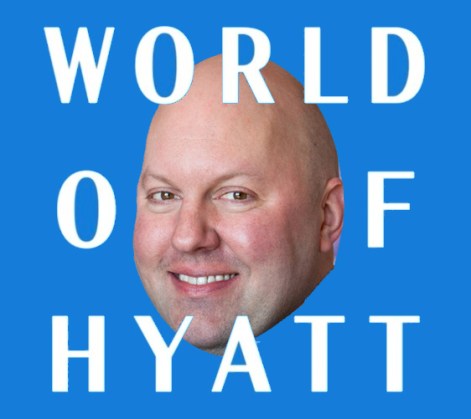
The release of their video today reinforces my original point by making it clear just how much Hyatt is employing the essential emptiness at the core of “World of Hyatt” to mess around with what it means to be a loyal traveler. It’s just too perfect that the logo they chose is literally empty inside.
marchyatt

Edit: my wife says I’m being totally unfair to Marc Andreessen, and that it’s very reasonable for the person who invented the web browser to offer up his time to benefit a charity. She further commented that I’m being cynical and obstinate for no reason. I maintain that it’s not the concept of offering his time as an inducement for someone to donate to charity that I take issue with as much as the idea of selling speech for a set price an infinite number of times because you can. Also, I was stuck in traffic behind one of those goddamned giant buses that cart tech people around so they don’t have to rub shoulders with the unwashed masses on public transit, so maybe I had a chip on my shoulder about tech people today.
What would I have to do to get you into some Flying Blue miles?

In general, it’s never a good idea to buy miles you don’t have an immediate use for, unless the opportunity staring you in the face is uncommonly good and unlikely to be repeated (such as the SPG deal I got in on a few months ago that included a 50% bonus on purchased miles that generated a shitload of Alaska miles when coupled with the 20% transfer bonus and 1:1.3 transfer ratio between Virgin America and Alaska). Still, I’m always on the lookout for opportunity zones, even though I usually don’t pull the trigger.

One particular opportunity zone involves purchasing miles in currencies other than the dollar, given the dollar’s strength right now. If your British Airways account is registered in the US, then you have to use dollars to purchase Avios. Flying Blue, on the other hand, charges you in Euros no matter where you are. At today’s exchange rate of 1 to $1.05, anyone purchasing in dollars is getting a major discount on FB miles.

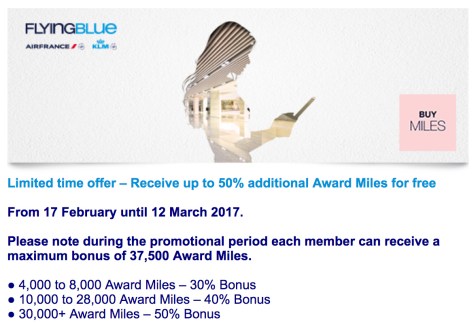
Additionally, Flying Blue is offering a promo right now for up to 50% bonus miles, depending on how many you purchase. The fewest miles you can purchase to get the full bonus is 30,000 (for a total of 45,000 after the bonus), which will set you back 825 Euros, or around $870 (as of today). That nets out to around 1.92 cents per mile, and in my opinion anything under 2 cents is worth paying attention to.

fbmiles2

Of course, this is far from a no brainer. Why would you NOT want to buy Flying Blue miles? I’m sure there are more reasons than what I’m about to list, but this is what jumps out at me:

  • Their website shows so much phantom availability, it might as well be called FantomBlue (BURN!)
  • They charge fuel surcharges that can get pretty high
  • You can’t book first class awards unless you’re an elite member
  • Miles are pretty easy to accrue since they partner with the three major points currencies
  • Their fraud department may not issue your tickets without a huge hassle. (I haven’t heard reports of this lately, but it was a major problem in the past.)
  • Their miles can only be kept from expiring by crediting a flight; transferring points, buying miles, or spending miles on magazines doesn’t do anything

Why WOULD you want to buy miles?

  • Intra-Europe economy awards are cheaper than when booking through some other SkyTeam partners. Also, they have a lot of fare buckets, so you can still get a decent deal even if saver awards aren’t available. Looking at any random day, you’ll see prices ranging from 8500 miles up to 15,000. However, the cheapest you’ll find on Delta is 15,000 miles, and on a lot of days, Delta shows no available flights when Flying Blue shows availability on almost every flight. At less than 2 cents per mile, your flights will be as cheap as $75 including seat selection and checked bags, which is better than pretty much everyone that flies out of normal airports.
  • Business class transatlantic awards are 62,500 miles each, so if the availability is there, you can get a one-way for ~$1190 plus fuel surcharges. That’s pretty good for a cash fare in business class (although of course you wouldn’t earn miles).
  • If you have a trip coming up where you know you’ll need a ton more miles than you can earn through credit card sign-ups, you can get a pretty good head start this way.
  • Finally, availability has been pretty good of late, although that could dry up at any time.

I personally am not going to buy any Flying Blue miles with this promo, but again, any time miles are available for under 2 cents apiece, I’ll take a closer look. Alaska is running a sale right now that’s getting a lot of coverage, but I haven’t seen anyone write about this yet (which as we’ve established time and time again is not evidence that no one has written about this). Now, obviously Alaska miles are preferable to FlyingBlue in just about every metric, but they’re also more expensive, even on sale. Don’t write off Flying Blue is all I’m saying. How’s that for an endorsement?

United’s Basic Economy underscores how sucky it is when airlines give up on being creative.

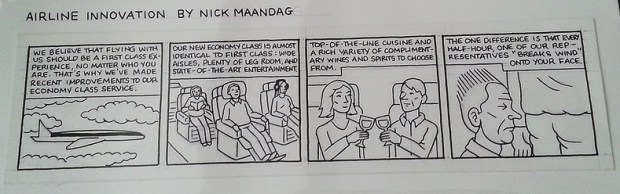
United rolled out Basic Economy fares today, which you already know because you come here for my hot takes, not to read breaking news. I’m not going to summarize the non-perks, but I do think it would be neat if airlines started thinking a little more creatively about how to offer different passenger experiences across a range of price points. To wit: I’d like to share with you a comic by Canadian cartoonist Nick Maandag. (I couldn’t find it published anywhere online, so I’m posting a photo of the original artwork that my friend Chris shot.)

maanag.jpg

I know taste in humor is a personal matter, but this is objectively hilarious, so I hope you laughed. However, I do think it’s a worthwhile thought experiment to think about what aspects of an airline’s premium experience are completely unnecessary and exist only to justify the price tag.

For me, pretty much everything related to the “soft product” is irrelevant. When I read trip reports, I pore over the photos of the cabin and the seat and then scroll really quickly through the food, since I don’t really give a shit about the meals. For one, the special vegan meal is going to be terrible no matter what, but I also have a hunch that – with a few notable middle eastern exceptions – premium airline food is good because it isn’t economy food (just like how most lounges aren’t that nice until you compare them with overcrowded terminals and gate seating areas).

The same goes for service – I love the idea of a “do not disturb” button like on United’s new Polaris seat, because I don’t want to talk to anyone. If I need some water, I’ll hopefully grab it from the walk-up bar. On my last flight coming home from Hawaii, the flight attendant came through the cabin and asked me if I needed anything, and, with my social awkwardness kicking in right on cue, I just looked back at her confused why she was talking to me. It was an uncomfortable exchange (due entirely to me being too shy to go out in public), but it reminded me why the ideal service concept for me is just to leave me alone. It’s not quite farting in my face every thirty minutes, but it’ll do.

Also, I don’t need a flat bed. It’s nice, but the couple times I’ve had a flat bed seat, I couldn’t sleep at all and I mostly used it in recliner mode anyway. (Sleeping on planes, like the fawning over attentive service, is just something I don’t get. Planes are loud, and they move around even when it’s smooth outside. They smell weird, people are always milling around, and even the widest seats are still these comparatively tiny planks in bed mode. How do people just conk out for hours at a time? It’s such an inhospitable environment for sleep! It’s a total mystery to me.)

I think what I’m describing is called Premium Economy (or maybe “Club World”). However, the few times I’ve costed out premium economy, it has been a terrible value in both dollars in miles. Air France premium economy is usually way more expensive than economy, and it’s almost twice the cost in miles. However, business class is only 12,500 miles more than premium economy for a one-way transatlantic flight, so for that small amount of miles I’d rather get the extra space and comfort in business.

I don’t really know where I’m going with this. If I had my own airline (which I’d call “Royal Jordanian”), I’d create two identical business class cabins, where one offered the full premium experience and the other offered only the seat with the same shitty buy-on-board food as economy and indifferent service (and no stupid amenity kit, blanket, etc) for 40% less. I’m sure I’d go out of business right away, but it would be a good experiment to see how many people were willing to pay a premium for a nice “soft product,” or if that cabin went out empty every flight because people just wanted a comfy seat. I suspect that’s what would happen, which suggests that the soft product is actually the least expensive part of the business class fare, and the airlines maximize profit margin by using meaningless soft product enhancements to justify the insanely high prices. More power to them, I guess, but as miles devalue past the point where I can use them for business class, I’m going to get more and more annoyed at how all the dumb soft product stuff is contributing to pricing business class out of my range.

Dynamic Hotel Pricing in Action (I promise I’ll write about something other than Hyatt soon)

I’ve been keeping an eye on hotel prices in New York, since I have a trip coming up in a few weeks, and I want to see if any good hotel deals open up. If anything looks especially good, I might cancel the points bookings I made and book a revenue stay instead. While surfing Hyatt’s website, I found some interesting dynamic pricing that I wanted to write about. It shouldn’t have been a surprise to find this, and I suspect it’s not especially newsworthy. If anything, it’s a good reminder to to check whether booking individual days could save you money. (By the way, I’ve done this a couple times, even at fancy hotels, and I’ve always had the hotel combine them into one stay, rather than making me check out, vacate the room, and check back in. I suppose that’s a risk, though.)

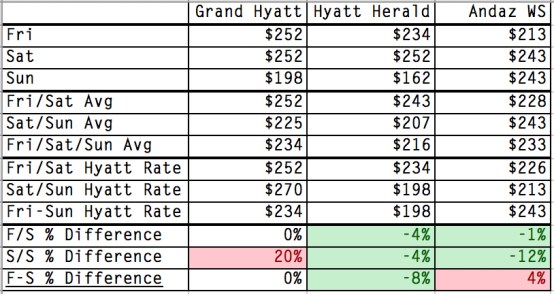
I’m going to be in town from Friday to Monday, so I looked at the pricing on three hotels for each night, and I averaged those nightly rates for Friday/Saturday, Saturday/Sunday, and Friday-Sunday. I then compared the averages of the daily rates with the average per day that Hyatt displayed when I searched for hotels over the same date range. Here’s the data:

hyattpricing2

So, if you were to book the Grand Hyatt for two nights on Friday and Saturday, you’d pay the same as if you paid the daily rate for both days. However, if you booked it for Saturday and Sunday, you’d pay 20% more than if you booked those days individually. The Hyatt Herald Square always saves you money over the daily rate if you book for multiple days, and the Andaz Wall Street will save you money if you book for two days at a time, but it will charge you more if you book all three days.

I also looked at IHG hotels, and I didn’t see any pricing anomalies like this (the displayed average was always just the average of each individual night). Like I said, I expect that this is a known issue to most frequent travelers, but I was surprised by how much the price can vary versus booking individual nights. A 20% premium to book the Grand Hyatt for two days seems pretty outrageous, but I guess it’s a good way to wring extra revenue out of weekend travelers. I doubt it’s that nefarious, though, since the pricing is all over the place. I’m intrigued enough to look into it further to pan for gold and see if I can find inventory that’s loaded incorrectly. Hey, it happened once!

What does Citizens United have to do with World of Hyatt anyway?

One of the key innovations in linguistics is the idea that language doesn’t have any inherent or universal meaning. Individual words are “signifiers,” and the concept that they evoke is a “signified” – the link between the two is an agreed-upon cultural fact. (This signifier/signified duality was first identified by Ferdinand de Saussure in the late 19th century.) For example, when you say the word “cactus” with your voice, the fact that the person you’re talking to thinks of a spiky plant living in the desert is due to our culture basically agreeing that this is the case. However, while certain words are pretty solidly hard-coded into our understanding, the fact that the relationship between a word and what it evokes is essentially arbitrary leaves room for slippage between word and concept.

Ludwig Wittgenstein’s Philosophical Grammar includes an exhaustive analysis of what goes on between hearing something and the understanding of it, and also of what “understanding” something really entails. It’s a gripping read, perfect for your next 14-hour long haul flight, so I don’t want to give you any more spoilers. However, I’m bringing this up because, while “words can mean more than one thing” is not exactly a groundbreaking claim, I’m looking a little deeper into language in this post. Specifically, I’m thinking about this:

witt

With this in mind, I want to look at the word “loyalty” right now… Obviously the definition of loyalty as it concerns frequent flyer programs has been changing quite a bit lately, but the terminology is not changing with it. To wit: airlines still call them “miles,” even though a mile is not representative of any distance flown. And now miles are even further bifurcated into those that can be used for free flights and “elite qualifying miles,” which cannot be redeemed for flights, but which are proof of how loyal you are to an airline. In this way, your loyalty is now turned into a currency that can be earned or even in some cases purchased. Credit cards offer EQM bonuses for signing or for hitting spending targets, which means that it’s possible to become pretty loyal to an airline like Delta by signing up for a bunch of American Express cards and never actually setting foot on a Delta plane.

Of course, the person who earned 40,000 EQMs by signing up for Delta Platinum and Reserve cards isn’t actually loyal to Delta, and the elite status they earned is more akin to a stuffed elephant purchased with 100,000 ski-ball tickets than a recognition by Delta of how good of a customer this person is. Nevertheless, both the airlines and the frequent flyers still agree to roll all of this up and call it “loyalty.” Unfortunately, in doing so – by preserving the relationship between signifier and signified that was agreed upon a long time ago – an understanding divide emerges where flyers no longer understand what airlines mean by loyalty because the airlines don’t understand it either.

Well, that’s not exactly true… the airlines know exactly what they’re doing: they’re tweaking the loyalty program to make it less expensive to operate, thus improving their net profit. It’s not really a secret, but what interests me is that, to use Wittgenstein’s terminology, they “have nothing but the signs either.” It’s not just corporate doublespeak, like calling a devaluation and enhancement in an effort to make it go over smoother with the program’s members. It’s more that marketing departments have always used a particular vernacular, and that vernacular is not as capable of evolving alongside the loyalty program’s terms and conditions.

Hotel loyalty programs aren’t exactly analogous to airline frequent flyer programs, since there was never a corollary to distance-based earning. The closest thing was the stay requirement for elite status – that way, you could conceivably stay at an inexpensive Hyatt Place for one night 25 times a year and earn Hyatt Diamond status. This made hotel loyalty programs susceptible to gaming via mattress runs – not to the degree that you could game airline programs with mileage runs, but the opportunity was there. Hyatt has eliminated stay-based elite qualification in the new World of Hyatt program, which closes this loophole. In this way, it’s similar in effect to airlines moving to mileage earning based on revenue rather than distance.

This is on my mind today because of a comment left on the blog yesterday:

I’m in the same boat (as are a lot of people). I stay ~110 night/year in hotels globally, yet struggled every year to get 25 in a Hyatt because their footprint is so small. I often went out of my way, staying in less convenient places or paying more than I wanted to in order to re-qualify for Diamond each year. Apparently my loyalty was not that important to Hyatt, so I reluctantly did a Platinum challenge with Starwood and I’m switching (I will keep my Hilton Diamond which is my primary brand). I like Hyatt properties better, and the breakfast benefits are much better, but if Hyatt doesn’t value loyalty, they aren’t going to get it.

This is a common complaint about the new program, and I definitely get it. In moving to a system where only room nights count toward elite status, Hyatt is signaling that they aren’t interested in rewarding people who take multiple short trips in a year and go out of their way to stay at Hyatt properties. Instead, they want to limit Globalist status to those customers who take long trips or earn 100,000 base points (which would require $20,000 in spending). This effectively thins the ranks of those who can reach Globalist status to those who can afford to be big spenders at Hyatt.

In so doing (and by keeping in lock step with airline programs), Hyatt is emblematic of the growing capitalization of speech that seems more and more to separate the wealthy from everyone else. This is a fairly insidious trend, since it operates within the the language we already speak, mutating the understanding of what the term “speech” actually means. That’s how we end up with a Supreme Court decision like Citizens United – corporations spending money on politics has to be something, so within the law, it is codified as form of protected speech. That it sounds patently ridiculous to assert that a corporation spending money constitutes speaking is beside the point: because speech actualizes language (which Wittgenstein established cannot be explained), speech is similarly impossible to explain. That leaves a pretty wide opening for the definition of speech to be changed as it suits the sociopolitical climate, and we live in a sociopolitical climate in which wealthy interests seek to perpetuate themselves. Once ensconced in legal literature, this new concept of speech as spending capital can then infiltrate other aspects of our language besides just in the technical/legal sphere.

We’re seeing the same thing happen with loyalty. If you break it down, there are two types of loyalty recognized by the travel industry. The first is performative loyalty: going out of your way to patronize a hotel chain or airline either because it generates a benefit like elite status or simply just out of positive associations with the brand itself. The second is transactional loyalty – spending money. If demonstrating loyalty can be understood the same way as speech, what’s happening here is not simply a corporation doing something to improve its bottom line. Instead, the roots go deeper, into the vein of contemporary capitalism that seeks to reduce all human activity to transactional terms.

From a marketing perspective, I think this is insane, and it bums me out that the people who run these programs can’t see the forest for the trees. Here’s why: as far as a brand goes, hotel brands are incredibly flimsy. Most hotel properties aren’t even owned by the brand; they’re owned and operated by a hospitality company that licenses the hotel’s name and brand image. Hyatt spends millions marketing its brand in order to create positive associations among travelers that motivate travelers to stay at a Hyatt, and the loyalty program is part and parcel of that. Despite the fancy marketing campaign around World of Hyatt, it moves the brand away from the performatively loyal customer, who is the very customer who has been the most receptive to Hyatt’s brand marketing from the start. Instead, Hyatt woos a very wealthy group of transactionally loyal customers, but that transaction cuts both ways: they now have customers that expect a lot more from them than simply delivering on brand promises. Indeed, top tier status now includes additional benefits not offered to Diamond members of the old program; Hyatt has simply calculated that these will cost less to provide, since the number of customers receiving them is smaller.

However, they’re now in a position where they’re directly buying transactional loyalty by giving out perks, which means that as soon as they reduce those perks (or another chain offers even better perks), there’s no warm fuzzy brand image to fall back on. This is a slow process. Hyatt isn’t going out of business next year because of this. And I realize I’m singling out Hyatt, but this really applies to every corporation who has “enhanced” their loyalty program to reward transactional loyalty. Maybe Hyatt never goes out of business – I’m not arguing that they definitely will. It’s a disturbing trend, though, since it underlines how the wealthy are disproportionately rewarded for their economic contributions.

That last point is a really easy one to argue against: of course the wealthy should be disproportionately rewarded; their contributions are disproportionately higher. That tautology gets to the heart of what I’m saying, though: if a company can’t see the value in lower-dollar customers who for whatever reason are loyal to that company’s brand, it will only legitimize the progressive economic marginalization of everyone who isn’t super wealthy. In a lot of ways, this is the endgame of American capitalism: eventually all human activity will be measured and valued in terms of how much capital it transfers. Revenue-based loyalty programs are just a by-product of this, and they’re hardly the most significant or worrisome example. Still, I don’t think it’s reading too much into it to tie these trends in the travel industry to the economy and culture as a whole, and of course (as it always seems to be) the takeaway is that we’re all fucked.

I’m conflicted about not going to Salt Lake City twice a year for the rest of my life

My professional life has been tied to the outdoor recreation industry ever since I dropped out of grad school in comparative literature and took a minimum wage job at a bike shop in southern California thirteen years ago. That means that I’ve spent a considerable amount of time in Salt Lake City, which hosts the bi-annual Outdoor Retailer trade show – in fact, I’ve gone to SLC twice a year every year since 2007. My first show was two days after I moved to the Bay Area, and I just completed my 20th show last month. I hate SLC airport, but I kind of love SLC. It gets way too hot for me to ever want to move there, but the scenery is beautiful, there are tons of good restaurants, bars, and bookstores downtown, and the cost of living is cheap. You’d think after 20 trips that I could figure out the fucking street names by now, but that one thing still eludes me. I’m even starting to warm up to the Delta Sky Club.

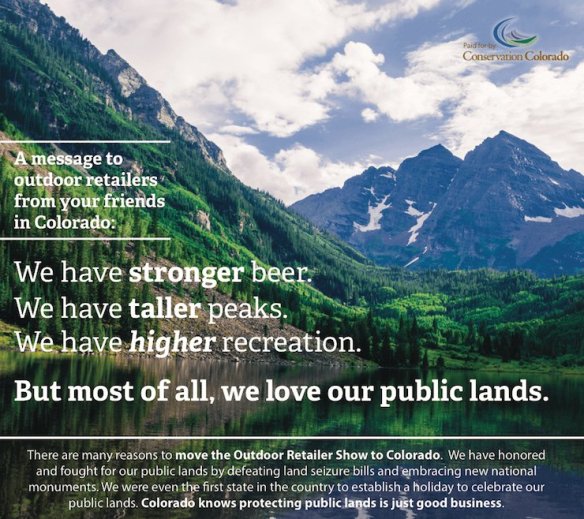
Unfortunately, despite having great outdoor recreation, Utah’s government isn’t particularly committed to protecting those areas. They’re opposed to Obama’s use of the Antiquities Act to declare new national monuments, saying that they can protect resources better on the state level, rather than conceding to a big federal land grab. Anyone who believes that, however, is either a disingenuous liar toeing the party line or a fucking gullible moron. They want to sell the land off to profit in the short term, and everyone knows this. For that reason, the Outdoor Retailer show just announced that they would no longer host the show in SLC and is considering alternative venues. The most likely seems to be Denver, and Colorado is making no secret of its desire to get in on SLC’s sloppy seconds. They even ran this ad in the Salt Lake Tribune and Deseret News:

colorado

(Let’s ignore for a second how the Outdoor Industry’s affinity for beer and pot threatens to make it a parody of itself… especially since anyone who has sat in a meeting across the table from a buyer at REI will tell you that your head better not be cloudy if you want to win any sales…)

I’m conflicted about Denver for really dumb reasons: chiefly that airfare from San Francisco is too expensive for me to fly first class. I realize that I’m an insufferable snob, but the $60-$80 premium to fly in first between SFO and SLC is my treat to myself for the amount of work these shows entail for me. I’ll be bummed out when I can’t afford $120-$180 extra each way to Denver. I can pretty much guarantee that there are no companies in the outdoor industry that reimburse their employees for first class airfare! After all, we’re slinging sleeping bags, not derivatives. The situation is a little better now that Virgin America is giving United some competition on the route, but it’s still overall more expensive than flights to SLC.

As someone who really isn’t a big fan of turbulence, I’m also not super jazzed about flying in and out of Denver all the time, especially in the winter. I’m sure I’d get used to it (and Salt Lake is no picnic either), but it’s just a little bit of extra stress to add onto a stressful week of work. The bottom line, though, is that I’ve been in and out of SLC so many times that I’m on autopilot now, and I’m annoyed to have my routine disrupted. When I travel for leisure, the wonder of discovery is what makes the trip great. For business, it’s what makes the trip a pain in the ass. I like knowing I could walk through the terminal with my eyes closed, hop in a cab, jump out at the Candlewood Suites, take the light rail to the convention center, etc. After so many years, I didn’t realize how comfortable with SLC I had become until I realized how irritating it will be to try to navigate the show in a city I had never been to – even if the beer is stronger and the recreation is higher.

This post isn’t super relevant to what I usually write about on this blog, but it has been in my mind for the past couple days. What about the road warriors? Do you like going to the same place over and over again, or do you enjoy using business travel to experience new places?

Hyatt offers me a soft landing into my stupid new World of Hyatt Discoveratrix status

It’s old news by now that Hyatt is relaunching their loyalty program under the “World of Hyatt” banner, including a realignment of elite benefits across four new tiers. Where it used to be a simple member/platinum/diamond hierarchy, it’s now split into “Member,” then “Discoveratrix,” then “Exploratoire,” and finally “Globalickity.” How they came up with those names is beyond me, but those are the actual names, despite what you may have seen elsewhere.

I have Hyatt Platinum status now and will be downgraded to Discoveratrix on March first when the new program launches. I was mad about this at first, because I thought I was losing my 2PM checkout benefit. However, upon checking the World of Hyatt website, it looks like Discoveratrixes still get late checkout upon request, so that’s good. I now get access to “preferred rooms” instead of room upgrades, but since I never once got an upgrade as a Platinum, that’s not too bad. I also get free water (gotta stay hydrated bruh) and a free room award night if I stay at five Hyatt brands. I think those are both new benefits, which is nice.

worldhyatt2

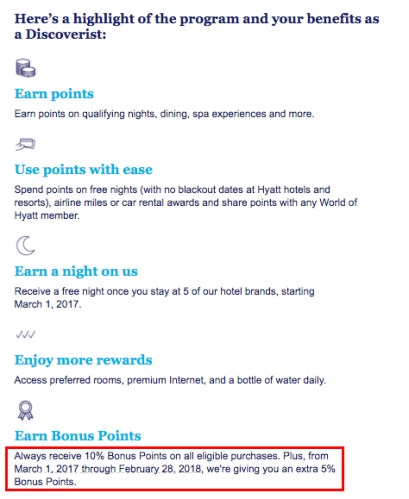
The only downgrade is that I go from earning 15% bonus points on stays down to 10%, although realistically that makes a tiny difference given how many points I normally earn through Hyatt stays each year. Still, it was nice to hear from Hyatt today that they’re offering me 5% bonus points through February 2018, essentially keeping me at the Platinum earning rate through my first year in the new program. Here’s the relevant part from the email they sent:

worldofhyatt

Is anyone excited about World of Hyatt? I suppose it’s good if you’re super loyal to Hyatt and terrible if you just barely qualified for Diamond status under the previous program. For someone like me, it seems like this is mostly a wash, although I appreciate Hyatt offering mid-tier people a soft landing into the new program. I should also note that the email specifically mentioned earning status by holding the Hyatt credit card, so this may not have been offered to all current Platinum members… or maybe people who earned Platinum through stays were offered additional benefits. Who knows! Is this really that important?

Hyatt offers me a soft landing into my stupid new World of Hyatt Discoveratrix status

It’s old news by now that Hyatt is relaunching their loyalty program under the “World of Hyatt” banner, including a realignment of elite benefits across four new tiers. Where it used to be a simple member/platinum/diamond hierarchy, it’s now split into “Member,” then “Discoveratrix,” then “Exploratoire,” and finally “Globalickity.” How they came up with those names is beyond me, but those are the actual names, despite what you may have seen elsewhere.
I have Hyatt Platinum status now and will be downgraded to Discoveratrix on March first when the new program launches. I was mad about this at first, because I thought I was losing my 2PM checkout benefit. However, upon checking the World of Hyatt website, it looks like Discoveratrixes still get late checkout upon request, so that’s good. I now get access to “preferred rooms” instead of room upgrades, but since I never once got an upgrade as a Platinum, that’s not too bad. I also get free water (gotta stay hydrated bruh) and a free room award night if I stay at five Hyatt brands. I think those are both new benefits, which is nice.

worldhyatt2

The only downgrade is that I go from earning 15% bonus points on stays down to 10%, although realistically that makes a tiny difference given how many points I normally earn through Hyatt stays each year. Still, it was nice to hear from Hyatt today that they’re offering me 5% bonus points through February 2018, essentially keeping me at the Platinum earning rate through my first year in the new program. Here’s the relevant part from the email they sent:

worldofhyatt

Is anyone excited about World of Hyatt? I suppose it’s good if you’re super loyal to Hyatt and terrible if you just barely qualified for Diamond status under the previous program. For someone like me, it seems like this is mostly a wash, although I appreciate Hyatt offering mid-tier people a soft landing into the new program. I should also note that the email specifically mentioned earning status by holding the Hyatt credit card, so this may not have been offered to all current Platinum members… or maybe people who earned Platinum through stays were offered additional benefits. Who knows! Is this really that important?

Wait hang on… Aeroplan miles can be redeemed on Cathay Pacific???

Man, you learn something new every day! In a funny coincidence, one of the most-viewed posts on this blog is about redeeming Alaska miles for a flight between New York and Vancouver on Cathay Pacific, with a dollop of poststructuralism on top just to keep it interesting… and now Cathay is back to surprise me once more, this time by sneaking into Aeroplan in a weird Star Alliance/One World confluence. Alliance are becoming more fluid every day, and the vicissitudes between them are my favorite part this whole miles and points game.

image
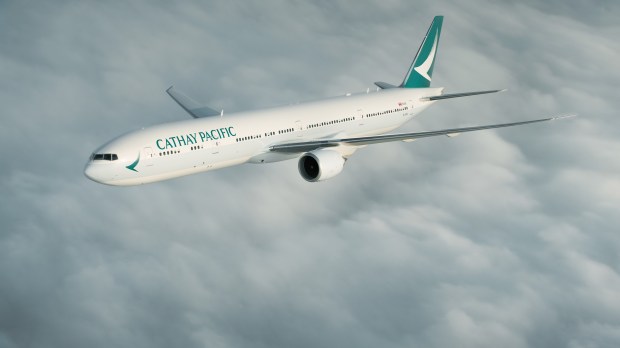
Here’s a picture of a Cathay Pacific plane, since posts with just text aren’t very interesting.

I was going to go into a whole thing about Roland Barthes here, but I’m on vacation, and I just want to get this post out. The superfluous detours into literary critical theory will just have to wait for another time.

Anyway, I got an email from Aeroplan tonight with the normal monthly updates, and for whatever reason, I decided not to ignore it. Usually these monthly newsletters don’t contain anything that hasn’t already been covered to death in the blogosphere, but I really don’t think I’ve seen anything yet on the Cathay partnership (although seeing as I’m on vacay, I very well could have missed it). Here’s what it says in the email:

“As of January 19th, 2017, fly and earn miles with Cathay Pacific or Cathay Dragon on select routes from Hong Kong. “

Since I don’t fly very much to or from Hong Kong (which is to say, I never fly to or from Hong Kong), this doesn’t immediately affect me, but I did think it was an interesting partnership, given that it spans two alliances. Even more interesting, perhaps, was this tidbit that I found when I clicked the link to see more information on Aeroplan’s site:

“Star Alliance™ Gold and Silver Benefits are not extended by Cathay Pacific or Cathay Dragon. Redemption on Cathay Pacific and Cathay Dragon will come later.”

The first bullet comes as no surprise, although it does have me wondering how a partnership like this comes about, and what types of negotiations need to take place. This isn’t like Lufthansa partnering with Etihad, since Etihad currently maintains a stable of partners without itself being part of an alliance. I’m sure this has happened before, but the whole idea of a Star Alliance program partnering with an One World airline seems very foreign to me, especially when logistical issues like reciprocal elite benefits are basically left out altogether. (I suppose the X-factor here is that Aeroplan is an independent loyalty program that spun off from Air Canada, which may give them more freedom than a program like United Mileage Plus.)

Even more interesting, though, is that this partnership is not limited to earning, and that we can expect to see redemptions coming soon as well. On the earning side, things are pretty limited to intra-Asia routes to/from Hong Kong, so I’m expecting the redemption side to be similarly restrictive. This could be really interesting for multi-carrier awards, though (assuming that’s allowed once Cathay inventory is loaded into Aeroplan’s award search). It certainly opens up a lot of destinations in Asia that aren’t super easy to get to on Star Alliance currently.

For reference, here is the list of routes where you can earn Aeroplan miles, which will give a sense of what can be expected when redemptions open up:

– Chiang Mai, Thailand
– Phuket, Thailand
– Bangkok, Thailand
– Cebu, Philippines
– Manila, Philippines
– Kuala Lumpur, Malaysia
– Ho Chi Minh City, Vietnam
– Hanoi, Vietnam

Are you excited to redeem Aeroplan miles on Cathay Pacific (and Cathay Dragon, by the way)? Or do you not really care, since this already old news to begin with…


Did anyone else get an invite to the “Ask Amex” pilot program?

I remember that I took a survey a while back about changes I would like to see to Amex’s concierge service, and the fruits of that customer research must be coming to fruition now with Amex’s new “Ask Amex” service that they’re rolling out. (I also took a really meta survey about what I want Amex’s customer research sample group to be called. Unfortunately, “PlattyBros” wasn’t an option.) I got an email about Ask Amex today, with a link to download the app. In a nutshell, Amex is rolling out an AI-based concierge for Platinum members that will help you do concierge-y stuff without having to wait on hold and talk to a real person. Seems cool, except…

I was a little skeptical, because Amex hasn’t to my knowledge said anything about this themselves. The service is provided by a third party (Mezi), and I was prompted to enter my Amex login credentials in order to prove I was one of the super-special invitees into the pilot program. The idea of sharing my Amex info (including login credentials and card data) with a third party is a little dodgy to me… I’m sure it’s fine, but without anything directly from Amex confirming that it’s real, I’m hesitant.

After some more digging, I started to realize that Ask Amex is kind of a bad deal. It’s pitched as an addition above and beyond my existing Platinum benefits, although the company behind it – Mezi – already has what looks like the same thing available for free to everyone. Putting an Amex GUI on it doesn’t suddenly make it special and worthy only of Amex Platinum members.

Additionally, I was able to find an FAQ on Mezi’s site, and it gets worse from there. First of all, you have to use your Platinum card, which means that any travel that you book will be at one point per dollar. Additionally, Mezi specifically states that bookings made through their portal don’t qualify as purchases made directly on a travel provider’s site, which means you wouldn’t get 5x points on airfare either. Nor would you earn 2x for booking on Amex travel, since even though the app looks like an Amex and quacks like an Amex, it’s not an Amex (or a duck). Finally, you can’t use Amex offers or make Hotel Collection and Fine Hotels and Resorts bookings through Ask Amex either.

Bottom line, Amex is rolling out a new digital concierge that may be a phishing scam, offers none of the features of its normal concierge, is not exclusive to Amex, and which prevents you from taking advantage of any category bonuses. All so you can ask your phone to book you a hotel room instead of suffering the indignity of having to search online. I get that AI is the future, but I’m good on holding onto the past for a little longer if this is what’s in store.

Has anyone signed up and used it? Am I right to ignore this, or am I missing out on some amazing concierge-ing?