Could there be any reason to get the Skypass Select Visa Signature card besides maybe to own the libs?

It seems like a lot has happened in the credit card universe in 2018, both good and bad, so I’ll forgive you if you forgot that US Bank pulled a “hold my beer” on the Barclay Arrival Premier and farted out the worst credit card this side of First PREMIER Bank. To be more specific, earlier this year US Bank unveiled a revamp of the Korean Air Skypass credit card range (some of which I wrote about already), which included the launch of what I’m to understand is a super-premium card called the Skypass Select Visa Signature. Here’s what it looks like.

The $450 fee is certainly in line with other super-premium cards, although the benefits don’t even come close. (The card isn’t even a Visa Infinite, which would give it a leg up on the $95 Skypass Visa Signature in the benefits department… which is odd given that US Bank does have a Visa Infinite option in the Altitude Reserve, and it even has a lower annual fee than this turd.) Plenty of blogs have written about what a turd this card is, so I’m not going to go into its turdy benefits or lack thereof. And while I do plan to float the idea of why it could possibly make sense to get this card in an extremely narrow set of circumstances, it’s not like I found some hidden secret benefit that no one else has written about or anything. The card fully deserves Doctor of Credit naming it “Worst Premium Credit Card” in their annual Creddie Awards.

https://platform.twitter.com/widgets.js

So what reason could I possibly have to put it on my radar for 2019? Besides, of course, the sweet sweet clicks I’ll get from being the only blogger to post an unboxing video. Here I go, trying to defend the indefensible…

In 2017, I took advantage of a targeted offer on the normal Skypass Visa Signature card for 45,000 Skypass miles after $3000 in spend, even though I didn’t have much of a use for them. I figured that if I ever got around to needing Korean Air miles, I’d transfer the rest from Chase, meaning that my existing Skypass balance would reduce the impact that this hypothetical Korean Air redemption would have on my Ultimate Rewards balance. Thus, in a roundabout way, I rationalized the bonus as an Ultimate Rewards play rather than what it was: a bunch of miles in a semi-obscure program I’d probably never use.

Except that rationalization fell apart when Chase cut ties with Korean Air, meaning that the only remaining transfer partner was SPG/Marriott. Luckily the miles have a HUGE expiration timeline (10 years), so I could wait around for additional transfer partners to emerge (or for US Bank to get off their ass and add transfer partners for the Altitude Reserve card). However, no matter what happens, the ~50,000 miles I currently have aren’t going to do me much good. On the other hand, 80,000 miles seems to be somewhat of a magic number for Korean Air, since that’s the amount required either for a first class ticket to Korea or a round-trip transatlantic Sky Team award in business class.

Where, then, could I easily get 30,000 Korean Air miles without blowing a huge hole in my Marriott account?

Let’s game out the value proposition here. The card has a $450 annual fee and includes a $200 travel credit. The travel credit applies to all travel and appears as a statement credit, so I’m gonna go ahead and value that the same as cash. FUIUD. Since I don’t regularly pay for tickets on Korean Air, stuff like a $100 discount on a Korean Air ticket or a $25 in-flight duty free credit can’t realistically be used to mitigate the annual fee. So, the cost to get this card is $250 plus the opportunity cost of spending $3000 to hit the minimum spend. Assuming I’d average two points per dollar in a more valuable currency, and that those points would be worth two cents each, that’s $120, bringing us to a grand total of $370.

Would I pay $370 for 33,000 Korean Air miles if you offered it to me? It’s around 1.1 cents per mile, which is a pretty good deal, but not a world beater or anything. However, given that I’m stuck at 50,000 miles now and that the extra 30k means the difference between a great redemption and no redemption, I might. As long as we’re talking hypothetically, I might also try canceling my current card and reapplying after a few months to see if US Bank lets me earn the bonus again (which happens to be 30,000 miles, just like the more expensive card for some reason). If that failed, though, it would be turd city for me.

I figured I’m not the only one in the world who was stuck with a non-ideal Skypass balance, especially after Chase ceased to be a transfer partner, so I at least figured it would be worth it to remind people of what is essentially a cheap way to buy Skypass miles. Don’t worry, though, I still think that the Skypass Select Visa is terrible.

You liked this post enough to read to the end, but did you like it enough to give me money? If so, check out my Patreon page. 

Wow, American’s 787 seat is actually pretty nice, if you choose 7A.

I’m in Chicago this weekend to see my family, and I flew here on American, as I usually do. I prefer United or Alaska on this route, but American is almost always cheaper in first class. Sometimes it will be on an A321 with individual screens (piloted by the father of a guy I went to college with), but most of the time it’s on a 737 with passably comfortable seats and direct-to-device streaming. It’s not the best value in the world for a first class product, but it’s still worth it to me to avoid wedging my fat ass into economy for four hours.

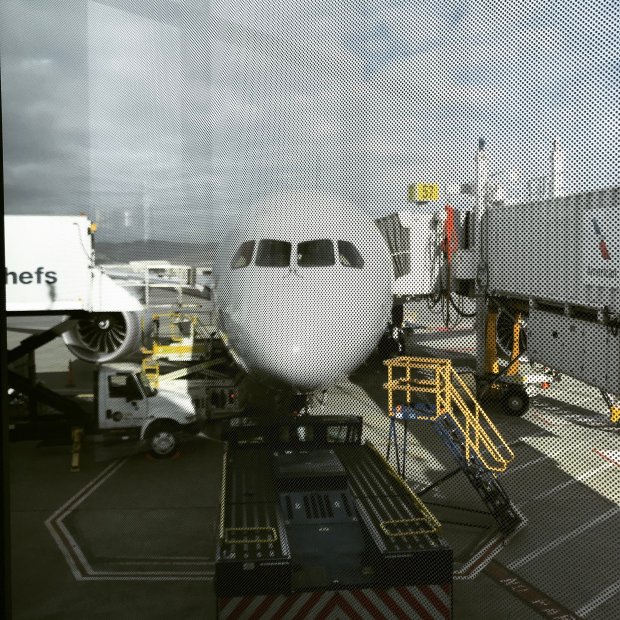
I got a real treat this trip though, since the flight at the time I needed was operated by a 787-8. I’ve been chasing widebodies on this route for years, but every time I book a United 777, it gets equipment-swapped at the last minute. I figured the same thing would happen here, so I was happily surprised when I saw it waiting at the gate, dwarfing all the other planes at SFO Terminal 2. (While it’s annoying I don’t have any lounge access in this terminal, sitting in a seat next to the window with this view was certainly a nice way to pass the time before the flight…)

Even better, on domestic flights, the lie-flat seats in business class are sold as “first class,” so you get WAY more for your money than you normally would on a flight like this. The only bummer was that this plane had the worse of American’s two business class configurations used on the 787. The superior one is a reverse herringbone seat called the “Super Diamond,” and it’s my favorite business class seat I haven’t tried yet. (If I don’t switch my flight coming back from Europe next year, I’ll get to try it twice on Air Canada — until then, all I can do is read review after review thinking about how nice it must be.)

The Super Diamond seat was actually a replacement when the manufacturer of American’s original design couldn’t actually make enough of the seats to fill all of American’s planes. It’s an odd design, with seats facing both forward and backward — and since they’re diagonal, that also means that some of them face the window and others face the aisle. Supposedly there are a number of shortcomings in the construction, most notably that entire groups of seats will shake when one passenger moves around.  

However, the two last seats in the cabin (7A and 7K) don’t have this problem, and they face the “right” way, meaning they face forward and are angled toward the window like a normal reverse herringbone seat. Still, from all the images I’ve seen, these seats look super narrow and uncomfortable, so I’ve never been too sad that American is absolutely god-awful when it comes to opening business class awards on most long haul flights. On the other hand, for a domestic flight even United’s 8-across “hostel-style” business class seats would be an upgrade over the norm.

The main drawback of the seat is that it is actually pretty narrow, especially at the shoulders. I kept bumping into the panel that runs along the inside of the seat, where the seat controls, entertainment controller, and reading light are. Since it sticks out from the wall, it’s kind of uncomfortable unless you make a point to sit in a way where you don’t lean against it. I really like that the armrest can be raised or lowered, since it makes the seat feel much wider in bed mode. (Notably, the rear-facing seats have fixed armrests on both sides, so I would imagine they feel even narrower than this one.)

Storage also isn’t great, though it’s better than a lot of seats. There are a bunch of little spaces to stash odds-and-ends, but the compartment under the ottoman is pretty small, so you’re going to have to keep your carry-on bag in the overhead bin if it isn’t sitting at your feet. 

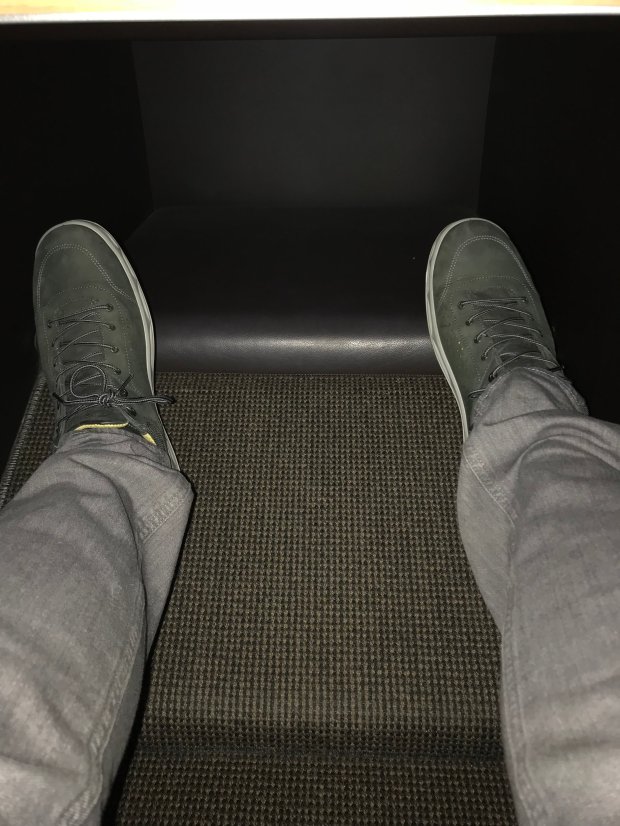
One other thing I like about this seat is that the foot area is totally open. Unlike other reverse herringbone seats I’ve tried, I felt this seat was less claustrophobic, since my feet weren’t going under anything. I remember feeling kind of wedged-in on KLM’s 787 seat, and American’s A321 first class seat (which is pretty much the same as what’s on KLM) felt especially narrow — and I also hit my knees repeatedly on the bottom of the screen when I tried to move around while reclining.

I was surprised that the flight attendants came through the cabin to open all the screens before takeoff (so passengers could watch the safety video) but then didn’t make an announcement about closing them when the video was over. Gate to gate entertainment? In any case, the screen never got in my way while relaxing, as you can see here: 

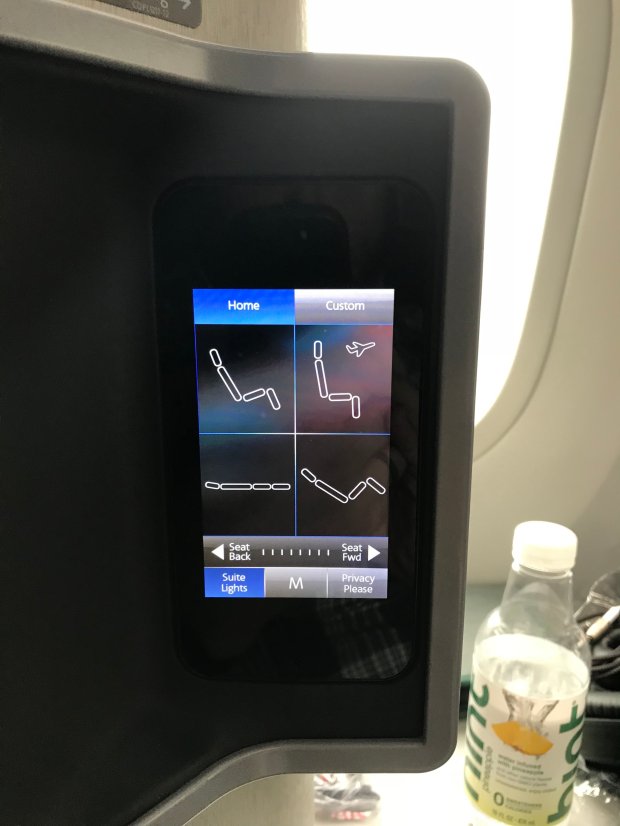
While it was a daytime flight, I did try reclining the seat into bed mode using the little control panel. Although the control panel looks pretty slick, it worked like crap, and I had to keep messing with it in order to make the bed go flat. I’m not sure if my particular seat was just glitchy or if this is common, but I found the presets to be almost useless, so I adjusted the seat piece-by-piece using the “custom” option instead.

I did notice that the seat felt a little narrow in bed mode around the head/shoulder area, but my legs had plenty of room. Basically the opposite of any other business class seat I’ve ever sat in. After lying down for a few minutes, I decided that I probably wouldn’t be too happy with the seat after a 14-hour flight to China or something… but I would feel the same way about a lot of business class seats, so that’s not too much of a dig.   

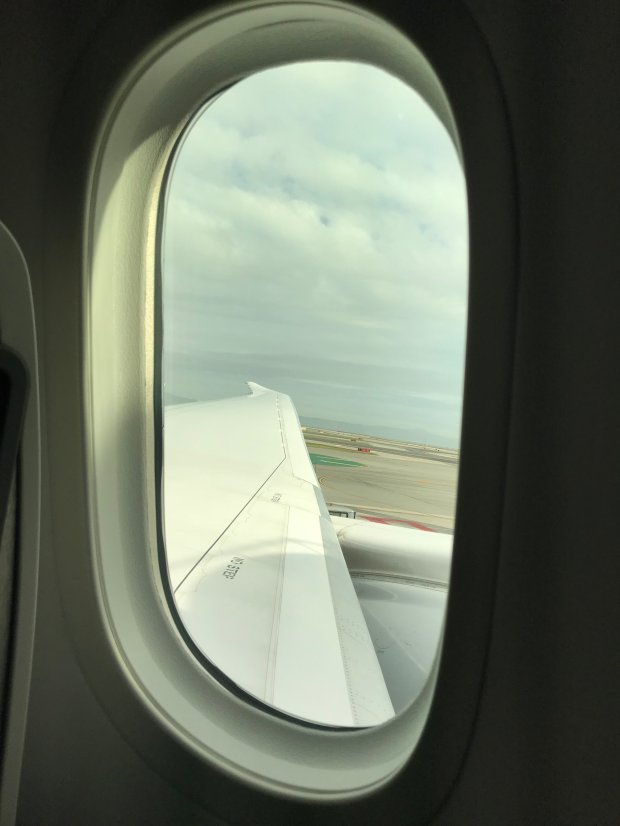
In the end, I liked American’s seat a lot more than I expected to, and the only seats on US carriers that I’d prefer would be the United Polaris seat, the new Delta One Suite, or American’s other configurations on the 777/787. Just make sure you pay attention to seat selection, since it makes a big difference (just like it does on Polaris). I especially like row 7, since it’s in a two-row mini-cabin behind the main business class cabin, so it’s much quieter during the flight. I should also point out that one of the bathrooms is very large for a 787, and extra space in a bathroom is not something I’ve come to expect from American. Plus, row 7 gives you a great view of the amazing Dreamliner wing, and if you get some turbulence, you can really see it start to flex. 

This ended up being a really fun flight due to the novelty of flying a Dreamliner on a short(ish) hop, and plus I watched a hilarious movie, and the pasta thing they served me for lunch was even sort of edible, which is pretty good for American. Now I just have to get over the disappointment of flying a crappy 737 back home, since I didn’t want to wake up in the middle of the night in order to catch the 787 out of Chicago at 7:10AM.

You liked this post enough to read to the end, but did you like it enough to give me money? If so, check out my Patreon page. 


Maybe the era of dirt-cheap airfare isn’t eliminating the need for points and miles after all

I’ve been thinking about the various threads in this post for a while, but an excellent article by Robert Dwyer on Milenomics this past weekend really helped crystallize everything for me. Go read it, then come back here.

I think Dwyer’s article resonated with me because I’ve always gotten annoyed by the idea that there’s some magic secret that enables you to travel “for free,” whether it’s subscribing to some crazy deal aggregator site or opening a bunch of credit cards. Sure there are tools that can help you travel better (whether that means for less money or more luxuriously than you otherwise would), but there’s always a cost involved. A long time ago, I signed up for alerts from one of those sites that promises to find you the best deals under the sun, and like 90% of what they sent me were $300 all-inclusive trips to China where the tour operator requires you to spend 15 hours a day visiting trinket shops in so they’d get a kickback from each shop.

The advent of ultra low cost international travel has been amazing, because it has enabled people who couldn’t otherwise afford overseas trips to see the world. However, there are hidden costs to booking trips on Norwegian/WOW/etc, and even when travelers are prepared for the restrictions and understand how to avoid add-on fees for food and baggage, there are risks. It’s why I don’t quite buy the argument that the decreasing cost of airfare in general makes points and miles worth less (in terms of value per redemption).

First, ULCCs use rock-bottom fares to market their overall value proposition the same way Emirates uses the on-board shower to create a halo around the entire brand. WOW may dump a handful of $99 transatlantic fares onto the market, but you’d need to book them almost immediately and also have the flexibility to sign up for an 8-night stay in Iceland in January or whatever. Points and miles trips are similarly constrained by finding availability, but it’s still much more likely that you’ll be able to find a suitable points/miles itinerary on a random date than a rock-bottom fare.

People twist themselves into knots trying to figure out how to value their points redemptions (which is how you get statements like, “Well, your points and miles would only be worth what you’d be willing to pay in cash”), and one of the ways skeptics love to diminish the value of miles is by throwing around dirt cheap airfare as a baseline for comparison. In other words, the naysayer argument goes that if it’s possible for any transatlantic flight to cost $100, then that’s what all transatlantic flights are worth, regardless of what the flight actually costs or would have cost on any given date/airline.

With the hypothetical value of a flight in the toilet, people get deal boners around making sure they never overpay (is there a greater sin in the American economy than overpaying for something?), which is how people who can afford much more end up scheduling trips for no other reason than because the flight is so cheap. I’ve said before in other contexts that there’s nothing wrong with traveling because you can — I maintain that traveling is always beneficial, regardless of what motivates it. The problem here is that travel takes time as well as money, and for many people, the time part of it is actually the limiting factor. I’m so in love with points because of how much more I’m able to enjoy the trips I have time to take, and I can’t imagine scrimping and saving on those trips just so I can brag that I’ve never overpaid for a flight.

The distortion involved in pegging all flights’ value to the very lowest cost of any one flight comes out when things start to go wrong. While it may not be all that different flying in a 787 with Norwegian or American Airlines, it will be different when Norwegian cancels your flight because their fleet is spread so thin that one plane going down for maintenance disrupts flights for a week. And while American’s call center isn’t known for its warm fuzzies, I can guarantee that you’ll get a better attitude from them than Norwegian’s “fuck it, thats what you get for booking Norwegian” approach to rebooking.

I’m not even speaking hypothetically here: Windbag friend Patrick Pibb recently booked a super-cheap Norwegian trip to Paris and back, and due to the engine issues with Norwegian’s 787-9s, they canceled her return flight. They informed her by way of an email saying that she was now booked to fly out of London three hours earlier on the same day. It was only a four-day trip to begin with, and Norwegian effectively cost her half a day (not to mention the cost of a ticket from Paris to London). She called to protest, and the best Norwegian offered was to book her on a Vueling flight at 6AM. No matter what happens, though, it won’t be worse for her than it was for all the people stranded overseas when Primera ceased operations overnight.

Booking award tickets with legacy carriers isn’t a foolproof plan or anything, but I’d still like my chances better with them if a plane were to go out of service or I needed them to rebook me through a different city. The bean counters will still insist that award tickets aren’t worth any more than basic economy on ULCCs, but I guess the whole point of this article is that those people are wrong.

Second, travel costs money. Flights are only a small part of it, so even if you get your flight “for free” (either using points or an absurdly low amount of money on a cheap ticket), you still need to get to/from the airport, to eat, to sleep somewhere, etc. You might find a great deal on a flight, a hotel, or a rental car, but you’re awfully unlikely to find all three at the same time. I’m kind of repeating what I wrote back in this post, but you get the gist.

Like I said before, rock-bottom fares are great when the enable people to travel who couldn’t otherwise afford it. On the other hand, the people who slavishly follow flight deals and can travel at the drop of a hat presumably have enough money to pay for the rest of the trip, and when you add up the entire net cost of the trip, a great fare is probably going to save you around 25% on the total cost. I mean, that’s not nothing, but the way some sites talk about these deals, you’d think Jesus was shitting winning lottery tickets or something. (I should admit that there’s an obvious counterargument here, but I’m kind of tired of working on this post, so I’ll wait until someone points it out in the comments to respond to it.)

Third, ULCC’s have a nasty habit of going out of business. I mentioned Primera before, but WOW and Norwegian aren’t on the most solid ground either. WOW seems to have narrowly avoided going under, and Norwegian will probably be acquired before they go bankrupt, but the two still make me nervous. I was thinking about this recently when I redeemed 100,000 Alaska miles for two “business class” tickets to Reykjavik on Icelandair. I didn’t want to, because it’s a lot of miles for what’s essentially 9 hours in domestic first class. It made sense, though, since I couldn’t find any other good transatlantic business options, and at least it’s direct instead of overflying Iceland and then backtracking from mainland Europe. And I twisted myself in knots trying to value this redemption, since I didn’t really know how much a flight from SFO to Iceland in 2×2 seating was worth to me.

At 9 hours, I knew I didn’t want to fly economy, and Icelandair’s business class is very expensive for what it is. In fact, it’s possible to fly in WOW’s premium sets for around $500 each, meaning my redemption was worth only around a penny per point — way too low for Alaska miles in my opinion. I value Icelandair and WOW roughly equivalent in terms of quality — I think the WOW seats actually have slightly more room, but they don’t have any inflight entertainment or TV, and Icelandair also offers access to SFO’s China Airlines lounge, which looks lackluster enough that I value Icelandair and WOW roughly equivalent in terms of quality. (I do have to admit I’m excited to kick off my Scandinavian vacation in the China Airlines lounge, though.)

Back when I was booking this trip, I was actually waffling between paying cash for the WOW flights or redeeming Alaska miles for Icelandair. Now that WOW just sent half their fleet into storage and it’s not currently possible to book SFO-KEF flights on their website, I’m pretty happy I didn’t spend a bunch of money booking something that far in advance with them. I don’t know how to value my redemption now, but I also don’t really give a shit, since I found the most comfortable way to get my wife and I to Reykjavik from San Francisco, and I had the Alaska miles sitting in my account. It’s worth “I’m happy we’re taking this trip”-per-point.

I don’t want it to come across like I think travel deal hunters are in the wrong or anything, just that there are opportunity costs to every tool in the savvy traveler’s toolbox. It could be annual fees, time spent researching deals, or risk booking flights on a carrier with poor reliability. There’s nothing inherently better about a cheap fare than an expensive fare if the expensive fare guarantees you the ability to travel where and when you want… just like there’s nothing inherently better about a first class ticket booked with miles versus an economy ticket booked with cash by someone who’s too busy living their life to read blogs like this one.

Updated 12/12 to add: Patrick Pibb is having a run of bad luck with flights lately, but her latest tribulations provided a great opportunity to see if I was right about American’s customer service being better in a pinch than Norwegian. A few days after Patrick’s Norwegian itinerary changed and she was given no compensation whatsoever, British Airways canceled a domestic European flight that would have left her stuck in a city without many outbound flights to major international gateways. Since this was part of an itinerary she booked with American, she called them to straighten it out. Unlike Norwegian, there were plenty of backup options, and they pieced together a suitable alternative on American with a connection in the US. Plus, they proactively offered Main Cabin Extra seats for free as compensation and refunded the British Airways fuel surcharges as well. Turns out I was right all along!

You liked this post enough to read to the end, but did you like it enough to give me money? If so, check out my Patreon page.

Trying to wring a few droplets of value from Flying Blue’s new dynamic award pricing on trips to Paris

You could say I wasn’t happy when Flying Blue announced changes to their frequent flyer program. Anytime a program ditches award charts in favor of dynamic pricing, it’s pretty much a sign that multiple stealth devaluations will follow in short order. Sure, programs like Delta will throw a bone in the form of award sales every now and then, but that doesn’t quite take the sting out of the fact that most Delta awards are substantially more expensive than they were a few years ago. As such, keep in mind that everything I write about in this post is liable to change at any time with no notice, so if you do want to take advantage of my “one weird trick to score cheap Flying Blue awards,” don’t wait too long.

The gist of this strategy is to add connections onto transatlantic flights, since for whatever reason awards with certain connections may price out cheaper. For instance:

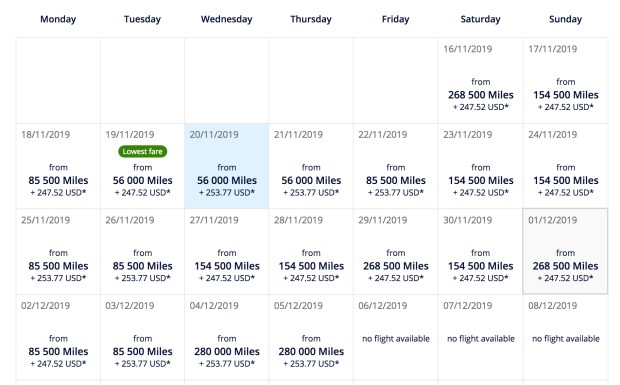
 SFO to CDG in November/December of 2019
SFO to CDG in November/December of 2019
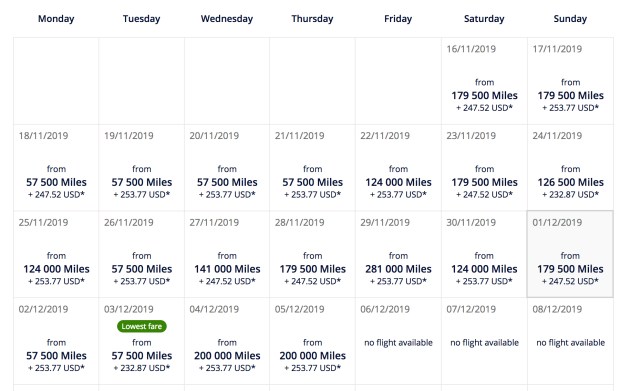
 SFO to CPH in November/December of 2019
SFO to CPH in November/December of 2019

Check out the award calendars for November/December 2019 showing flights between SFO and either CDG or CPH. Weirdly, the prices aren’t uniformly different; on a couple days the CPH connection knocks 15,000 miles off the price of SFO-CDG direct, and on other days, it adds 14,500 miles. Hooray for dynamic pricing!

This isn’t really groundbreaking stuff; in the world of revenue tickets, this sort of chicanery is well-known (and well-discouraged by airlines), although this is the first time I’ve noticed it in award ticketing. It’s called throwaway ticketing, and it comes with a number of risks. First, you can’t check a bag, since it will get routed to the final destination. Second, if there are irregular operations, the airline may route you differently, since they’re only required to get you to your end destination rather than ensuring you touch down at every point along the way. Finally, airlines hate this, and it’s a good way to get your account shut down. It’s common practice never to use your frequent flyer number when flying a throwaway ticket itinerary, although in this case, since it’s an award ticket, you don’t really have a choice.

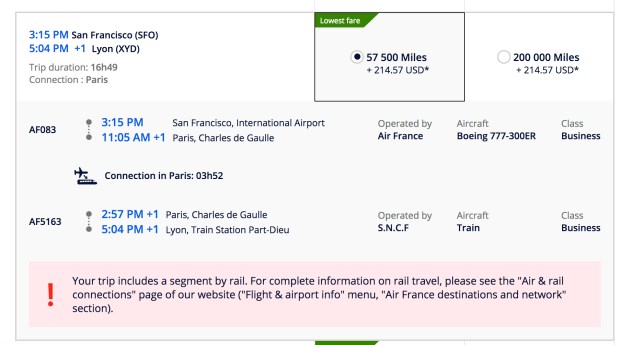
Don’t worry, though — there’s a workaround that should avoid all three of these problems. I present to you the award calendar for SFO to Lyon, France:

First, notice how adding the Lyon connection opens up additional saver awards that weren’t showing in the original search for SFO-CDG. Weird, and a useful reminder to try plugging in a bunch of different cities to see how they affect basic transatlantic award pricing. However, the reason I’m specifically pointing out Lyon is that Air France will give you the option both of flying to LYS airport as well as to XYD, otherwise known as Lyon Part-Dieu train station. In fact, on the day that I searched, the only options available for 57,500 miles involved a connection by train.

You can probably see where I’m going with this… The connection by train is sold by Air France on behalf of SNCF, so it isn’t treated the same as a connecting flight. For one, your bags aren’t checked all the way through to Lyon. According to Air France’s page about air-rail connections, you have to go pick up your train ticket at a desk inside the TGV station at CDG airport, but once you do that, I’m pretty sure they won’t know if you ever get on the train.

(I should point out that I’m not 100% sure about this, since a conductor would normally scan the barcode on the ticket to check its validity at some point during the train trip. However, I’d be shocked if this data were communicated back to Air France in any way. More likely you just need to scan the ticket at the barcode reader in front of the train track where your train is departing. In other words, out of an abundance of caution, you could always wait at the train station until your track was assigned and then scan your ticket before taking the RER to central Paris.)

If you’re curious, here is the webpage where you can learn more about Air/Rail trips. However, the part that really matters is spelled out pretty clearly:

It sure seems to me like they’re only concerned with you skipping the first leg of the trip, not the second. Unfortunately, that only addresses the outbound portion of the trip, meaning you’d still have to pay the full 71,000 miles to get back home (or finish your trip in Lyon). I wanted to see if there’s a workaround here too, though, and there kind of is. It depends on how much you value saving 13,500 points.

Basically, I cross-referenced SNCF’s network with the rail stations recognized by Air France’s search engine, and I found the closest TGV station to CDG: Reims. Well, not technically Reims, although that’s the city to entire into the award search. The actual TGV station used by Air France is Champagne Ardenne, which is around 40 minutes by train from Paris, with trains running pretty often. Once in Champagne Ardenne, you’d go to the TGV Air counter to check in for your flight and then head directly from there to CDG (36 minutes).

Realistically, you’re looking at around 2-3 hours to get from central Paris to the airport, depending on the length of the connection you give yourself in Champagne Ardenne. That’s compared to around 45 minutes if you took the RER B, so basically an extra 1-2 hours. This is the kind of thing I would never do if Justine and I were traveling together, but I love train travel, so I wouldn’t mind the extra running around to save a bunch of miles if I were traveling alone.

Has anyone done this? I thought we would try it on the outbound leg of our next trip, but we ended up planning a trip to Iceland instead of Paris. They’re very similar, I know, so it was kind of a toss-up. I wouldn’t be surprised if Air France fixed this at some point, but there could also be some weird French government stuff behind it, where Air France is “encouraged” by their government part-owners to buy blocks of train tickets in order to prop up wholly state-owned SNCF. Who knows… “Forget it Jake, it’s Frenchytown.”

You liked this post enough to read to the end, but did you like it enough to give me money? If so, check out my Patreon page.
How much better is seat 4A on Swiss’s 777 compared to the other seats? 41% better.

Before I jump in, I need to remind you that if you subscribed to my blog before November of this year, you need to resubscribe in order to continue receiving notifications of new posts. You can subscribe either by RSS or email — just click the menu button in the upper left corner of the page.

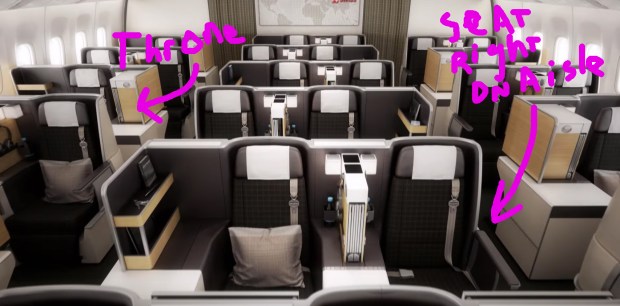
I have something of a storied history with seat 4A on Swiss’s 777-300. Specifically, last year I booked it only to be booted out by Swiss and forced to pay my way back to an inferior seat. Let me back up a second for those that are just getting here… Swiss introduced a new business class seat on their flagship 777 a few years ago, and there’s a wild disparity in quality among the various seats. There are fairly narrow window seats with no storage and no direct aisle access, narrow aisle seats, wide aisle seats with a big storage console, and in the pole position, the throne seats (or “privacy seats”) that Swiss used to reserve only for elite members. In 2017, they made the decision to start selling access to the thrones (for around $200 for a transatlantic flight), which sucked for elites but helped out those who longed for such a nice, spacious seat.

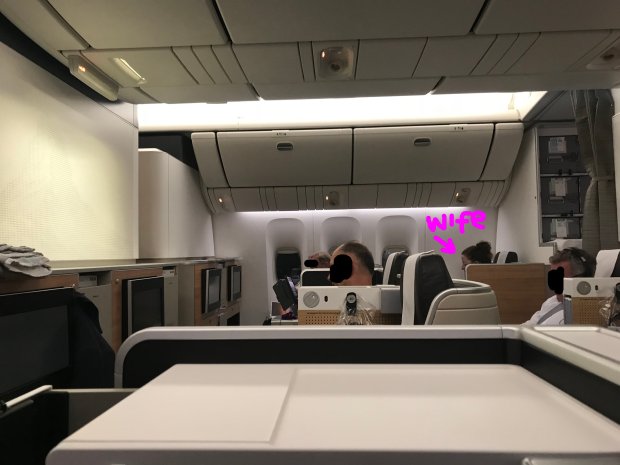
However, even among throne seats, there are good and bad ones. Well, more accurately, there are good and better ones. On my first Swiss flight, I was in a throne in the middle of their massive business class cabin, and it was fine. However, the bulkhead seats (7A and 4A) offer more foot room and storage space, so those are definitely the ones to pick. And between those two, 4A is the best, since it is located in a two-row mini-cabin in front of the main business class cabin. Not only is this mini-cabin much quieter in flight, you also get to turn left when you board, meaning the economy parade doesn’t march down the aisle past your seat during boarding.

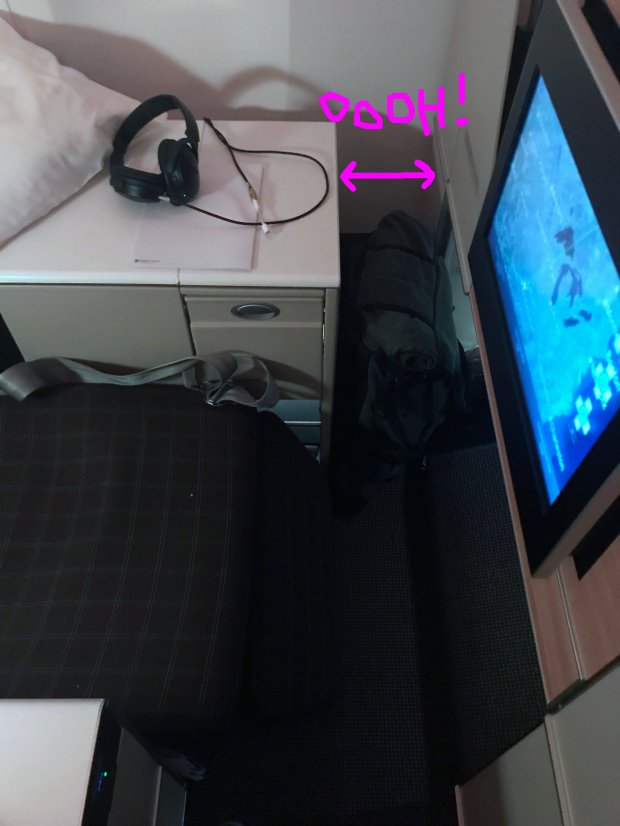
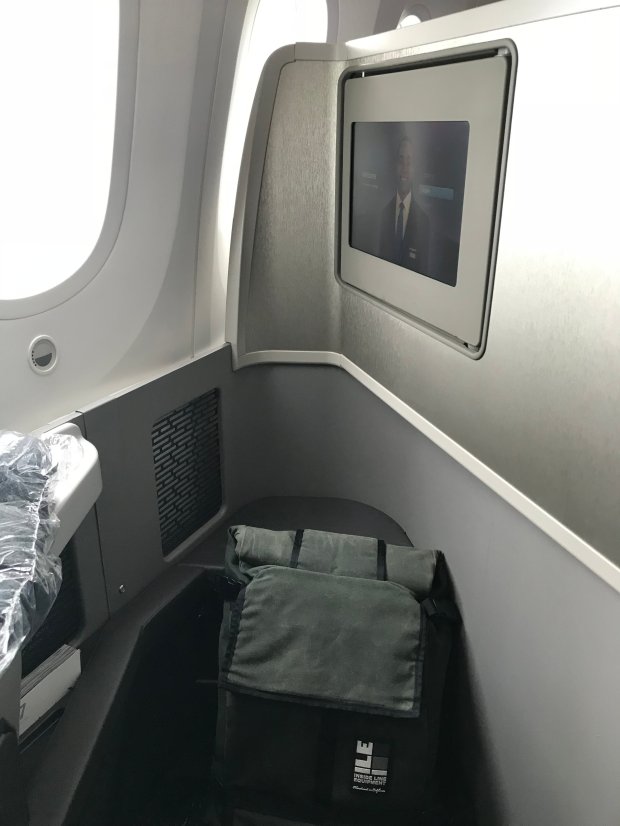
To give you an idea of the extra room afforded by the bulkhead seat, I present to you the following two examples. First, the seat is actually around 10” further away from the front console, which really makes a difference in terms of personal space. It also makes for a great storage nook for a backpack. In all the other throne seats, the front of the armrest touches the console, so you’d have to keep your bag in the overhead bin instead.

Secondly, the area for your feet is HUGE. One of the big downsides to the throne seat is that your feet need to fit in the space between the two paired seats in front of you, which can be pretty constricting when trying to sleep. It can also make the seat feel like a coffin, since half of your body goes into a fairly narrow space. Between the extra depth of the seat and the huge foot area, the bulkhead throne seat makes for a really great bed. In fact, I was able to sleep uninterrupted for around 2 1/2 hours, which is unheard of for me. Plus, I was only woken up because the plane hit some pretty rough air over the ocean, and I dozed off again once it smoothed out.

In the end, the main question is whether it’s worth $200 to upgrade to this seat, and I think it absolutely is. Especially since Swiss has no fuel surcharges on Aeroplan, it’s pretty easy for me to justify the extra money for such a big jump in comfort. I’ve paid for throne seats both times I’ve flown on Swiss, but I felt way better about the purchase on this flight. The only downside is that you can kind of see into the first class cabin, which looks AMAZING. In the main business class cabin, you don’t know what you’re missing.

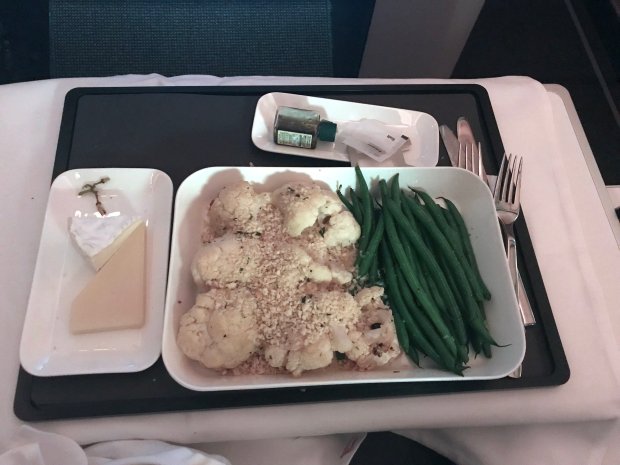
Speaking of first class, Swiss forgot to provision my vegan meal on this flight, but they had an extra vegetarian meal in first class, so they let me have that. It was some kind of breaded baked cauliflower thing, and OH MY GOD was it good. Not quite to the level of the amazing coconut curry I had on British Airways, but right up there, and better than the food I had in Emirates first class on the tail end of this trip. It’s not representative of Swiss’s business class catering in general, but it was a nice surprise when I thought I was going to have to pick around a big piece of meat for dinner.

I was kind of lukewarm on Swiss after my last flight on them, but after this flight, I’m of the mind that this is one of the better ways to fly transatlantic in business class. It certainly beats KLM, which is what I had flown earlier in the year, and I’d put it on par with SAS.

You liked this post enough to read to the end, but did you like it enough to give me money? If so, check out my Patreon page.

The dumb thing about how airlines are gutting the concept of lounge “membership” and a possible way to save some money if you’re desperate.

US-airline lounge memberships, I’m assuming, used to involve white-gloved stewards fetching you from the security queue and whisking you into a space of refinement and comfort so you could relax before your flight. Unfortunately, this elegance was eventually taken over by harried traveling salespeople cramming stale pretzels and sweaty cheese into their food-holes and stinking up the bathroom with airplane bottle whiskey farts. Clearly something needed to be done, so the airlines begin to revitalize their lounges with nicer fixtures, elevated food offerings, and a fresh, consistent brand identity. The only downside is that these new fancy lounges quickly filled up with people (and this wasn’t helped by the increased popularity of credit cards offering lounge access).

I know I’m getting the history at least partially wrong here, but I’m not that concerned about it. What I am concerned about is the sudden need to cut down on lounge usage by changing what a lounge “membership” even means. In the good old days (meaning 2017), you could pay for a lounge membership from Delta/American/United and then access one of their lounges no matter what airline you were flying. Now, those memberships only get you access if you happen to be flying Delta/American/United that day. So not really a membership at all.

There are a few things that seem short-sighted about this collective decision (or should I say American/United’s craven need to do whatever Delta does). First, lounge members are the only ones actually paying retail for lounge access. Everyone else is getting it either at a bulk discount rate (like those who access a lounge via credit card) or as a bundled part of a larger suite of benefits (either through elite status or a premium fare). I get that premium passengers and elites are super important to cater to, although it’s still odd to attack the people most willing to pay outright for a certain service.

Second, there is a definite marketing/branding value to a passenger visiting a lounge even if they don’t fly that particular airline. Any venue that hosts even a nominal amount of foot traffic will pitch the number of ways that potential advertisers can reach customers who enter that space, and airports are generally seen as an extremely high-value venue for that type of advertising. A branded airport lounge is essentially a commercial for that airline, complete with a controlled, idealized space that presents everything good about an airline to the customer. Moreover, since lounges don’t cram you into tiny seats and subject you to the whims of rude flight attendants, an airline’s lounge is probably better advertising for the airline than a flight on that same airline. Plus, any customer who pays for an annual lounge membership is clearly not an occasional leisure traveler, but rather a potential high-value flyer who will bring repeat business. Yet by limiting that customer’s ability to enter the lounge, the airline is explicitly turning that potential business away.

Third, airlines are getting rid of the entire reason you’d pay for lounge membership in the first place, versus getting it from a credit card. For years I considered buying a Sky Club membership, since the airlines I fly most often out of SFO are Alaska/Virgin, American, and Delta. All three airlines’ gates are connected post-security, which means I’d get a lot of use out of SFO’s excellent Sky Club.

I already get Sky Club access when flying Delta from my Amex Platinum card, but the potential for additional Sky Club use when flying other airlines (on routes that Delta doesn’t offer from SFO) was high enough that it may have been worth it for me to pay for a membership outright. Well, I guess it wasn’t worth it, since I never did it. But I thought about it. And now I’ll never do it, since a membership contains no incremental benefit versus the access I already get. Plus, starting in 2019, it’s going to cost $545, which is an insane price. Leave it to Delta to simultaneously gut the benefits AND raise the price! For that money you could just pay the annual fee on an Amex Platinum, and you get Sky Club access plus airline credits, Centurion lounge access, and all the other great Platinum benefits. Or you could save $100 and get the Amex Delta Reserve card, which comes with exactly the same lounge privileges. (Jeez, I sound like I’m hawking credit cards now. Sorry about that.)

Okay, so what about that money-saving trick I mentioned? For American and Delta flyers, the simple answer is just to get the right credit card. Duh. The problem is that, for United flyers, Chase’s 5/24 policy prevents many people from taking advantage of the credit card option. The United Club card is a pretty decent card all things considered, but in today’s Mad Max Fury Road-esque churning environment, it’s out of reach for most of us. What isn’t out of reach, however, is an Air Canada Maple Leaf Lounge membership. AC offers three tiers — Canada, North America, and Global. The North America tier is the one I’m most interested in, since it offers lounge access to most United lounges in the US if you’re flying on a Star Alliance flight that day. Normally this would be a clear disadvantage when compared to the United Club card’s full membership privileges, but with United following Delta’s lead and eviscerating the whole idea of “membership,” there’s now no functional difference.

The North America membership costs $495 Canadian, which comes out to around $430 after you include the tax. That’s certainly not cheap, but it’s less than you’ll pay United for similar lounge access, and it’s even nominally less than a United Club card. I thought maybe it was limited to people in Canada, but when I entered my customer info on the purchase page, it let me enter my address and billing info in the US. This isn’t a deal that I’d take advantage of personally, since I don’t fly United all that often to begin with, but I could see it making sense for a United semi-frequent flyer in a place like ORD where the United Club is really your only option (especially now that United is discontinuing day passes).

I wasn’t going to write a post about the Maple Leaf thing on its own, since I don’t think it’s that great of a deal. However, when combined with my bloviating on the value of letting people who pay for lounge memberships into the lounge, I feel like it’s worth it. What about you? Are you chomping at the bit to join the Maple Leaf club?

You liked this post enough to read to the end, but did you like it enough to give me money? If so, check out my Patreon page.
Blog news: New website coming soon, transition headaches possible.

I’ll keep this short, since I’m spending most of my time this weekend working on migrating the blog to a brand new website. I’m tired of WordPress, so starting sometime this weekend, I’ll move everything over to Squarespace and hopefully keep it there for the long haul. Squarespace offers a number of advantages, but the most visible will be that I have much more control over the design and layout, so there should be a big improvement in readability, ease of accessing old posts, and load times when scrolling through the post archive.

newsite
Here’s a preview of the new site layout. Do you love it or do you love it?

In the meantime, a number of interruptions are possible, from incoming links not working to the entire site being down temporarily. Once it’s up, there will probably be some issues with images not showing up, weird formatting, etc. Cleaning all that up will be an ongoing process, so hopefully it isn’t too disruptive. Also, if you’re subscribed either via email or RSS, you will need to resubscribe. I will put one more post on this site before shutting it down with instructions on how to subscribe on the new site.

Finally, I’m moving away from the direct donation link at the bottom of each post and replacing it with a Patreon campaign. For those who aren’t familiar, Patreon is a website that allows you to make small recurring contributions to creators whose work you enjoy. Some people make six-figure incomes through Patreon, although I’m hoping to get $10-$15 per month.

Bottom line, I’m excited to up my blog game with the new site. Thanks in advance for your patience during any downtime due to the transition.

The winds of change are blowing.

Welcome to the new Windbag Miles! If you’re keeping count, this is the fourth iteration of the site, although I don’t think any readers have been with me through all four. Previous revisions were all just cosmetic changes on the same platform, though — this is a bigger deal, since I migrated the entire site off of WordPress and onto Squarespace. I’ve had frustrations with WordPress for a while, but the kicker came a couple weeks ago when a 3000-word post got erased due to a glitch in the text editing window. Ugh.

I looked at various options for hosting the blog, and Squarespace seemed like the best choice. After all, fifty thousand podcast hosts can’t possibly be wrong, can they? (I tried to save $10 off my first month by entering code WINDBAG at checkout, but it didn’t work.) While I’m no website expert, I do like that Squarespace has a better variety of design templates as well as more customization options within each template. I’ve always liked the idea of a text-only front page, and I’m happy that I can control the weight of the font (the chunky bold font on the old site always kind of bothered me). Plus, the titles on the old blog were way too big, and I wasn’t paying WordPress enough money to let me mess with it. Is this boring? I think this is boring.

All this is to say that I’m very happy with the look and feel of the new site, although as with any migration, there may be some issues. Feel free to email me if anything seems weird — so far it has mostly been images either missing or not sizing properly, and some formatting issues. The most important thing to keep in mind if you were a subscriber to the old blog (email or RSS): since this is a totally new site, you will need to resubscribe.

Finally, I’m changing my approach to funding this blog. Squarespace is more expensive than WordPress, so I’m hoping to raise some money to cover the new hosting fees. As you know, I’ve never loved the idea of mucking up the blog with ads, and that’s doubly true now that I’m actually happy with the design of the site. I settled on the little five dollar donation link that I put at the bottom of all the posts, but I always felt it was a little tacky. But without ads, affiliate relationships, or direct donations, how will I achieve my dreams of blog riches?

The obvious answer is to start a Patreon, so I did. I’m not sure how many readers will be interested in giving me a monthly donation, but if you like what I do and want to kick me a few bucks each month, I’ll be eternally grateful. To be honest, I never thought the blog would get anywhere near the size it is now, and I’m only a tiny speck in the overall points and miles blogosphere. Still, I’m amazed so many people read my profane ranting, and I appreciate every goddamned set of eyeballs. But I want your money too, goddamn it.

Thanks for bearing with me during the transition, and now that I’m done tinkering with the site, I can finally get back to writing posts, including a recreation of that one that WordPress chewed up, the jerk.

Polaris vs. Flagship: Who has the best lounge in the US?

The answer is that it doesn’t matter, since this trend of airlines massively upping their lounge game is great and it’s not like you’re ever going to have to choose between American’s Flagship Lounge JFK and United Polaris SFO. Also, I’m highly unqualified to weigh in on the best lounge in the US, having not been to a single lounge outside of a handful of airports. So take my verdict with a grain of salt, and then pour that salt in Delta’s eye for letting themselves be eclipsed by United and American. The unquestioned leader among the Big 3 is trying to pull this whole “We don’t need special lounges since our Sky Clubs are so nice to begin with” thing, and it reminds me of Akbar Al-Baker saying that Qatar Airways doesn’t need premium economy because their economy seats are so nice. Delta does have some extremely nice lounges in their network, especially the Sky Clubs in Seattle and San Francisco… however, they still don’t hold a candle to what American and United are doing on the premium end of things.

Because I’m stupid, I didn’t take any photos of American’s flagship lounge while I was there, but you can see photos all over the web if you look. Here’s a photo from American’s website:

Before I go into why I prefer United, both lounges are pretty competitive in terms of amenities. They both offer a wide range of seating, runway views, premium alcohol, a nice buffet and plenty of snacks, showers, and sit-down dining. They’re also both very elegant, upscale spaces that clearly feel a cut above standard airline clubs (even Delta Sky Clubs).

But as I mentioned, I still give United the edge, for the following reasons. (Keep in mind I’m specifically comparing Flagship JFK and Polaris SFO.)

#1: Design. I’ve mentioned this before, but I pay a lot of attention to airline visual design, and I really like how United has created an entire design concept around Polaris and then used that concept to inform the design of everything from the lounge to the cabin to the amenity kit, bedding, and so on. It elevates the premium experience and shows an attention to detail that American and Delta lack in their own visual identities. The Flagship lounge is definitely nice, but nothing about it says “American Airlines” to me. There’s wood paneling and red accents in the lounge, but then the cabin is dark gray and dark blue, and the amenity kit is black and green. I realize it doesn’t make a material difference in how nice the lounge is, but anyone who cares about premium travel values being in a beautifully designed space (even if they don’t admit it), and Polaris is the clear winner here.

#2: Space. When I took my fancy tour of the Polaris lounge, my concern was that it wouldn’t seem so nice once it was packed to the gills with people and you had to wait an hour to shower or dine in the restaurant. Well, I’m happy to report that after visiting the lounge before a recent flight, it was still almost completely empty. It’s simply massive, and it looks like they’ve addressed the overcrowding issues I experienced at the Polaris lounge in Chicago. The Flagship lounge is smaller and felt much more crowded, and there were more people using the sit-down dining, despite it being limited only to first-class passengers. I imagine this is due to American’s less restrictive access policy, but it does take away from the overall enjoyment of the lounge.

#3: Facilities. The Flagship lounge doesn’t have enough bathrooms, and they’re communal rather than the individual stalls in the Polaris lounge. I went in to take a #2 before my flight and all the stalls were occupied, so I ended up using the shower instead. Well to be clear, I used a toilet in one of the shower stalls, not the shower itself. I’m not a monster. Speaking of the shower stalls, the Polaris showers are way nicer, as you can see in the following selfie:

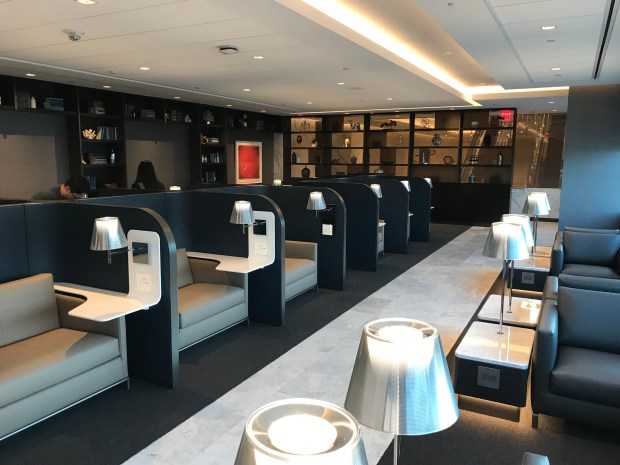
#4: Fixtures. Although I had a nice time in both lounges, the Polaris lounge offers a nicer variety of seating options, including those really great cubicle seats. There are also nap rooms if you’re tired.

In terms of the food quality, I’d say that both lounges are about equal both at the buffet and in the restaurant. However, given how few planes American operates with 3-cabin first class, only a handful of people can actually take advantage of both dining options. On the flipside, the Polaris lounge opens the sit-down dining room to everyone, rather than just first class passengers, which is a really nice benefit.

The only area where I prefer American to United is the check-in process, which I’d at least consider to be lounge-adjacent. While I didn’t love Flagship check-in, it theoretically should save time and provide a more exclusive experience when functioning correctly. (In my case, my wife didn’t have Pre-check given that her ticket was booked in her maiden name, and the Flagship lounge people were super rude to her about it and made her go to the very back of the economy check-in line, meaning it took her around 30 minutes to clear security. I don’t know why this happened, but I’ll chalk it up to a jerk staffer and not an indictment of the entire Flagship check-in concept.) Still, something is better than nothing, which is what United offers their premium passengers at check-in.

In the end, I feel like it’s pretty obvious that the Polaris lounge is nicer, but I’ve learned many times on this blog that certain people are like diehard sports fans when it comes to airlines, so I’m sure I’ll hear from the HOW DARE YOU PRAISE UNITED IN ANY CAPACITY people in the comments before too long. In any case, both lounges are great and I’d be very happy to return to either one, so don’t get too bent out of shape over my opinion.

You liked this post enough to read to the end, but did you like it enough to give me money? If so, check out my Patreon page.

Polaris vs. Flagship: Who has the best lounge in the US?

The answer is that it doesn’t matter, since this trend of airlines massively upping their lounge game is great and it’s not like you’re ever going to have to choose between American’s Flagship Lounge JFK and United Polaris SFO. Also, I’m highly unqualified to weigh in on the best lounge in the US, having not been to a single lounge outside of a handful of airports.

So take my verdict with a grain of salt, and then pour that salt in Delta’s eye for letting themselves be eclipsed by United and American. The unquestioned leader among the Big 3 is trying to pull this whole “We don’t need special lounges since our Sky Clubs are so nice to begin with” thing, and it reminds me of Akbar Al-Baker saying that Qatar Airways doesn’t need premium economy because their economy seats are so nice. Delta does have some extremely nice lounges in their network, especially the Sky Clubs in Seattle and San Francisco… however, they still don’t hold a candle to what American and United are doing on the premium end of things.

IMG_4032
Polaris lounge SFO.

Because I’m stupid, I didn’t take any photos of American’s flagship lounge while I was there, but you can see photos all over the web if you look. Here’s a photo from American’s website:

flaggy

Before I go into why I prefer United, both lounges are pretty competitive in terms of amenities. They both offer a wide range of seating, runway views, premium alcohol, a nice buffet and plenty of snacks, showers, and sit-down dining. They’re also both very elegant, upscale spaces that clearly feel a cut above standard airline clubs (even Delta Sky Clubs).

But as I mentioned, I still give United the edge, for the following reasons. (Keep in mind I’m specifically comparing Flagship JFK and Polaris SFO.)

#1: Design. I’ve mentioned this before, but I pay a lot of attention to airline visual design, and I really like how United has created an entire design concept around Polaris and then used that concept to inform the design of everything from the lounge to the cabin to the amenity kit, bedding, and so on. It elevates the premium experience and shows an attention to detail that American and Delta lack in their own visual identities. The Flagship lounge is definitely nice, but nothing about it says “American Airlines” to me. There’s wood paneling and red accents in the lounge, but then the cabin is dark gray and dark blue, and the amenity kit is black and green. I realize it doesn’t make a material difference in how nice the lounge is, but anyone who cares about premium travel values being in a beautifully designed space (even if they don’t admit it), and Polaris is the clear winner here.

#2: Space. When I took my fancy tour of the Polaris lounge, my concern was that it wouldn’t seem so nice once it was packed to the gills with people and you had to wait an hour to shower or dine in the restaurant. Well, I’m happy to report that after visiting the lounge before a recent flight, it was still almost completely empty. It’s simply massive, and it looks like they’ve addressed the overcrowding issues I experienced at the Polaris lounge in Chicago. The Flagship lounge is smaller and felt much more crowded, and there were more people using the sit-down dining, despite it being limited only to first-class passengers. I imagine this is due to American’s less restrictive access policy, but it does take away from the overall enjoyment of the lounge.

#3: Facilities. The Flagship lounge doesn’t have enough bathrooms, and they’re communal rather than the individual stalls in the Polaris lounge. I went in to take a #2 before my flight and all the stalls were occupied, so I ended up using the shower instead. Well to be clear, I used a toilet in one of the shower stalls, not the shower itself. I’m not a monster. Speaking of the shower stalls, the Polaris showers are way nicer, as you can see in the following selfie:

IMG_4031
That’s one clean Windbag.

#4: Fixtures. Although I had a nice time in both lounges, the Polaris lounge offers a nicer variety of seating options, including those really great cubicle seats. There are also nap rooms if you’re tired.

IMG_4029IMG_4022

In terms of the food quality, I’d say that both lounges are about equal both at the buffet and in the restaurant. However, given how few planes American operates with 3-cabin first class, only a handful of people can actually take advantage of both dining options. On the flipside, the Polaris lounge opens the sit-down dining room to everyone, rather than just first class passengers, which is a really nice benefit.

The only area where I prefer American to United is the check-in process, which I’d at least consider to be lounge-adjacent. While I didn’t love Flagship check-in, it theoretically should save time and provide a more exclusive experience when functioning correctly. (In my case, my wife didn’t have Pre-check given that her ticket was booked in her maiden name, and the Flagship lounge people were super rude to her about it and made her go to the very back of the economy check-in line, meaning it took her around 30 minutes to clear security. I don’t know why this happened, but I’ll chalk it up to a jerk staffer and not an indictment of the entire Flagship check-in concept.) Still, something is better than nothing, which is what United offers their premium passengers at check-in.

In the end, I feel like it’s pretty obvious that the Polaris lounge is nicer, but I’ve learned many times on this blog that certain people are like diehard sports fans when it comes to airlines, so I’m sure I’ll hear from the HOW DARE YOU PRAISE UNITED IN ANY CAPACITY people in the comments before too long. In any case, both lounges are great and I’d be very happy to return to either one, so don’t get too bent out of shape over my opinion.

Support your windbag!

This site is ad-free, because I think ads are ugly. That's why I rely on readers for support! If only one person per year gives me $5, then I'll have $5 more per year. Everyone wins!

$5.00