Hello new credit card page, good-bye stupid article about how I value points.

A quick note about some new content on the site and a reshuffling of the header bar. First, I took down the link to the page about how I value points, since this post hasn’t aged well (in my opinion). It was one of the first things I wrote on the blog, and it’s way more involved than I think is even remotely necessary, to the point that I’m almost a little embarrassed of it. It’s not that I think it’s wrong or anything, just that it massively overclaims how anal-retentive I am about valuing my redemptions. So, now it’s off the header bar, but it isn’t gone forever. In its place, I’ve added a new page collecting all the quasi-useful articles I’ve written about credit cards over the past couple years. If this blog is good for anything (besides profane ranting), it’s that my insane obsession with credit cards sometimes leads me to post useful information. I figured it would be helpful to gather those rare gems in one place, although I did try to limit it to articles that are still reasonably current as of this writing.

You liked this post enough to read to the end, but did you like it enough to give me money? If so, check out my Patreon page.

Hello new credit card page, good-bye stupid article about how I value points.

A quick note about some new content on the site and a reshuffling of the header bar. First, I took down the link to the page about how I value points, since this post hasn’t aged well (in my opinion). It was one of the first things I wrote on the blog, and it’s way more involved than I think is even remotely necessary, to the point that I’m almost a little embarrassed of it. It’s not that I think it’s wrong or anything, just that it massively overclaims how anal-retentive I am about valuing my redemptions. So, now it’s off the header bar, but it isn’t gone forever.

In its place, I’ve added a new page collecting all the quasi-useful articles I’ve written about credit cards over the past couple years. If this blog is good for anything (besides profane ranting), it’s that my insane obsession with credit cards sometimes leads me to post useful information. I figured it would be helpful to gather those rare gems in one place, although I did try to limit it to articles that are still reasonably current as of this writing.

That’s all for now — I won’t even put a donation link at the bottom of this post, since I don’t think I deserve $5 just for telling you that I changed the header bar.

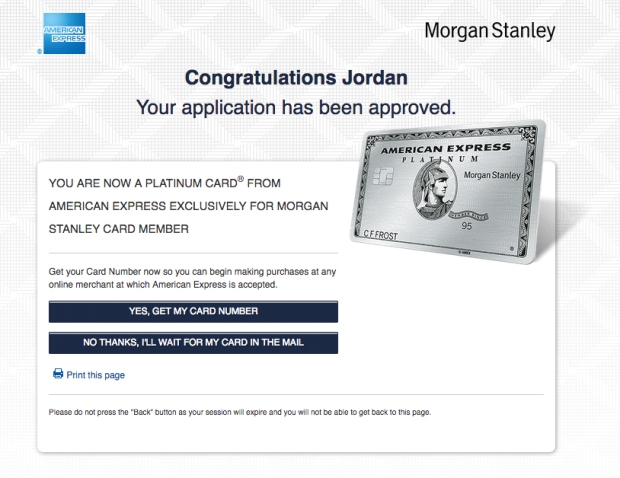
It worked! (For now.) I have a Morgan Stanley Amex Platinum! (For now.)

Hey, if you’re new to this blog, check out my page on credit card info for other articles you may like. And since I don’t run any ads on this site, I depend on readers for support (via Patreon). Thanks!

A little while back, I wrote a post about Morgan Stanley’s new investment product, Access Investing. Unlike a normal Morgan Stanley brokerage account, which requires many thousands of dollars to open and comes with perks like a real, live financial advisor, Access is open to anyone willing to invest $5000. You can even sign up online (in fact, that’s what they want you to do — the whole point of Access investing is that you never interface with a real person). Read my original post for more information on what Access is and how it fits into Morgan Stanley’s ecosystem. I got to wondering if Access would be considered an “eligible brokerage account” in terms of Amex’s co-branded Morgan Stanley cards, and even after someone from Morgan Stanley told me that it wouldn’t, I wasn’t convinced. After all, this hobby thrives in the vicissitudes between one person’s policy and an automated system’s ability to misread that policy for my benefit.

However, I wasn’t about to put up real money just to try to get a fancy credit card, so I spent a while researching the funds Morgan’s algorithm proposed and gaming out the negative compounding of the management fees I would need to pay before I jumped in. Ultimately, I felt that my investment mix was a little stock-heavy already, and I saw an upside to taking $5000 and moving it onto a platform that would track the market with a more muted daily swing (that’s the goal, at least).

Once I started messing around in the account, I realized that it runs on the same online platform as any other Morgan Stanley account, which only bolstered my hunch that the Access account could conceivably pass for one of their standard accounts. I still had to wait a little while to apply for the Platinum card, given other minimum spending requirements I was working on, but I finally got around to it today… and much to my surprise, I was instantly approved.

From reading this post by Frequent Miler, I was expecting my application at least to go to pending while Amex verified if I actually did have a Morgan Stanley account. On the application page, you only have to check a box promising that you do actually have an account — you aren’t required to provide an account number or any other details, so clearly there’s a verification step that needs to happen at some point.

Given the instant approval, I’m worried that the secondary audit is going to lead to an account shutdown, which is why I qualified my excitement a little bit in the title of this post. After all, I was told specifically that Access accounts don’t qualify for the full suite of Morgan Stanley services, which includes the credit cards. And how would Amex know if I even had a Morgan Stanley account at all, unless they contact Morgan Stanley and ask them?

In any case, the bottom line is that for now, my Access account is enough to get me a Morgan Stanley Platinum card. I sure hope it sticks, since there doesn’t seem to be any other way (at least that I can find out in the open) to backdoor your way into a Morgan Stanley account with a fairly small amount of money. I’ve been interested in this card for a long time due to the free authorized user, so I’ve done some pretty significant digging trying to figure out how to get one without being mr. moneybags. That’s why I was so excited when I found out about the Access platform, and it’s why I’m cautiously optimistic that I’ve finally uncovered a way to get the card without having to win the lottery first.

Here’s one other wrinkle I’ll put out there, in case you really want to push the limits… You can create your Access account without actually funding it. You’ll get an email every couple days reminding you to fund your account, but it exists (with an account number and everything) even without any money in it. You have 60 days to fund your account before it closes automatically, so if you were really averse to giving any money to Morgan Stanley, you could always try to open an account this way, get the Amex card, hit the spending target within 60 days, pocket the bonus, and wait for them to close the card the next time they do an audit and realize you no longer have a brokerage account. I don’t recommend this, given Amex’s penchant for clawing back bonuses when they feel you’ve obtained them wrongly, but you may have a higher risk tolerance than I do.

Finally, for anyone who’s wondering if I’m worried about getting in trouble with Amex for this… I’m not. The terms on the application page are general enough to apply to any brokerage account, and Access investing is a brokerage account. I don’t think they can claim I was trying to defraud them, so the worst that happens is that they update their terms (which they’re allowed to do) and then cancel my account. After all, it’s not as if I’m faking an account or anything, and I do plan to keep my account open as long as I have the card.

Has anyone else tried this? Are you going to? I’d love to get some other data points to see if my instant approval just happened to be good luck (possibly followed by the bad luck of having my account shut down). I’m also curious if anyone is interested in the other Morgan Stanley card (which Frequent Miler has covered in detail as well). And of course, I’d love to be responsible for breaking useful information for a change, instead of just rambling on semi-coherently!

You liked this post enough to read to the end, but did you like it enough to give me money? If so, check out my Patreon page.

It worked! I had a Morgan Stanley Amex Platinum! (2022 Update)

[2022 Update: whew what a completely tranquil and uneventful four years it has been since I originally wrote this post! It’s nice when life and society don’t continuously throw curve balls at you, and those curve balls aren’t made out of rusty nails, and those rusty nails aren’t also on fire. So relaxing!

Anyway, I’m updating this post with the breaking news that Morgan Stanley is going to stop accepting new applications for Access accounts as of 12/1/22. In a hilarious ouroboros of points and miles blogging, I only found out about this because I saw a sudden spike of traffic on this post as the result of an article on Miles Earn & Burn that announced the new news while linking back to me. I should think ME&B for keeping this blog on life support, since the only traffic I get anymore is from them, or from people who are apparently so curious about timeshare presentations that the post I wrote about attending a timeshare presentation back in 2017 is still relevant to them.

So, to make a short story long, as of 12/1/22, everything written in this post will be irrelevant to you, and people will have even less reason to read my defunct blog about points, miles, and creative uses of profanity. It was a wild ride while it lasted, though, you gotta admit.]

A little while back, I wrote a post about Morgan Stanley’s new investment product, Access Investing. Unlike a normal Morgan Stanley brokerage account, which requires many thousands of dollars to open and comes with perks like a real, live financial advisor, Access is open to anyone willing to invest $5000. You can even sign up online (in fact, that’s what they want you to do — the whole point of Access investing is that you never interface with a real person). Read my original post for more information on what Access is and how it fits into Morgan Stanley’s ecosystem.

I got to wondering if Access would be considered an “eligible brokerage account” in terms of Amex’s co-branded Morgan Stanley cards, and even after someone from Morgan Stanley told me that it wouldn’t, I wasn’t convinced. After all, this hobby thrives in the vicissitudes between one person’s policy and an automated system’s ability to misread that policy for my benefit.

However, I wasn’t about to put up real money just to try to get a fancy credit card, so I spent a while researching the funds Morgan’s algorithm proposed and gaming out the negative compounding of the management fees I would need to pay before I jumped in. Ultimately, I felt that my investment mix was a little stock-heavy already, and I saw an upside to taking $5000 and moving it onto a platform that would track the market with a more muted daily swing (that’s the goal, at least).

Once I started messing around in the account, I realized that it runs on the same online platform as any other Morgan Stanley account, which only bolstered my hunch that the Access account could conceivably pass for one of their standard accounts. I still had to wait a little while to apply for the Platinum card, given other minimum spending requirements I was working on, but I finally got around to it today… and much to my surprise, I was instantly approved.

morgs

From reading this post by Frequent Miler, I was expecting my application at least to go to pending while Amex verified if I actually did have a Morgan Stanley account. On the application page, you only have to check a box promising that you do actually have an account — you aren’t required to provide an account number or any other details, so clearly there’s a verification step that needs to happen at some point.

Given the instant approval, I’m worried that the secondary audit is going to lead to an account shutdown, which is why I qualified my excitement a little bit in the title of this post. After all, I was told specifically that Access accounts don’t qualify for the full suite of Morgan Stanley services, which includes the credit cards. And how would Amex know if I even had a Morgan Stanley account at all, unless they contact Morgan Stanley and ask them?

In any case, the bottom line is that for now, my Access account is enough to get me a Morgan Stanley Platinum card. I sure hope it sticks, since there doesn’t seem to be any other way (at least that I can find out in the open) to backdoor your way into a Morgan Stanley account with a fairly small amount of money. I’ve been interested in this card for a long time due to the free authorized user, so I’ve done some pretty significant digging trying to figure out how to get one without being mr. moneybags. That’s why I was so excited when I found out about the Access platform, and it’s why I’m cautiously optimistic that I’ve finally uncovered a way to get the card without having to win the lottery first.

Here’s one other wrinkle I’ll put out there, in case you really want to push the limits… You can create your Access account without actually funding it. You’ll get an email every couple days reminding you to fund your account, but it exists (with an account number and everything) even without any money in it. You have 60 days to fund your account before it closes automatically, so if you were really averse to giving any money to Morgan Stanley, you could always try to open an account this way, get the Amex card, hit the spending target within 60 days, pocket the bonus, and wait for them to close the card the next time they do an audit and realize you no longer have a brokerage account. I don’t recommend this, given Amex’s penchant for clawing back bonuses when they feel you’ve obtained them wrongly, but you may have a higher risk tolerance than I do.

Finally, for anyone who’s wondering if I’m worried about getting in trouble with Amex for this… I’m not. The terms on the application page are general enough to apply to any brokerage account, and Access investing is a brokerage account. I don’t think they can claim I was trying to defraud them, so the worst that happens is that they update their terms (which they’re allowed to do) and then cancel my account. After all, it’s not as if I’m faking an account or anything, and I do plan to keep my account open as long as I have the card.

Has anyone else tried this? Are you going to? I’d love to get some other data points to see if my instant approval just happened to be good luck (possibly followed by the bad luck of having my account shut down). I’m also curious if anyone is interested in the other Morgan Stanley card (which Frequent Miler has covered in detail as well). And of course, I’d love to be responsible for breaking useful information for a change, instead of just rambling on semi-coherently!

Support your windbag!

This site is ad-free, because I think ads are ugly. That's why I rely on readers for support! If only one person per year gives me $5, then I'll have $5 more per year. Everyone wins!

$5.00

Am I too hard on the Park Hyatt Paris Vendôme, or just the right amount of hard?

I stayed at the Park Hyatt Paris Vendôme (PHPV, or “HPV” for short) for six nights back in 2016, and it was okay. I gave it a decent review at the time, but over time my feelings have somewhat soured on it. Part of it is the location — the last time I was in Paris, I stopped by the Vendôme area to grab some macarons, and I was reminded how much I don’t like it. In retrospect, I think it was a bad decision to stick us in that part of the city for a week, and I’m taking out some of my regret on the Park Hyatt. Most of the reviews online talk about how great the location is, so maybe I’m in the minority here. I’ve talked about all this before, so I’ll move on. In my review of the Waldorf Astoria Amsterdam (the sweet, sweet Waldorf Astoria Amsterdam), I compared it very favorably to the Park Hyatt Paris, since these two are still my only benchmarks for this sort of top-tier luxury hotel, and I don’t think they’re anywhere near in the same league. A commenter opined that I was being too hard on the Park Hyatt, and I was reminded of this comment a few days ago reading this effusively positive review over at One Mile at a Time.

Now, first let me say that using a top-tier elite upgrade to get a suite and then getting further upgraded into a bigger suite sounds pretty great, but it’s so not representative of how most people will experience this hotel. I’ve said in the past how annoyed I get reading reviews of a hotel I want to stay at, only to see that the review is of the presidential suite because of a domino-like cascade of elite upgrades. I was even conflicted when I wrote my Waldorf Astoria review, since at least some of the nice treatment I received at the hotel was due to having Diamond status with Hilton… although anyone can get Diamond status for $450 per year now, so it’s not quite the same thing as a status that’s actually hard to achieve, like Hyatt Globalist.

If I had had Hyatt Diamond status at the time of my Park Hyatt stay, I would have been treated to their very excellent breakfast buffet on a daily basis, and I likely would have been upgraded into a better room than what I received as a Hyatt Platinum. (For reference, my Hyatt Platinum status was ignored completely, except to save me 50% on the breakfast buffet.) Those two things would definitely have made an appreciable difference in my overall stay.

It’s not just the room and the breakfast buffet, though. Or the hideous decor, which is at least very memorable. The whole experience at the Park Hyatt felt barely nicer than your standard category 5/6 Hyatt property. For instance, I still found myself constantly waiting for the elevator both going up and going down. Or the fact that our room was cleaned at a different time every day, so we kept having to wait in the lobby when we came back to the hotel, despite trying to time our return based on the previous day’s housekeeping schedule.

Here’s another example… Given that they have a fancy nail salon in the hotel, I thought it would be a fun treat for Justine to get a manicure, so I tried to set one up for her. First I went to the concierge and asked how to go about booking an appointment, and they sent me downstairs to the spa. The receptionist at the spa didn’t know what I was talking about, called someone else, and then told me that I had to go to the nail salon itself, which is in a room on the third floor of the hotel. So I went up there, and no one was there. I finally was able to get the damn manicure scheduled, but it took forever and was super annoying. I’m not saying I’m above stuff like this, but the Park Hyatt damn well should be. Is it really five star service to send someone on a wild goose chase just to purchase one of the services the hotel has to offer?

Aside from check-in, the staff at the hotel was completely hands-off. No one greeted us when we came in, asked us how our stay was going, or anything like that. The service in the restaurant at breakfast was indifferent, and check-in and check-out were like any other hotel. Maybe I’m paranoid, but I kind of felt like they knew were there using points and treated us accordingly.

Now, contrast this with the Waldorf, where every interaction with the staff seemed totally personalized. (Maybe they were pulling the wool over our eyes, but as long as the end result was the same, I don’t care.) Rahter than at a counter, check-in was in a separate room where we sat in armchairs and got hot towels. The servers in the breakfast room remembered our preferences day-to-day. The doormen never missed an opportunity to say hello or good-bye. Even though we were there on points and free night certificates, everything personal interaction exuded a genuine effort to make us feel like the most important guests in the hotel.

This may have been just good versus bad luck. You see it all the time on planes, where one reviewer raves about the service or food on a particular airline while someone else has a horrible time. And maybe it was about status after all, and the Waldorf treated me better because I was a Hilton Diamond (which I doubt). The bottom line, though, is that I don’t feel like my Diamond status was the reason we had such a good stay there — sure, the breakfast was great and our room was a little nicer than a base room at the hotel, but the whole experience around staying at the hotel was what made the stay so great.

At the Park Hyatt Paris, I don’t doubt that getting quadruple upgraded into a palatial Parisian luxury apartment would make the hotel sound pretty damn appealing. If you’re a Hyatt Globalist and have suite upgrade awards to burn, by all means go nuts. But for rank and file travelers, my this assessment of the PHPV from my original review still stands: “STAY AT THE PARK HYATT VENDOME. OR DON’T. IT’S NICE BUT IT WON’T CHANGE YOUR LIFE.”

Finally, there’s a little matter of the price of the hotel, which is usually around $600 per night. Unless you’re a Hyatt elite, you have to go into it with the understanding that all you’re getting for that extra few hundred bucks per night is some more marble in your room and some beef jerky monster sculptures. You could get an incredible AirBNB in Paris for that much. Or a beautiful suite at a not-as-nice hotel like one of the Intercontinentals. On points, it’s a different story depending on how many Chase/Hyatt points you have and how you value them. Either way, though, my strong caution is to not let the blogosphere’s collective reverence for this hotel inflate your expectations to the point that you’d stretch your budget (whether cash or points) to stay at this hotel instead of a less expensive one.

However, I do relish the idea of this blog being a true marketplace of ideas, so I welcome your disagreement. If you’ve had amazing experiences at the Park Hyatt (or terrible experiences at the Waldorf Amsterdam), leave ’em in the comments. I’m sure prospective Vendômers will appreciate it.

You liked this post enough to read to the end, but did you like it enough to give me money? If so, check out my Patreon page.

Am I too hard on the Park Hyatt Paris Vendôme, or just the right amount of hard?

I stayed at the Park Hyatt Paris Vendôme (PHPV, or “HPV” for short) for six nights back in 2016, and it was okay. I gave it a decent review at the time, but over time my feelings have somewhat soured on it. Part of it is the location — the last time I was in Paris, I stopped by the Vendôme area to grab some macarons, and I was reminded how much I don’t like it. In retrospect, I think it was a bad decision to stick us in that part of the city for a week, and I’m taking out some of my regret on the Park Hyatt. Most of the reviews online talk about how great the location is, so maybe I’m in the minority here. I’ve talked about all this before, so I’ll move on.

In my review of the Waldorf Astoria Amsterdam (the sweet, sweet Waldorf Astoria Amsterdam), I compared it very favorably to the Park Hyatt Paris, since these two are still my only benchmarks for this sort of top-tier luxury hotel, and I don’t think they’re anywhere near in the same league. A commenter opined that I was being too hard on the Park Hyatt, and I was reminded of this comment a few days ago reading this effusively positive review over at One Mile at a Time.

Now, first let me say that using a top-tier elite upgrade to get a suite and then getting further upgraded into a bigger suite sounds pretty great, but it’s so not representative of how most people will experience this hotel. I’ve said in the past how annoyed I get reading reviews of a hotel I want to stay at, only to see that the review is of the presidential suite because of a domino-like cascade of elite upgrades. I was even conflicted when I wrote my Waldorf Astoria review, since at least some of the nice treatment I received at the hotel was due to having Diamond status with Hilton… although anyone can get Diamond status for $450 per year now, so it’s not quite the same thing as a status that’s actually hard to achieve, like Hyatt Globalist.

If I had had Hyatt Diamond status at the time of my Park Hyatt stay, I would have been treated to their very excellent breakfast buffet on a daily basis, and I likely would have been upgraded into a better room than what I received as a Hyatt Platinum. (For reference, my Hyatt Platinum status was ignored completely, except to save me 50% on the breakfast buffet.) Those two things would definitely have made an appreciable difference in my overall stay.

It’s not just the room and the breakfast buffet, though. Or the hideous decor, which is at least very memorable. The whole experience at the Park Hyatt felt barely nicer than your standard category 5/6 Hyatt property. For instance, I still found myself constantly waiting for the elevator both going up and going down. Or the fact that our room was cleaned at a different time every day, so we kept having to wait in the lobby when we came back to the hotel, despite trying to time our return based on the previous day’s housekeeping schedule.

Here’s another example… Given that they have a fancy nail salon in the hotel, I thought it would be a fun treat for Justine to get a manicure, so I tried to set one up for her. First I went to the concierge and asked how to go about booking an appointment, and they sent me downstairs to the spa. The receptionist at the spa didn’t know what I was talking about, called someone else, and then told me that I had to go to the nail salon itself, which is in a room on the third floor of the hotel. So I went up there, and no one was there. I finally was able to get the damn manicure scheduled, but it took forever and was super annoying. I’m not saying I’m above stuff like this, but the Park Hyatt damn well should be. Is it really five star service to send someone on a wild goose chase just to purchase one of the services the hotel has to offer?

Aside from check-in, the staff at the hotel was completely hands-off. No one greeted us when we came in, asked us how our stay was going, or anything like that. The service in the restaurant at breakfast was indifferent, and check-in and check-out were like any other hotel. Maybe I’m paranoid, but I kind of felt like they knew were there using points and treated us accordingly.

Now, contrast this with the Waldorf, where every interaction with the staff seemed totally personalized. (Maybe they were pulling the wool over our eyes, but as long as the end result was the same, I don’t care.) Rahter than at a counter, check-in was in a separate room where we sat in armchairs and got hot towels. The servers in the breakfast room remembered our preferences day-to-day. The doormen never missed an opportunity to say hello or good-bye. Even though we were there on points and free night certificates, everything personal interaction exuded a genuine effort to make us feel like the most important guests in the hotel.

This may have been just good versus bad luck. You see it all the time on planes, where one reviewer raves about the service or food on a particular airline while someone else has a horrible time. And maybe it was about status after all, and the Waldorf treated me better because I was a Hilton Diamond (which I doubt). The bottom line, though, is that I don’t feel like my Diamond status was the reason we had such a good stay there — sure, the breakfast was great and our room was a little nicer than a base room at the hotel, but the whole experience around staying at the hotel was what made the stay so great.

At the Park Hyatt Paris, I don’t doubt that getting quadruple upgraded into a palatial Parisian luxury apartment would make the hotel sound pretty damn appealing. If you’re a Hyatt Globalist and have suite upgrade awards to burn, by all means go nuts. But for rank and file travelers, my this assessment of the PHPV from my original review still stands: “STAY AT THE PARK HYATT VENDOME. OR DON’T. IT’S NICE BUT IT WON’T CHANGE YOUR LIFE.”

Finally, there’s a little matter of the price of the hotel, which is usually around $600 per night. Unless you’re a Hyatt elite, you have to go into it with the understanding that all you’re getting for that extra few hundred bucks per night is some more marble in your room and some beef jerky monster sculptures. You could get an incredible AirBNB in Paris for that much. Or a beautiful suite at a not-as-nice hotel like one of the Intercontinentals. On points, it’s a different story depending on how many Chase/Hyatt points you have and how you value them. Either way, though, my strong caution is to not let the blogosphere’s collective reverence for this hotel inflate your expectations to the point that you’d stretch your budget (whether cash or points) to stay at this hotel instead of a less expensive one.

However, I do relish the idea of this blog being a true marketplace of ideas, so I welcome your disagreement. If you’ve had amazing experiences at the Park Hyatt (or terrible experiences at the Waldorf Amsterdam), leave ’em in the comments. I’m sure prospective Vendômers will appreciate it.

Support your windbag!

This site is ad-free, because I think ads are ugly. That's why I rely on readers for support! If only one person per year gives me $5, then I'll have $5 more per year. Everyone wins!

$5.00

[Off Topic] How American Express and Chase helped me fix my mountain bike.

On the trail halfway through a mountain bike ride is an odd place to be reminded how glad I am that I got into credit card churning, but that’s where I was today when I said to myself, “GODDAMN I’m glad I got into credit card churning.” Here’s what happened: I was riding downhill, and my front brake started making a lot of noise. That in itself isn’t too unusual, since the braking surface gets pretty hot and can cause a squealing noise when the pads clamp down, but toward the end of the steep section, I could also feel a lot of feedback coming from the front wheel, like the brake wasn’t disengaging. When I got a chance to hop off and inspect further, I realized that the brake was completely clamped down and wasn’t going to release unless I took it apart… which is not something I was very excited to do on the trail. One quick fix is to take the brake pads out and manually push the brake pistons back into the caliper, but in a situation where the pistons “want” to be in the out (clamped down) position, they’ll just return there over time. The only other thing that was going to work at this point would be to reset the pressure in the caliper by pushing the pistons back in manually, replacing the pads, and stuffing something between the pads that’s thicker than the brake rotor. That way, the pistons would hopefully default to the new thickness in between the pads, meaning that when I put the wheel back in, the pistons would be retracted enough to leave a gap on either side of the rotor.

One problem… In my workshop I would just use some feeler gauges, but I don’t bring any feeler gauges with me when I ride. You know what I do bring with me, though? My Amex Platinum and Chase Sapphire Reserve cards. These are perfect, since they’re stiffer than normal cards, which means they won’t deflect when the brakes are pushing against them. I basically made a sandwich with the two metal card acting as bread, and then I stuffed random other cards in between to create outward pressure against the brake pads while I squeezed the lever a bunch of times. Somewhat surprisingly, it actually worked, and I rode the rest of the way to my car with nary a peep from the brakes after that point.

So, while the Amex Platinum card constantly falls out of my wallet (and has stretched out the pocket where I normally put it, making it so any other card I put in there would also fall out), every once in a great while I’m reminded of how handy it is to have a thin piece of metal at my disposal. I’ve heard of people using these cards as ice scrapers before, but I’m pretty stoked I was able to use them to fix my bike.

Anyone else have any crazy uses for their metal cards, or do you refuse to carry them and insist on plastic cards instead?

You liked this post enough to read to the end, but did you like it enough to give me money? If so, check out my Patreon page.

[Off Topic] How American Express and Chase helped me fix my mountain bike.

On the trail halfway through a mountain bike ride is an odd place to be reminded how glad I am that I got into credit card churning, but that’s where I was today when I said to myself, “GODDAMN I’m glad I got into credit card churning.” Here’s what happened: I was riding downhill, and my front brake started making a lot of noise. That in itself isn’t too unusual, since the braking surface gets pretty hot and can cause a squealing noise when the pads clamp down, but toward the end of the steep section, I could also feel a lot of feedback coming from the front wheel, like the brake wasn’t disengaging.

When I got a chance to hop off and inspect further, I realized that the brake was completely clamped down and wasn’t going to release unless I took it apart… which is not something I was very excited to do on the trail. One quick fix is to take the brake pads out and manually push the brake pistons back into the caliper, but in a situation where the pistons “want” to be in the out (clamped down) position, they’ll just return there over time. The only other thing that was going to work at this point would be to reset the pressure in the caliper by pushing the pistons back in manually, replacing the pads, and stuffing something between the pads that’s thicker than the brake rotor. That way, the pistons would hopefully default to the new thickness in between the pads, meaning that when I put the wheel back in, the pistons would be retracted enough to leave a gap on either side of the rotor.

One problem… In my workshop I would just use some feeler gauges, but I don’t bring any feeler gauges with me when I ride. You know what I do bring with me, though? My Amex Platinum and Chase Sapphire Reserve cards. These are perfect, since they’re stiffer than normal cards, which means they won’t deflect when the brakes are pushing against them. I basically made a sandwich with the two metal card acting as bread, and then I stuffed random other cards in between to create outward pressure against the brake pads while I squeezed the lever a bunch of times. Somewhat surprisingly, it actually worked, and I rode the rest of the way to my car with nary a peep from the brakes after that point.

IMG_3971a

IMG_3970

So, while the Amex Platinum card constantly falls out of my wallet (and has stretched out the pocket where I normally put it, making it so any other card I put in there would also fall out), every once in a great while I’m reminded of how handy it is to have a thin piece of metal at my disposal. I’ve heard of people using these cards as ice scrapers before, but I’m pretty stoked I was able to use them to fix my bike.

Anyone else have any crazy uses for their metal cards, or do you refuse to carry them and insist on plastic cards instead?

Support your windbag!

This site is ad-free, because I think ads are ugly. That's why I rely on readers for support! If only one person per year gives me $5, then I'll have $5 more per year. Everyone wins!

$5.00

Are you having panic attacks over Chase devaluing the IHG free anniversary night? Here are some cognitive behavioral therapy (CBT) techniques that may help.

In the extremely unlikely event that you haven’t already read it elsewhere, Chase sent out letters to IHG cardholders today stating that as of May 1st, the free anniversary night benefit will be restricted to hotels costing 40,000 points or less. This is a significant devaluation to what may have been the single best benefit of any credit card, and people are predictably upset. Judging from what I saw today on Twitter/blog comments/etc, the reaction is akin to this: https://www.youtube.com/watch?v=wLBbgI2x5ME

(In case you’re at work and can’t watch the clip, Bob’s friends inexplicably fly into a rage and beat the shit out of him every time he says “Kate and I are getting married.” If you replace “Kate and I are getting married” with “Kate and I are devaluing the IHG free night benefit,” you’ll get a sense of how people are taking today’s news.)

Let’s take a few deep breaths. First of all, blogs have been proclaiming this benefit “too good to last” for years now. Everyone knows it was going to get devalued sooner or later, so it’s not like this is some huge shock. Second, even with the 40k cap, it’s still one of the better free night benefits out there. If a devaluation was inevitable, I’d rather see them put a cap on where you can redeem it rather than instituting a $10,000 spending requirement à la Hilton. But, I don’t want to deny you your feelings right now, since many of you are clearly pissed off (as evidenced by the tweets I saw today proclaiming an immediate closure of the account followed by a ritualistic shredding of the card). So, rather than just write a post about how people are overreacting, I thought I would try to help you work through your feelings using some tried-and-true techniques from the world of cognitive behavioral therapy.

#1: Downward Arrow At its heart, a panic attack is a misfiring of your sympathetic nervous system (AKA your fight or flight response) when there’s no external danger. You get the same physical symptoms as if someone were chasing you with a gun, although there’s no one with a gun. (It’s not considered a problem in psychology circles to have panic attacks when someone actually is chasing you with a gun.) The result is something that could more or less be described as having an army of flaming ants crawling underneath your skin while your lungs fill with sand and your fingers are stuck in electrical sockets.

While panic attacks feel like they come out of nowhere, that’s not actually the case. A key exercise is to identify what exactly it is you’re afraid of, since that will help you identify situations that trigger panic attacks. This is called the “downward arrow” technique, and it usually goes something like this:

I’m afraid I’m having a heart attack –> I’m afraid OF having a heart attack –> My family has a history of heart disease –> I’m afraid my genetics doom me to an early death –> Because I’ve accepted early death as an inevitability, I’m constantly scared that my moment has arrived.

In this example, the patient who was randomly having panic attacks that felt like heart attacks can set out to work on his (false) conviction that he’s going to die early, and through therapy, he will probably find that the frequency of his panic attacks decreases.

Bringing this around to the IHG card, I think the people who are freaking out need to identify what it is they’re actually scared of. Is it that all great credit card benefits will eventually go away? Is it that this is another sign that churning is ultimately doomed and they’ll have to go back to flying economy and staying in Motels 6? Is it that they’ll never have a good option to stay at the Intercontinental Bora Bora? Stop here and do some self-examination, and then come back and move on to #2.

#2: Twisted/Untwisted Thoughts One problem that’s consistent across a whole range of mental illness issues is the tacit acceptance of one’s own thoughts as being “correct.” For someone that suffers from self loathing, all the reassurance in the world is useless, because “I’m the only one who really knows how awful I am.” Of course, that’s almost never true: a person is usually a terrible judge of her own character. The “objective” facts she concocts are in fact “twisted thoughts,” and so an important exercise is to recognize, identify, and untwist those thoughts. Like most CBT techniques, it requires diligence and persistence, but after a while, her brain will begin to recognize twisted thoughts as they form and untwist them before they take hold and cause anxiety/depression.

Let’s look at some of the fears that resulted from the downward arrow exercise:

Twisted: Churning is ultimately doomed and I’ll have to go back to flying economy.

Untwisted: Churning is getting harder, but new cards pop up every year, and more banks are getting into the premium credit card space, opening additional opportunities.

Twisted: All great credit card benefits will ultimately go away.

Untwisted: It was nice to have this great benefit all these years, but new cards offer new and different benefits, like the Hilton Aspire card offering Diamond status, or whatever Amex’s forthcoming super-premium Marriott card is going to offer.

Unfortunately, sometimes it’s tough to fully accept the untwisted version, because your anxiety assigns greater credibility to the twisted thought than its untwisted counterpart. If you’re having this problem, proceed to #3.

#3: Double Standard Technique In many cases, the anxiety sufferer will applies a double standard to himself versus others. In this case, a role-playing exercise can help identify the double standard and cut through the twisted thought’s grip on his overall thought process. In the exercise, the therapist plays the role of a trusted and loving friend in the same predicament, and the patient helps him deal with his issues, examining in the process how his responses to the friend differ from his responses to himself. Here’s an example:

Friend: “I’m so angry that Chase devalued the IHG free night benefit. Now my churning game is totally fucked, and I might as well go back to staying at a Motel 6.”

Patient: “I’m sorry you’re having a tough time with this development, but there are still some great things about this card that you can benefit from.”

Friend: “Fuck that, I’m canceling my account and putting this card in the shredder where it belongs.”

Patient: “I validate your feelings of anger, but have you considered how good of a value it is to have a free night at any IHG hotel costing up to 40,000 points per night for only $49?”

Friend: “Bullshit, that benefit was only good for aspirational redemptions like the Intercontinental London or Bora Bora.”

Patient: “Really? When was the last time you went to Bora Bora?”

Friend: “Okay, well I never went to Bora Bora, but almost every IHG hotel in NYC is more than 40,000 points per night, and I liked using the free night there, since hotels in NYC are so expensive. Losing that pretty much guts any reason for having this shitty card.”

Patient: “Well, you do have the Hyatt card, right?”

Friend: “Yeah, $75 for any category 1-4 Hyatt is a great deal.”

Patient: “But there aren’t any Hyatts in New York proper that are category 4s. Even the Hyatt Place is a category 5. And Hyatt’s limited footprint makes it even harder to find category 4s in desirable locations.”

Friend: “Yeah, but HYATT is so great!”

Patient: “Is it? Consider how strategic you can be with the IHG card now that you aren’t hoarding the free night to use on some aspirational redemption that will cost either a ton of points or a ton of money to extend beyond a single night… There are IHG hotels everywhere, and even hotels in the middle of nowhere are sometimes $200 per night. Last year I used it when I had to stay a night in Burlington, WA, where the Holiday Inn Express would have been $180 per night. In that case, I appreciated effectively paying $49, and it worked out better than planning a stay at a fancy hotel just for the sake of it. Also, there’s an EVEN hotel in Brooklyn that’s 40,000 points per night, so quit yer bitchin’ about not being able to use the free night certificate in New York anymore. Like the Intercontinental Times Square is so great, anyway.”

Friend: “You’re right… this douchebag blogger I read just talked about using the free night at the Crowne Plaza in Copenhagen, and even though the guy is a douchebag, that does sound like a good redemption. The douchebag even talked about this hotel in Milan that’s only 30,000 points even though the cash rates are close to $400.”

Patient: “I agree, he is a douchebag. Yay, we finally agree!”

At this point, having completed the exercise, the therapist would take the patient through his responses and point out how he was able to think critically about the twisted thought when it was bothering his friend. Through persistence, the patient can then begin to internalize the process uncovered in the double standard technique, which will strengthen his belief in the rational, untwisted voice, ultimately dissolving the perceived authority of the anxious, twisted voice. Once anxiety’s influence over the thought process recedes, the patient’s mind will no longer be dominated by fear, at which point the patient will be much less susceptible to panic attacks.

In the case of the IHG free night, the bottom line is that any devaluation is a bummer, but once you see past the immediate shock of the playing field changing shape, you can figure out how to wring value of of what’s left without acting irrationally or impulsively. If you’ve been having a tough day trying to deal with the unfortunate new reality of the IHG free night benefit, I hope these techniques can help you and those around you. You have my best wishes as you embark on this difficult yet very rewarding process.

Or, you know, just get the fuck over it.

Note: shortly after I wrote this post, I was alerted to the fact that IHG’s published list of ineligible hotels includes many hotels costing 40,000 points or less, including the EVEN Hotel Brooklyn I mentioned in the article. There’s some confusion here, because IHG presents the list as a reference of all hotels costing more than 40,000 points, not as a list of ineligible hotels per se. IHG being the clusterfuck that it normally is, I expect that these hotels were specifically excluded, since they’re mostly in desirable locations where cash rates are often high. It looks like most of the Holidays Inn in Paris (many of which are 40,000 points or less) are also excluded… although the Indigo Milan that I keep windbagging about is still okay (for now). So, I think it’s probably more likely that IHG just added the wrong verbiage to describe the list, rather than including these specific hotels by mistake. I’m sure we’ll know more soon (or not, given that this is IHG we’re talking about). Anyway, I think the rest of the article still stands, and I encourage you to repeat the techniques if finding out about the ineligible 40k hotels has caused your panic attacks to resume!

UPDATE 4/5: Much to my surprise, IHG has amended the excluded property list and removed the 40,000 hotels that were on it previously. Hooray! Although, if you have a restricted free night certificate, I wouldn’t sit on it too long, since I’m almost positive these hotels will be the first to get bumped up to 45,000 the next time IHG reassigns categories. But don’t worry, a Candlewood Suites in the middle of nowhere is going down from 25,000 to 20,000, so it’s not technically a “devaluation.”

You liked this post enough to read to the end, but did you like it enough to give me money? If so, check out my Patreon page. 

Are you having panic attacks over Chase devaluing the IHG free anniversary night? Here are some cognitive behavioral therapy (CBT) techniques that may help.

In the extremely unlikely event that you haven’t already read it elsewhere, Chase sent out letters to IHG cardholders today stating that as of May 1st, the free anniversary night benefit will be restricted to hotels costing 40,000 points or less. This is a significant devaluation to what may have been the single best benefit of any credit card, and people are predictably upset. Judging from what I saw today on Twitter/blog comments/etc, the reaction is akin to this:

(In case you’re at work and can’t watch the clip, Bob’s friends inexplicably fly into a rage and beat the shit out of him every time he says “Kate and I are getting married.” If you replace “Kate and I are getting married” with “Kate and I are devaluing the IHG free night benefit,” you’ll get a sense of how people are taking today’s news.)

Let’s take a few deep breaths. First of all, blogs have been proclaiming this benefit “too good to last” for years now. Everyone knows it was going to get devalued sooner or later, so it’s not like this is some huge shock. Second, even with the 40k cap, it’s still one of the better free night benefits out there. If a devaluation was inevitable, I’d rather see them put a cap on where you can redeem it rather than instituting a $10,000 spending requirement à la Hilton. But, I don’t want to deny you your feelings right now, since many of you are clearly pissed off (as evidenced by the tweets I saw today proclaiming an immediate closure of the account followed by a ritualistic shredding of the card). So, rather than just write a post about how people are overreacting, I thought I would try to help you work through your feelings using some tried-and-true techniques from the world of cognitive behavioral therapy.

#1: Downward Arrow
At its heart, a panic attack is a misfiring of your sympathetic nervous system (AKA your fight or flight response) when there’s no external danger. You get the same physical symptoms as if someone were chasing you with a gun, although there’s no one with a gun. (It’s not considered a problem in psychology circles to have panic attacks when someone actually is chasing you with a gun.) The result is something that could more or less be described as having an army of flaming ants crawling underneath your skin while your lungs fill with sand and your fingers are stuck in electrical sockets.

While panic attacks feel like they come out of nowhere, that’s not actually the case. A key exercise is to identify what exactly it is you’re afraid of, since that will help you identify situations that trigger panic attacks. This is called the “downward arrow” technique, and it usually goes something like this:

I’m afraid I’m having a heart attack –> I’m afraid OF having a heart attack –> My family has a history of heart disease –> I’m afraid my genetics doom me to an early death –> Because I’ve accepted early death as an inevitability, I’m constantly scared that my moment has arrived.

In this example, the patient who was randomly having panic attacks that felt like heart attacks can set out to work on his (false) conviction that he’s going to die early, and through therapy, he will probably find that the frequency of his panic attacks decreases.

Bringing this around to the IHG card, I think the people who are freaking out need to identify what it is they’re actually scared of. Is it that all great credit card benefits will eventually go away? Is it that this is another sign that churning is ultimately doomed and they’ll have to go back to flying economy and staying in Motels 6? Is it that they’ll never have a good option to stay at the Intercontinental Bora Bora? Stop here and do some self-examination, and then come back and move on to #2.

#2: Twisted/Untwisted Thoughts
One problem that’s consistent across a whole range of mental illness issues is the tacit acceptance of one’s own thoughts as being “correct.” For someone that suffers from self loathing, all the reassurance in the world is useless, because “I’m the only one who really knows how awful I am.” Of course, that’s almost never true: a person is usually a terrible judge of her own character. The “objective” facts she concocts are in fact “twisted thoughts,” and so an important exercise is to recognize, identify, and untwist those thoughts. Like most CBT techniques, it requires diligence and persistence, but after a while, her brain will begin to recognize twisted thoughts as they form and untwist them before they take hold and cause anxiety/depression.

Let’s look at some of the fears that resulted from the downward arrow exercise:

Twisted: Churning is ultimately doomed and I’ll have to go back to flying economy.
Untwisted: Churning is getting harder, but new cards pop up every year, and more banks are getting into the premium credit card space, opening additional opportunities.

Twisted: All great credit card benefits will ultimately go away.
Untwisted: It was nice to have this great benefit all these years, but new cards offer new and different benefits, like the Hilton Aspire card offering Diamond status, or whatever Amex’s forthcoming super-premium Marriott card is going to offer.

Unfortunately, sometimes it’s tough to fully accept the untwisted version, because your anxiety assigns greater credibility to the twisted thought than its untwisted counterpart. If you’re having this problem, proceed to #3.

#3: Double Standard Technique
In many cases, the anxiety sufferer will applies a double standard to himself versus others. In this case, a role-playing exercise can help identify the double standard and cut through the twisted thought’s grip on his overall thought process. In the exercise, the therapist plays the role of a trusted and loving friend in the same predicament, and the patient helps him deal with his issues, examining in the process how his responses to the friend differ from his responses to himself. Here’s an example:

Friend: “I’m so angry that Chase devalued the IHG free night benefit. Now my churning game is totally fucked, and I might as well go back to staying at a Motel 6.”
Patient: “I’m sorry you’re having a tough time with this development, but there are still some great things about this card that you can benefit from.”
Friend: “Fuck that, I’m canceling my account and putting this card in the shredder where it belongs.”
Patient: “I validate your feelings of anger, but have you considered how good of a value it is to have a free night at any IHG hotel costing up to 40,000 points per night for only $49?”
Friend: “Bullshit, that benefit was only good for aspirational redemptions like the Intercontinental London or Bora Bora.”
Patient: “Really? When was the last time you went to Bora Bora?”
Friend: “Okay, well I never went to Bora Bora, but almost every IHG hotel in NYC is more than 40,000 points per night, and I liked using the free night there, since hotels in NYC are so expensive. Losing that pretty much guts any reason for having this shitty card.”
Patient: “Well, you do have the Hyatt card, right?”
Friend: “Yeah, $75 for any category 1-4 Hyatt is a great deal.”
Patient: “But there aren’t any Hyatts in New York proper that are category 4s. Even the Hyatt Place is a category 5. And Hyatt’s limited footprint makes it even harder to find category 4s in desirable locations.”
Friend: “Yeah, but HYATT is so great!”
Patient: “Is it? Consider how strategic you can be with the IHG card now that you aren’t hoarding the free night to use on some aspirational redemption that will cost either a ton of points or a ton of money to extend beyond a single night… There are IHG hotels everywhere, and even hotels in the middle of nowhere are sometimes $200 per night. Last year I used it when I had to stay a night in Burlington, WA, where the Holiday Inn Express would have been $180 per night. In that case, I appreciated effectively paying $49, and it worked out better than planning a stay at a fancy hotel just for the sake of it. Also, there’s an EVEN hotel in Brooklyn that’s 40,000 points per night, so quit yer bitchin’ about not being able to use the free night certificate in New York anymore. Like the Intercontinental Times Square is so great, anyway.”
Friend: “You’re right… this douchebag blogger I read just talked about using the free night at the Crowne Plaza in Copenhagen, and even though the guy is a douchebag, that does sound like a good redemption. The douchebag even talked about this hotel in Milan that’s only 30,000 points even though the cash rates are close to $400.”
Patient: “I agree, he is a douchebag. Yay, we finally agree!”

At this point, having completed the exercise, the therapist would take the patient through his responses and point out how he was able to think critically about the twisted thought when it was bothering his friend. Through persistence, the patient can then begin to internalize the process uncovered in the double standard technique, which will strengthen his belief in the rational, untwisted voice, ultimately dissolving the perceived authority of the anxious, twisted voice. Once anxiety’s influence over the thought process recedes, the patient’s mind will no longer be dominated by fear, at which point the patient will be much less susceptible to panic attacks.

In the case of the IHG free night, the bottom line is that any devaluation is a bummer, but once you see past the immediate shock of the playing field changing shape, you can figure out how to wring value of of what’s left without acting irrationally or impulsively. If you’ve been having a tough day trying to deal with the unfortunate new reality of the IHG free night benefit, I hope these techniques can help you and those around you. You have my best wishes as you embark on this difficult yet very rewarding process.

Or, you know, just get the fuck over it.

Note: shortly after I wrote this post, I was alerted to the fact that IHG’s published list of ineligible hotels includes many hotels costing 40,000 points or less, including the EVEN Hotel Brooklyn I mentioned in the article. There’s some confusion here, because IHG presents the list as a reference of all hotels costing more than 40,000 points, not as a list of ineligible hotels per se. IHG being the clusterfuck that it normally is, I expect that these hotels were specifically excluded, since they’re mostly in desirable locations where cash rates are often high. It looks like most of the Holidays Inn in Paris (many of which are 40,000 points or less) are also excluded… although the Indigo Milan that I keep windbagging about is still okay (for now). So, I think it’s probably more likely that IHG just added the wrong verbiage to describe the list, rather than including these specific hotels by mistake. I’m sure we’ll know more soon (or not, given that this is IHG we’re talking about). Anyway, I think the rest of the article still stands, and I encourage you to repeat the techniques if finding out about the ineligible 40k hotels has caused your panic attacks to resume!

UPDATE 4/5: Much to my surprise, IHG has amended the excluded property list and removed the 40,000 hotels that were on it previously. Hooray! Although, if you have a restricted free night certificate, I wouldn’t sit on it too long, since I’m almost positive these hotels will be the first to get bumped up to 45,000 the next time IHG reassigns categories. But don’t worry, a Candlewood Suites in the middle of nowhere is going down from 25,000 to 20,000, so it’s not technically a “devaluation.”


Support your windbag!

This site is ad-free, because I think ads are ugly. That's why I rely on readers for support! If only one person per year gives me $5, then I'll have $5 more per year. Everyone wins!

$5.00