Perhaps the only thing worse than generational thinkpieces criticizing millennials for being lazy and ill-prepared (for a world that baby boomers left as little more than a smoking pile of embers) are products marketed explicitly to millennials. There are plenty of products made with millennials in mind, but when you come right out and say it, you instantly expose yourself as an out-of-touch old who just put on a backward hat so he can come into your “crib” and “rap” with you.
I just died.
Here’s a joke: what’s the most offensive thing you can call a hipster? Answer: a hipster. Similarly, I can’t imagine that there’s a single millennial out there who scours Snapchat for companies who advertise that their products are made for millennials. (I think I might be a millennial, but I was born in 1980, so I’m kind of in between generations. I actually experienced high school for a couple years before I had an email address, and I didn’t have a cell phone until I was 20.)
Hilton has their new “TRU” brand of hotels that’s made for millennials, and while that’s are pretty bad, JOON is definitely worse. They both share an emphasis on being authentic, which… guys, come on. If you say something is authentic, it isn’t. Marketing authenticity is like Schroedinger’s cat paradox. However, JOON is worse by a long shot by making its name sound like the French word for “young.” Hang on, I have to go barf, and I’ll be back in a sec.
I’ll concede that I’m not a professional marketer, so I might not be aware that there’s a segment of French society who is sitting around waiting for an airline that signals to them that it’s for young people in the most ham-handed way possible. However, as someone who’s right on the edge of being a millennial, I had some ideas that I wanted to volunteer. If you work for JOON, feel free to take any and all of these.
I like traveling to New York, and the last couple times I have done it, I’ve been lucky enough to fly in first class. It’s awesome, since it basically counts as an international flight in terms of the seat, but it can also get pretty expensive. I don’t have enough points to fly first class to NY a couple times a year, and transcon premium cabin saver availability is usually terrible anyway. (The one exception to this rule is Alaska/Virgin, but the downside is that they don’t have flat beds in first like United/Delta/American/JetBlue.)
That got me thinking – if not in first, what’s the best transcon experience? I used to fly SFO-BOS in Virgin economy pretty regularly, and it was always fine. For the purposes of this post, though, I’m aiming for the sweet spot in between economy and first – we’ll call it premium economy for expediency’s sake, even though each airline has their own term for it. After running through the options, here are my picks. (Keep in mind that I haven’t flown any of these recently, so this is my own speculation, not a definitive proclamation. As always, let me have it the comments if you disagree with me so much that you get angry.)
#1 – Delta, specifically on a 767-300
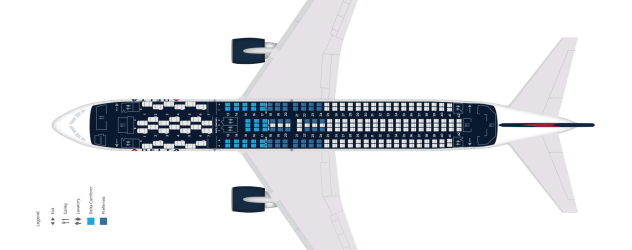
Around half of Delta’s transcons from SFO are on a 767 (the others are on 757s). The 767 economy cabin is 2-3-2, so right off the bat, there’s the benefit of not being stuck next to two people if you choose a window seat. While the shoulder room isn’t any more than you’d get on a 3-3 narrow body, having just two people and then an aisle feels less cramped to me. In the extra legroom seats, you’d get as close to a normal domestic first class as you can get without jumping up a cabin. Also, flying out of SFO as an Amex Platinum cardholder, Delta has a tie for the best lounge opportunity with their flashy Sky Club in Terminal 1.
Pricing and availability: When looking at the lowest SFO-JFK fares that I could find, Delta’s Comfort+ fare bucket prices out around $85 more than normal (not basic) economy, which goes for $190. Also, should you want to use miles, Delta’s availability corresponds much more closely to the cash fare than programs like United or American. For most flights, the lowest cash fare will also be redeemable with the lowest amount of miles. (This is in stark contrast to United and American, who will have multiple flights a day at rock bottom prices with no saver economy seats available.) It sucks, because it portends Delta’s switch to revenue-based redemption, but in this particular case, it presents an opportunity. Also, Delta is one of only two airlines here that include extra legroom seats in a separate service class, rather than selling them as an upgrade. That means that you can redeem miles for the entire cost the extra legroom seats – on all others (except Virgin), your miles would only cover the base fare, and you’d have to pay cash for the extra legroom. The best price I could find for Comfort+ was 19,000 Sky Miles. That worked out to around 1.44 cents per mile which honestly isn’t terrible for Delta. Bottom line, the widebody layout plus the flexibility to pay with all cash or all miles (and a reasonable number of miles at that) makes Delta my #1 option.
#2 – Virgin
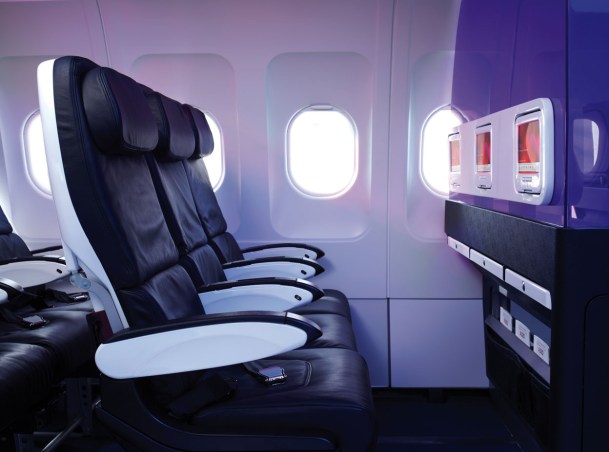
Virgin’s Main Cabin Select is a separate fare class like Delta, and the perks include free movies and free food. Most airlines offer free entertainment on transcons anyway, so the on-demand movies aren’t a huge plus, although I love ordering free snax through Virgin’s “RED” system. Legroom is also great, since the only Main Cabin Select seats are in the bulkhead row or the exit row. If I had to sit in 3-3 economy, the bulkhead on one of Virgin’s planes would definitely be my top choice. Lounge access isn’t great in SFO Terminal 2, unless you have Admiral’s Club access. However, Terminal 2 is pretty nice, and once you’ve experienced them once or twice, none of the lounges in SFO are worth getting to the airport early for anyway.
Pricing and availability: Unfortunately it’s not yet possible to redeem Alaska miles for Main Cabin Select, so if you want to redeem points, you’re stuck using Elevate points under Virgin’s revenue-based program. I do hope this changes at some point, although saver availability may be an issue with only 12 seats available per flight. Price-wise, I found these seats as low as $304, which is a $134 premium over normal economy. This puts Virgin among the most expensive options, but between the free snacks and my emotional attachment to Virgin, I’m okay paying more.
#3 – American
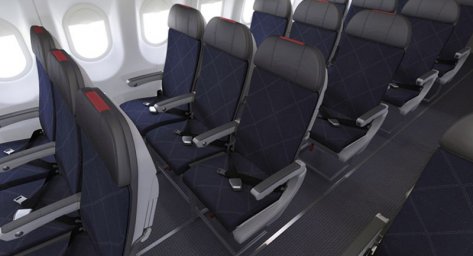
American’s A321 is the only 3-cabin plane used regularly on transcons by any airline. While you’d be in the back in this hypothetical scenario, the upside is that putting three cabins on a plane this size doesn’t leave much room for economy, so the cabin is tiny (comparatively). That means the plane boards more quickly, and there is less of a scrum around the bathrooms after American serves everyone a bean and cheese burrito with extra beans. (American flies out of SFO T2 as well, so the lounge situation would be the same as with Virgin.)
Pricing and availability: American’s saver economy availability isn’t great, and you’d have to buy up to extra legroom anyway. However, their fares are pretty good – $170 base fare was the lowest I could find, plus $88 for an extra legroom seat, making American the cheapest option overall.
#4 – JetBlue
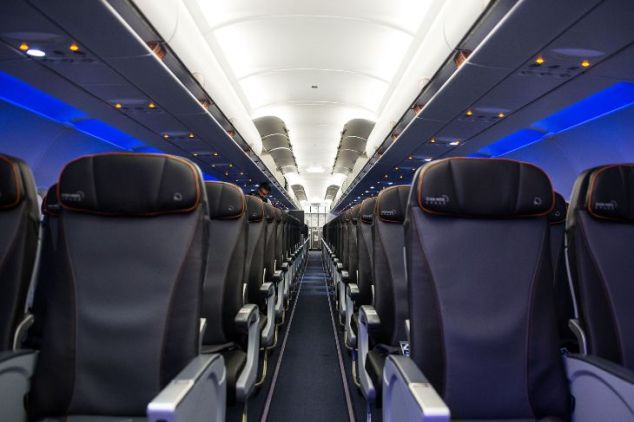
Another airline that flies an A321 on this route, although JetBlue has more seats due to only having a fairly small business class cabin up front. You’re more or less splitting hairs here between JetBlue and American, and I have a feeling most people would prefer JetBlue. My reasons for putting it here instead of #3 are all pretty small: first, there’s the larger economy cabin, plus I don’t like JetBlue’s IFE all that much. You’d actually get more legroom here than on American, but I’ll sacrifice an inch or two of legroom for on-demand movies rather than DirecTV. You may get access to the Air France lounge in the SFO international terminal via Priority Pass, although AF has been known to deny entry to Priority Pass cardholders if they’re too crowded. Of course, flying out of this terminal presents significantly better plane spotting opportunities, so that’s a small benefit. (I didn’t make a separate category for it, but I’d put Delta’s 757 on par with JetBlue.)
Pricing and availability: The best pricing I could find was $175 for a base fare plus $99 for extra legroom. The small price premium over American is another reason I put this down at #4. Since JetBlue has a revenue-based program, the redemption amounts will mirror the cash fare.
#5 – United
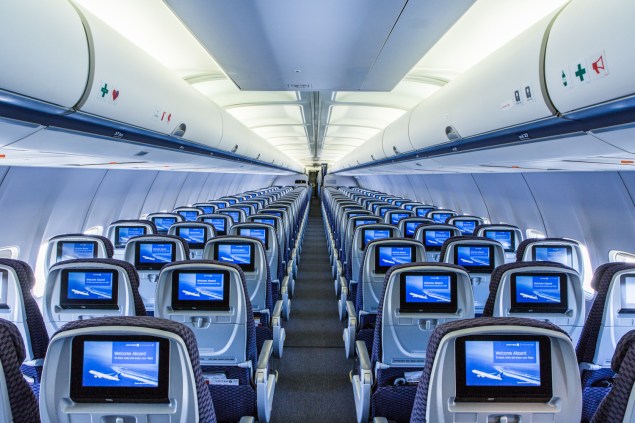
I usually try to defend United, but it’s not even close here. United mostly flies internationally-configured 757s on this route, and economy passengers benefit from upgraded entertainment and additional snackage. Lounge-wise, you’d get your pick of United Clubs if you’re using a free pass from Chase’s United card; otherwise it’s the Centurion lounge, which is definitely among SFO’s best. A lounge maketh not a flight, though. United’s 757 transcon is a fine product, but it doesn’t have any of the X-factors of the above options… no 2-3-2 seating like Delta, no sleek coolness like Virgin, no sparsely-configured aircraft like American, and no XL legroom like JetBlue. It’s middle of the road, which means price would have to be the differentiator…
Pricing and availability: … and, predictably, it isn’t. Since the introduction of basic economy, the normal economy fares are bumped up on United’s SFO-EWR route to $195, with another $129 on top of that for an extra legroom seat. Saver availability usually sucks pretty bad, too. As the second most expensive option, United falls close to the bottom.
#6 – Alaska
The only reason I’m putting this one on here at all is that it comes up among the Virgin America results when you search SFO to JFK on Alaska’s website. Alaska’s Bay Area transcon is SJC-EWR, so if you live in the South Bay, this might make a lot of sense. (I have nothing against EWR and don’t find it any harder to get to/from than JFK.) However, at least according to Alaska’s seat map, the 737-900s they use on this route don’t have extra-legroom seats, which pretty much disqualifies them for me. I’m not such a snob that I won’t fly economy, but I gotta have my extra inches. You would get lounge access at the it-looks-decent-but-I-haven’t-tried-it Club at SJC lounge via Priority Pass.
Pricing and availability: Points availability is pretty good, but I’d rather save my Alaska points for a more aspirational use, since they can be tough to earn outside of churning the sign-up bonus on the Alaska credit card. Price-wise, I saw $210 as the lowest price, which puts it above all of the other options as well.
Final note: I realize this is really SFO-centric, which is due to the fact that I live near SFO. I didn’t research pricing from LAX, but obviously big swings would change the rankings. However, all costs being the same, I’d rank these options in the same order. I also mostly looked at dates in the fall, although I looked at a fairly wide range to determine the typical lowest price for each option.
I know, I’ve been threatening to write about this forever, even though fear of flying is probably even less common among my audience than paying with a debit card. I mention it a lot in my posts, but there’s a reason for that: not a day goes by that I don’t deal with my fear of flying. It’s not just on days I have to fly. It’s any day where it’s cloudy (the clouds are probably turbulent), or when I see a plane in the sky (if I were on the plane, I’d be really anxious), or if I’m just anxious about nothing in particular, my asshole of a mind will focus that feeling on an upcoming flight just to be a jerk. As I’ve said before, I’ve never worked harder on anything than on taming my fear of flying (I hesitate to say “overcoming,” since I’m not sure it will ever go away completely). This post is about where the fear came from, and what I’ve done to address it. Maybe it will be helpful to some people who deal with similar issues. If you don’t have a fear of flying and don’t really care about mine, go ahead and sit this one out and wait for my next gem to drop in a couple days.
My fear of flying has two main prongs. The first (which I know I have mentioned before) was a freak accident in which I almost died. See, most people have a little voice in their head that says, “you aren’t about to die it this very moment.” I used to have that voice, but I don’t anymore. Irrationally or not, being high up in the air makes me feel vulnerable to death, and since my accident, it’s very hard to talk myself out of that feeling.
The second prong was a flight from New Zealand to San Francisco that was really, really rough. Rough enough that the flight attendants told passengers it was the worst Pacific crossing they’d ever been through (and I’d assume Air New Zealand flight attendants have a few Pacific crossings under their belts). Passengers were screaming, some were barfing, and it went on for hours. I’ve never been so scared, since I was firmly convinced that I was going to die. Not knowing anything about turbulence, I was sure that the pilots were covered in flop sweat, white knuckling the stick up in the cockpit and praying to the gods of flight to spare them the catastrophe that I was sure was about to befall us.
Flying had been tough after the accident, but after the New Zealand flight, all hell broke loose. To be honest, I didn’t realize how bad it was going to be until the next time I flew. As soon as the wheels left the ground, the panic hit me like a ton of bricks, and all the little coping mechanisms I had developed haphazardly over the years fell completely flat. I spent the flight (a short hop to Salt Lake City) hyperventilating, and I realized that this was going to be a thing from now on.
I got back home after an equally difficult return flight and started the process of figuring out how I would ever get back on a plane. I talked to a psychoanalyst who said, “Not only am I confident, I’m certain that you’ll eventually be able to fly again without taking medication.” He may as well have told he that he was also certain I’d grow wings out of my ass and fly around under my own power. Just the thought of having to fly would set off an anxiety attack; most nights I would dream that I was dying in a plane crash. I started researching Amtrak, figuring I may as well just give up on flying ever again.
Here’s the thing, though: even then, I knew I’d have to fly again, and I wanted to be able to. If you’ve ever told a person any variation of, “You’re more likely to die on the way to the airport; flying is safer than driving,” you don’t get how phobias work. Nobody wants to have a phobia. People who are nervous flyers aren’t just ill-informed morons who just need to hear from you about how safe flying is before they can comfortably get on a plane again.
Having said that, it’s true that lack of information plays a major part in flying anxiety. The catch is that you have to internalize the information, and someone condescendingly telling you that your fear is stupid has the opposite effect. A common element of flying anxiety is to not understand why everyone else on the plane isn’t equally terrified (which creates a feedback loop and only ramps up the panic). Those unhelpful admonishments that usually start with “Well, you know…” or “You do realize that…” only reinforce the fear that I’m the only one who understands the gravity of the situation, and that just makes it worse for me.
Patrick Smith of AskThePilot.com is probably the best resource I can think of for nervous flyers. And while his website is good, his book is even better – particularly the chapter on turbulence. Before reading it, I legitimately didn’t know that turbulence didn’t pose a danger to planes. And you’d be surprised how many people I tell about the non-danger of turbulence who also had no idea. I mean, when your body is getting thrown around like you’re on a roller-coaster, it’s only natural to think that what’s happening isn’t normal.
What I needed to internalize went far beyond “flying is safe.” It was that the specific things that I felt were unsafe – the wings visibly flapping in the jet stream, the steep drops, the loud noises a 777 makes when it’s getting battered by wind – were in fact completely normal. I watched videos of wing flexibility tests, and I devoured as many articles as I could by pilots and other experts about why turbulence at altitude isn’t going to crash a plane. I learned that pilots often engage autopilot during turbulence to limit any overcorrection and then sit back to ride it out just like the passengers (well, as much as a pilot ever “sits back” while flying a plane).
It took maybe 10 flights before I started to feel existentially at ease (in other words, that I wasn’t about to die). Just being up in the air started to feel normal, rather than it feeling like a precarious, perilous position to maintain for hours on end. That was a big hurdle to get over, but it only solved part of the problem.
Here’s the major issue: I’m no longer scared that turbulence is going to crash the plane and kill me, but the physical sensation of rough air (let’s say moderate or worse) makes me feel like I’m dying, which causes a panic attack. It’s an input that operates on a physical level, and it’s so disruptive to my nervous system that, no matter how hard I try, I can’t regulate my thoughts until the ride has smoothed out and those inputs have passed.
There’s a technique in cognitive behavioral therapy called “downward arrow,” where you pick a situation that causes anxiety, and you drill down all the way to the very specific thing about that situation that makes you feel scared. (For example, “Movie theater” –> “Being in a crowd in the dark” –> “Not being able to get out of the crowd in the dark” –> “Being vulnerable to physical harm” –> “A shooter coming into the theater and killing me.”) Once you have the specific thing you’re scared of, the therapeutic process can zero in and more effectively address the main source of the anxiety.
For my issues with turbulence, the downward arrow exercise didn’t point to any fear of external harm; at its core, my issues with turbulence are that it scares me out of my mind. Anyone who has suffered a panic attack knows how horrible it is. For someone who hasn’t experienced it, I liken it to sticking your finger into an electrical socket, except instead of your finger, it’s your lungs and brain. There’s literally no worse feeling I have ever experienced, and yes that includes the accident during which I was buried alive and almost crushed to death.
So what do you do when you have fully internalized that flying is completely safe and that turbulence is completely benign, but the physical experience of turbulence sends you into a panic even as you remain aware that you aren’t in any danger? I have spent the past seven years trying to answer this question. (One other way I try to explain this to people is to substitute the mental anguish of panic with physical pain. What if turbulence invariably caused your leg to feel like it was caught in a bear trap? Would you be nervous about turbulence then?)
First, let’s get this out of the way: I take drugs to help me fly, and they work. Some fear of flying programs discourage this, since the most common drugs (benzodiazepines) dull your ability to react, which can limit their effectiveness. Brain chemistry is very personal, so what works for me may not work for you. That said, a lot of “drug-free” fear of flying approaches get almost masochistic in their resistance to any palliative avenues of self-care. Sure, drugs may be the junk food to exposure therapy’s broccoli, but if the point is to convince yourself that you can get through a flight, then getting the fuck through the flight is a necessary first step.
Exposure therapy also has the risk of re-traumatization – especially in a theater like air travel, where progressive exposure is really difficult. Sure you can tiptoe through the first steps (start by driving to the airport and going home, then try going inside and leaving right away, then try clearing security and leaving, etc.), but once the plane is off the ground, you’re locked in to whatever happens until it lands again. An unexpectedly rough flight may shake everything loose and make you realize you can handle it just fine, but it risks having the opposite effect. This is why most forms of exposure therapy are done under pretty close supervision by a therapist – yet another difficulty when trying to apply exposure therapy to commercial flying.
I take lorazepam (the generic form of Ativan), although klonopin, xanax, and valium can be equally effective for people, depending on an individual’s particular brain chemistry. When I first started flying again, I took huge doses of lorazepam – big enough that if I took a dose that size on an average Saturday, I’d be nearly comatose for hours. However, the amount of anxiety produced by flying made me barely feel like I was on anything. At first, this created issues as I learned how to regulate my dosage… like the time I kept popping pills on the way from San Francisco to Boston because “I didn’t feel anything,” and then got lost in Logan airport looking for baggage claim until a cashier at Au Bon Pain made me sit down at an open table because I was all glassy-eyed and confused. Good times.
In recent years, I have made a lot of progress. I’ve done a bunch of flights in the last couple years without any meds at all (turns out that psych was right after all), but I usually take a small dose, just to put myself at ease a little more. I know I can get through a flight without taking anything, but it’s a constant struggle to defuse the tension that builds up, and a minimal amount of lorazepam helps me slow my heart rate and relax without affecting my alertness or coordination. I have even been through some rough stuff and come out just fine – most notably a drug-free flight into Seattle during a storm complete with major roller-coaster drops on the descent. It wasn’t fun, and I still found it terrifying, but I got through it.
Here are some ways that I have learned to cope over the years… First, the challenge is always to keep your thoughts from running away unchecked. Whether it’s turbulence or something else, there is a definite line between physical discomfort and panic. One of the keys to being able to tame my overall anxiety around flying was to understand that feeling uncomfortable during turbulence is one sensation, a panic attack is another, and the two don’t have to be linked. I can go through a rough patch and think “wow, this sucks and I feel awful,” without thinking “I’m completely fucked and oh shit oh shit oh shit.” One way to get to this point is to take medication designed specifically to prevent it from happening. We’ve been over this already.
Music is a big one too. I have two default playlists for turbulence – one is very slow, heavy, droning music by bands that coincidentally start with the letter H (Hum, Harvey Milk, Helmet), and the other is super up-tempo fist-pumping stuff like Andrew WK. Depending on my mood and the intensity of the bumps, I’ll pick one of the playlists and make it the soundtrack, as if rocking and rolling through the air is a thing that I’m doing for fun. It’s not that I use music just to calm down, or to take my mind off the turbulence. Instead, the music integrates with the experience of flying through rough air and gives me something to focus on, centering my thoughts and keeping them from spiraling quickly into fear and panic.
Writing is a major component of my anxiety management as well. Maybe the most important component, actually – even moreso than drugs. I realized on my first flight after the phobia started how powerful a tool writing can be when it comes to keeping my mind from racing. I took my seat after boarding and immediately started veering into pre-panic anxiety, so I pulled out a notebook and wrote down some of the motivational stuff I had drilled into my mind in the months leading up to the flight. I quickly realized that it didn’t even really matter what I was writing – the physical act of writing slowed my thoughts down to the speed of my pencil on the paper, which prevented my thought process from going off a cliff. Going back and reading my old notebooks, there are times when I would fill up entire pages with stuff like, “Okay WOW IT’S BUMPY but I’m fine, just gotta keep writing, BIG BUMPS WHOA, it sucks but I’m fine, writing writing, that’s what I’m doing, feeling okay even in bumps, writing is good…” It seems ridiculous in retrospect, but it worked, so that’s really all that matters.
Finally, it’s impossible to overstate the benefit of meditative breathing. I have read that it’s impossible to have a panic attack while practicing meditative breathing – I’ve never tested this, but I do know that focusing on breathing can stop a rising panic attack in its tracks. Panic attacks have a certain velocity, where everything seems to speed up – fast heart rate, racing thoughts, hyperventilation, sweating, and so on. Breathing is the one thing you can always control, though, and by slowing it way down and focusing intently on the in/out rhythm, everything else starts to settle back down too.
Realizing that you can arrest a panic attack’s momentum is hugely valuable, since so much of the fear around panic anxiety is that when an attack strikes, there’s nothing you can do. It’s very comforting to know that the knife’s edge between panicking and not panicking isn’t so much a knife’s edge as a plateau that you can control with techniques as simple as breathing or writing.
The lack of control is a big issue for many people who have a fear of flying. This could either be the lack of control over the plane itself, or simply the lack of control over one’s situation (insofar as you’re stuck on a plane and can’t get off no matter what). However, what meditative breathing taught me is that I’m at least in control of my reaction to my surroundings. While I may not enjoy it, I can focus on dealing with the anxiety and pushing it away, or I can succumb to it and let myself roll headfirst into a panic attack. And that choice starts with my ability to regulate my breathing.
EDIT: After I published this post, I realized that I left out one additional technique that has been very helpful. Again, this may just be something that works for me, but I figured it was still worth mentioning. I call it “rebound thoughts,” and it’s basically a catalog of the thoughts that accompany rising anxiety paired with the exact opposite thought that instantly refutes it. By studying these in advance, I can beat back the fearful thoughts as they start, rather than letting them build until I’m having panic attack. Here’s an example: probably one of the most reliable signals that I’m about to have a panic attack is that I start thinking, “get me off this plane.” The rebound thought there is: “Keep me on this plane!” To expand on that: “Keep me on this plane so I can keep challenging myself to encounter turbulence and prove to myself that I can manage this.” Another one is, “that last bump was fine, but if it keeps going or gets worse, I’m gonna lose it.” Rebounding: “that last bump was fine, and if I can do one, I can do a hundred – so bring it on and let me see how big of a bump I can handle!” I agree that this sometimes veers into motivational speaking territory, but in the moment, psyching yourself up is one of the most important things you can do to keep fear and anxiety at bay. After all, panic is just your fight or flight response misfiring, which creates a surge of adrenaline. If you can repurpose that adrenaline surge into making you feel like you’re having an exhilarating experience as opposed to a terrifying one, you’re much less likely to panic.
In the end, I don’t know if I’ll ever get all the way to the point where I can say I’ve beaten my fear of flying. It’s more like back pain. Some flights are great, and I fly through turbulence as calm as if I were at home on the couch, and other ones are tense and shitty. The point, though, is that I always do it, even if it stresses me out. That’s why I say I have tamed my fear – I don’t let it dictate my choices or prevent me from seeing the world, but I do still wrestle with it constantly. I’m pretty sure that if I suddenly found myself in a job where I was flying a couple times a week routinely, the repeated and consistent exposure would finally get me to the point where I could fly without nervousness. That’s all hypothetical, though, since I don’t travel that much for work, and I don’t have the time or money to fly somewhere every weekend just for practice.
Still, without getting too didactic, have hope if this is something you also struggle with. It’s definitely possible to get to a place where flying is doable, and sometimes I even find it enjoyable. And let’s be clear that I love a lot of things about flying – in fact, I love pretty much everything about flying except for the physical feeling of flying. There’s nothing I’d like more than to be like the 75% of flyers for whom the worst thing about flying is the legroom… the people don’t care what the weather is doing, and who don’t bat an eyelid when the plane flies into a thunderstorm or over a mountain range. But even if I never get there, the fact that I can do it at all is still a pretty huge accomplishment, and the fact that I figured out how to do it in maximum comfort thanks to churning is the cherry on top.
This doesn’t have anything to do with flying, but it’s a cute picture of my dog, who’s always happy to see me when I get home from wherever I’ve been.
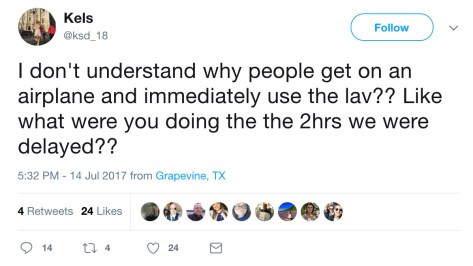
I’ve seen a bunch of pile-ons on Twitter lately chastising people who use the lav right after boarding. What’s wrong with them??? What were they doing in the terminal for the last hour?!!?!?! DO THEY KNOW HOW STUPID THEY LOOK TO EVERYONE ELSE?!?!!?
Let’s start this post off right. This is Piss Christ by Andres Serrano. It’s a crucifix submerged in urine.
Here’s the example I just found on Twitter that prompted me to write this, but it’s certainly not the only one. In fact, boarding-urinators are right up there with people who put their bare feet on stuff and people who refuse to turn off their cell phones as a favorite bugaboo of frequent travelers.
So I’m sure your legs are crossed tightly in burning anticipation of whatever reason I could possibly have to engage in such uncouth behavior. Here it is: like 20-25% of the flying public, I have major anxiety around flying. I haven’t made that a secret on this blog, and at some point I want to write about it in more depth, since I’ve worked harder on getting over it than anything else I’ve ever done in my life. But it’s there, and I have to deal with it if I want to travel by air. Unfortunately, a common symptom of anxiety is frequent urination – like every 15 minutes frequent urination. Check it.
Now, (TMI alert), this isn’t just a few drops either. This is the body in an agitated state evacuating water like it’s putting out a forest fire, and it doesn’t go away until anxiety levels decrease (AKA the plane lands). So it’s not an exaggeration to say that I use the bathroom in the terminal immediately before boarding, and then again immediately after boarding. And, if the flight attendant and the people sitting next to me are lucky, I’ll go again after boarding is complete but before the door is closed. I know, it’s very inconvenient for everyone. But you know what’s more inconvenient? Pissing all over yourself right before a five hour flight, and leaving a piss-soaked seat for the crew to clean up later.
I try to be a good soldier on planes and not get up when the seatbelt sign is on, and the last time I decided to hold it during boarding, the captain kept the seatbelt sign on for 50 minutes, despite it being glass-smooth the entire way. (I’m sure there was a reason for this, like reported turbulence by other pilots or forecasted weather that didn’t materialize.) I’m not criticizing the captain, I’m pointing out that the period during boarding is sometimes the only opportunity to use the bathroom for over an hour. Last time I flew out of JFK, there was a 45-minute ground delay and turbulence for the first hour of the flight. If I hadn’t used the bathroom during boarding, it would have been a hell of a soggy flight in that JetBlue Mint suite.
I don’t know if everyone who’s bothering you by using the bathroom during boarding is doing it for the same reason as I am. Maybe they are just neglectful of their own bladder and decided to wait until they boarded the flight to do their business. Just keep in mind the next time you’re tempted to pile on about this that the person who’s cramming themselves into a tiny piss-box at the front of the plane and and fighting passengers to get to/from their seat probably is as unhappy as you are about the fact that they’re peeing at that moment.
The plane I most want to fly on is the A350, and the cabin in which I most want to fly on it is Finnair’s business class. This is partially because I’m overly enamored of all things Scandinavian, and also probably because Finnair’s interior design kind of reminds me of an ice hotel, which is on my bucket list of travel experiences. Here, see if you can tell which one is the airplane and which one is the ice hotel:
The problem is, aside from a brief window during which Finnair flew their A350 from New York to Helsinki, they’re primarily used on routes between Europe and Asia. Right now, I don’t have any plans to travel to Asia in the first place, and I have even fewer plans to travel between Europe and Asia. That means that I probably won’t get to try Finnair’s A350 anytime soon – especially since Finnair is especially strong between Europe and Asia and is focusing there for the bulk of their future growth.
Except… turns out they fly the A350 once a day between LHR and HEL for whatever reason. This doesn’t seem to be a temporary thing, either, since it’s officially announced as an A350 route on their fancy A350 hype page (although they do include a caveat that equipment swaps are always a possibility). Since I do want to go to Finland sometime in the next couple years, this piqued my interest – especially since I want to go in winter, when Finnair doesn’t operate a direct flight to SFO. That means I’ll have to break my journey at some point, and flying BA first class to LHR and then picking up Finnair business to go the rest of the way would be a pretty great itinerary.
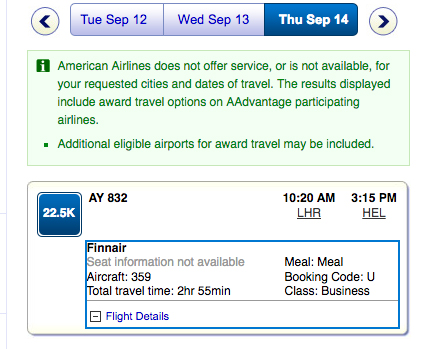
Unfortunately, it may not be that easy. However, just looking at the LHR-HEL leg, availability is pretty good, at least for the random dates I checked. Searching on American (since Finnair is a Oneworld partner), I saw availability on this particular flight for around half the days in September.
I guess 22,500 AAdvantage miles is kind of a lot for what’s probably around 2 1/2 hours in the air, but I’d do it in a heartbeat if it made sense in the context of my overall travel plans. Because I don’t actually like flying that much (I’m more interested in premium cabins in a kind of asperger-y way), I think a couple hours in Finnair would be enough to quench my thirst. Aside from something like Emirates first class, where there’s an elaborate 75-course meal to eat, $5000 cognac to drink at the bar, and minutes upon minutes of showering to shower, I don’t really know that I’d ever want to spend more time in a plane than is necessary. Even in relative luxury like SAS or Swiss business class, I still just wanted the flight to be over after a few hours. So, what I’m saying is, I don’t feel like I’d be disappointed in not getting the “full” Finnair experience by taking this flight.
Of course, the better option than shelling out 22,500 miles would be to tack it onto a transatlantic award for free. I was able to make a sample itinerary work in economy (SFO-LHR-HEL), but it was tougher in business. The reason is that BA business availability is pretty sparse over the periods when Finnair is open, and vice versa. BA has every-day availability in November, but Finnair doesn’t have a single day in November with business availability on this particular flight. I don’t know that much about general availability trends on either of these carriers, but it seems like Finnair opens space a couple months in advance, whereas BA has always been better the further out you book, in my experience. I’m not saying it’s impossible to string these two flights together to book a single award, but there’s definitely some luck involved.
Regardless, it does strike me as funny that you’d pay the same to fly in an industry-leading reverse herringbone seat on the most technologically advanced jetliner (is that true?) as you would to sit in BA’s shitty 29″ pitch “business class” with a blocked middle seat. Such are the little quirks of this hobby that make it worthwhile, I guess.
Bottom line is that I’m happy I may yet get a chance to fly on the A350. Although I may not ever get around to it, I just like knowing it’s there (as long as I don’t get equipment-swapped). Has anyone flown the A350 in general, and Finnair’s version in particular? Feel free to make me enraged with jealousy by describing your experience in the comments.
You learn something every day, I guess. Maybe this is common knowledge already, but I wasn’t aware that Amex has different names for the two tiers of the Membership Rewards program. This distinction (and the similar one you get with Chase between cards like the Freedom and the Sapphire Preferred) is always the most difficult thing to explain to people who are just getting into churning. It’s hard enough to keep all the programs straight in the first place, so learning that Ultimate Rewards or Membership Rewards points aren’t the same across the board is a bridge too far. Just tell your dad, “Yes, the Freedom card earns Ultimate Rewards points, but they’re not the same Ultimate Rewards points that the Sapphire Reserve earns,” and watch his eyes glaze over. (Sorry dad.)
Anyway, the other day, I applied for the Amex Green card using an incognito offer for 25,000 points. This is such a comically bad card, I’m almost embarrassed to use it to hit the $1000 spending requirement. Maybe I’ll just use it for some online purchases to try to save face. It’s honestly crazy that Amex still offers this card – it’s like if Microsoft still offered to sell you Windows on floppy disks. I get that they need an entry-level charge card with minimal benefits, but do they really need an entry-level charge card with minimal benefits? 25,000 points isn’t a bad welcome offer, though, so I figured it was worth the credit inquiry to pick it up.
(Other people pay more attention to credit inquiries than I do, so I’ll leave it to them to determine whether Amex does a hard inquiry for current customers when applying for incognito offers. I know that applying for a new card while logged in only gets a soft inquiry, but since the whole point of incognito offers is to use your browser to trick Amex into thinking you’re a brand new customer, it would make sense that those applications get more scrutiny.)
I haven’t received the card yet, but today I got a letter in the mail from Amex with some interesting verbiage:
While setting up your rewards program membership, we noticed that you are already enrolled in a more rewarding American Express Membership Rewards program. We are pleased to inform you that since you already have at least one eligible card enrolled in the Membership Rewards First program, as a special thank you for opening a new card with us, we have automatically enrolled your new Green Card Card [sic] in this program.
I guess I just assumed that all the points would pool together in one account, since that’s what happened when I opened my Blue for Business card, which also earns the crappy Membership Rewards points. It doesn’t really seem like much of a special thank-you, although I guess it’s good to have written confirmation just in case I go to transfer my points and find out that I can’t due to a system glitch. However, this is the first time I’ve ever heard of “Membership Rewards First,” which apparently is what Amex calls the Membership Rewards program we’ve all come to know and love.
Nothing groundbreaking, sure, but I do like learning about stuff like this, since it helps me understand the infrastructure behind the rewards programs whose value I’m trying to maximize.
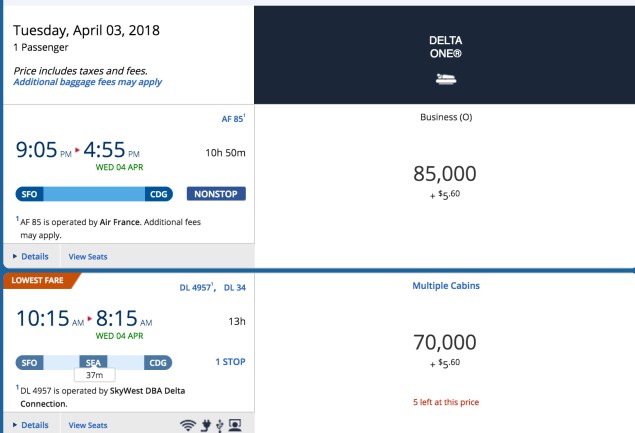
There’s a chance I might head to Paris next spring for a quick trip, and it represents a good opportunity (if it happens) to clean out my stash of Sky Miles. Despite not having any idea of the dates or even if I actually will end up going, I decided to search availability just to see what’s what. This is the first time I’ve run into Delta’s new award pricing structure in which partner awards are never lower than level 2 pricing (according to their non-existent chart).
Six months ago, it would have cost the same amount (70k) to fly on Delta or on Air France. Ten months ago, it would have been even cheaper (62.5k). Such is life in Delta’s new America, where devaluations come fast and hard, and you just gotta hang on for dear life. Now, even though there’s saver availability on Air France, it still cots 85,000 miles, while Delta’s own flight stays the same at 70k.
This brings up an interesting question… which one would you pick? The travel time isn’t drastically different, and the SEA-CDG leg on the Delta itinerary is on an A330, which features Delta’s reverse herringbone seat. While it’s not going to blow you away, it’s definitely a comfortable way to cross the Atlantic. The SkyWest flight up to Seattle isn’t great, but you get the benefit of the E175’s 1-2 configuration in first class, and since it’s a Delta Shuttle flight, it will have full meal service even though it’s a short flight. What I’m saying is, it’s a perfectly acceptable itinerary.
Flying Air France is better, of course. It’s on a 777 that will finally be retrofitted with their “new” reverse herringbone business class that has been on the market for almost three years. (The SFO-CDG flight has taken a frustratingly long time to get the new configuration.) It’s not too different from Delta’s, although it has more storage space and extra elbow room due to the wider fuselage on the 777. Probably better food, too.
So, would you pay an extra 15,000 miles to take the direct flight in the (marginally) better cabin? I’m curious, since I’m definitely of two minds about it. For a quick solo trip, I’d probably save the miles and suffer the connection, despite wanting to try Air France’s new business class. I already feel guilty using miles to fly long haul business class on solo trips, so it would probably be good not to drain the overall stash too much. If Justine and I were going on vacation together, it would be a pretty easy choice to blow the extra miles on the direct flight just to make everything smoother.
Ultimately, these are the types of choices Delta is forcing upon us with their most recent whack against the Sky Miles tree, although I should point out that availability on Delta is actually pretty good for flights to Paris, and that’s commendable. At least if they’re going to gouge us on partner awards, it’s nice that they also aren’t draining away all the availability on their own flights like some other domestic carriers. Even better that they open space on domestic positioning legs from an outstation like SFO. United could take a lesson from them, since transatlantic availability from SFO almost always involves a domestic leg in economy to somewhere at least a few hours away. Of course, that’s due to United’s abysmal domestic first class availability on its own flights, which is a topic for another post. At least for the time being, Delta is compensating for its objectively shitty devaluation spree by providing a decent amount of opportunity to redeem at the pre-devaluation amount. Well, pre-the most recent devaluation, at least…
A couple weeks ago I flew from Zurich to SFO on Swiss, and it was pretty good. Again I didn’t take a bunch of photos, because no matter what photos I take, it’s not going to give you any perspective on the cabin that you can’t find in this post from The Points Guy. Reviews I read going into the flight were definitely mixed – this is not a product people rave about, although with my expectations sufficiently moderated, I definitely enjoyed my flight.
Here’s the first thing you should know going in: luckily Aeroplan doesn’t charge fuel surcharges on Swiss awards, because you’re gonna want to pay $200 to sit in one of the throne seats. As I’ve written previously, these seats were previously blocked for elites, although they were recently made available for purchase only. Now, the seats in the middle with the extra space are blocked for elites, so if you aren’t a fancy Swiss thing, and you’re traveling with a companion, you’re stuck in the not-so-desirable window seat pairs. This could always change, but that’s how the seat maps looked for the flights I checked.
However, once that $200 is paid and you’ve rationalized it by telling yourself that it’s cheaper than a fuel surcharge on Air France, you’re in for a treat. The seat’s nice. It’s the same seat as JetBlue offers in Mint class, only without the door… however, while JetBlue’s seat is sleek if unspectacular, the Swiss seat is very nicely finished. There are tons of storage compartments, the wood trim looks great, the screen is fantastic, and the seat itself is pretty comfortable, provided you get a firmness setting that you like. Sure there’s no door, but… does it really matter that much? It’s not like the walls go all the way up to the ceiling, so the door really doesn’t offer that much extra privacy.
Also, I’m happy to report that I didn’t have a problem with the size of the foot cubby. To make extra room, I took my shoes off, although I soon realized that my socks were super smelly… good thing Swiss includes stylish bright red socks in the amenity kit. Decked out in a green plaid shirt, gray shorts, and red socks, I’m sure I looked amazing during the flight. Anyway, once the shoes were off, I didn’t find the foot cubby restrictive, and I even slept on and off for around two hours, which is a new record for me. It was a daytime flight, but I had had an exhausting week, so I was dead tired even in the middle of the day. All the issues I had with the JetBlue seat – small foot cubby, narrow sarcophagus-like sleeping surface – weren’t issues this time around. Whether that’s due to subtle differences between the seats or just my extra tiredness is unclear, but I found the seat plenty comfortable for lounging and then sleeping.
I normally think amenity kits are dumb, but I like how Swiss gives you a tote bag instead of a stupid zip pouch that you would just throw away. The amenities themselves are fine – I threw all of them away except for those to die for red socks. The kit was waiting at my seat along with headphones, a nice pillow, and a blanket. Shortly after I boarded, they came by with orange juice, sparking water, and champagne on a tray, but I didn’t see them again until meal service started, despite the fact that we had a 1-hour ground delay.
In fact, the service on this flight wasn’t great. I mean, it was fine, but it wasn’t any different than service in economy, except for the fact that they had more stuff to bring out. But once meals were over, the flight attendants mostly stayed in the galley. I had to keep asking them for water, which was annoying. I think the crew probably has it pretty rough on this plane, since there are a ton of business class seats to serve, so they probably don’t have much room for improvisation when it comes to the service flow. Still, just bring me a goddamn bottle of water that’s bigger than 6oz and I’ll leave you alone, I swear.
One other thing: I was really disappointed about not being in the mini-cabin (rows 4 and 5), but it ended up not mattering. The seat is private enough (and I was toward the front of the main business cabin in seat 9A) that I wasn’t really aware of the other 60 or so passengers in the cabin. I suppose the smaller cabin is better and more intimate, but it’s really kind of splitting hairs. Also, 4A is usually blocked, and 5K (the other throne seat in the mini-cabin) has no windows. I’d much rather have a window than be in the smaller cabin.
What else? Bathrooms were fine, and there are a few to choose from, so there was never a wait, despite the volume of passengers. (Maybe because they never gave out any water, no one had to pee?) There were snacks set up in the galley, too, which was good, since I was pretty hungry during the flight.
Oh yeah, I haven’t mentioned the food at all. It was great! Seriously, Swiss killed it with the food on this flight – by far the best airplane food I’ve ever had. One thing I majorly appreciate is that some thought goes into their vegan/vegetarian meals – both meals included a little card about the vegetarian restaurant that Swiss partners with, and apparently it’s the oldest vegetarian restaurant in the world. The only thing it was missing was some protein, which is why I was hungry later. The main dish was a vegetable pasta dish that I wouldn’t be disappointed to eat in a restaurant, and the salad had a bunch of stuff in it besides just lettuce and a tomato or two. Plus, they had seriously the best bread I have ever eaten in my life. It was somehow both fluffy and dense at the same time, and the fact that they offered me margarine to put on it instead of butter just made it all that much better. Swiss: come for the bread, stay for the method of transportation that gets you across the ocean in mere hours.
The second “breakfast” meal was even better – it was a vegetable breakfast burrito that was cut into slices, and I would have eaten five portions if I could have. I actually should have taken photos of it, since I realized that there aren’t many (any?) blogs that focus on reviewing vegetarian/vegan meals on flights, and I thought maybe this could be my focus. But I was too busy eating and watching Crazy Stupid Love to get my phone out.
Last thing: there are no air vents on Swiss, so I brought a little USB fan with me after seeing that #thatjohn guy recommend it on Twitter. Thankfully I never needed it – the cabin was pretty mild during the flight, which probably means it was freezing, since I’m always too hot. I still wish they’d install air vents, but I guess it’s to be expected since nothing in Europe is air conditioned.
Lastly, I won’t write a whole post about it, but the Swiss business class lounge in Zurich Airport is probably my favorite lounge I’ve ever been to. I’ve been saying that a lot lately! In short order, I visited the Delta SkyClub in SEA, the Polaris lounge in ORD, and now this – and all three were easily better than any lounge I’d been to prior. The Swiss lounge has great food, a great drink selection, great snacky food if you don’t want a full meal, and even a freezer with mini-cartons of Movenpick ice cream (and a sorbet for yours truly). The views are fantastic, and there’s an outdoor terrace if you want to see the action up close… although if it’s super hot like it was when I was there, you can sit at a high counter along the windows and get the same view you’d get from the terrace. Great bathrooms, too – on par with Amex Centurion lounges. I didn’t realize until I left to go to my flight that there were shower facilities, which sucks because I would definitely have taken advantage. Still, pretty much everything about the lounge was great, so I’d definitely give yourself a little time to check it out before your flight. Plus, if this is just the business class lounge, I’d love to see the first class lounge! There’s also a separate lounge for elite members that has an insane whisky bar, but that’s gonna stay out of reach for me.
Bottom line on Swiss – as long as you shell out for the throne seat, you’ll have a good time. It’s a solid product with not-great service but excellent food, and you’re getting more personal space than in any other business class configuration I know of.
Since you read this far, maybe you want to consider supporting this blog? I’m committed to keeping it ad-free, so reader support makes a huge difference!
When I started this blog, part of the reason was to think out loud a little bit about my credit card strategy and maybe even engage in a dialog with the intrepid few who read along. Now that the year is half over and I’m just about done with a bunch of minimum spending requirements, I have been thinking about my overall strategy and which cards I should keep/cancel. (Also, as an aside, are you guys familiar with the band Pile? I’m listening to the album You’re Better than This while I write this post, and it’s fantastic.)
Instead of a picture of all my credit cards fanned out, here’s a capybara with a bird on its head.
I’m starting to get concerned that I’m too heavily invested in Amex right now, and that I need to focus on diversifying a little bit, even if my total return isn’t as high as it would be if I kept the focus on Membership Rewards. How did we get here? First, between cards like the Everyday Preferred and the Blue for Business, Amex points have become really easy to earn. Add to that some very generous referral bonuses, elevated sign-up bonuses, and a steady crop of Amex offers that earn bonus points instead of cash back, and it’s easy to earn thousands of points every month. Some offers (like earning an extra point on all transactions at Whole Foods for the rest of the year) are just begging to be capped, but god love ’em, they’re leaving it open.
Here’s my worry with Amex: I’m not super eager to earn and burn these points, because the biggest windfall opportunities (sign-up bonuses) are mostly closed to me at this point. There’s the Charles Schwab Platinum card that I plan to open later this year for 60k, but after that I’ve done pretty much all there is to do. I’ll continue to pull in probably 50-75k or so a year between normal spending and special promotions, but that’s not enough for two round-trip long haul business class tickets. I wouldn’t mind sitting on a big stash of points and spending them judiciously, but I’m worried the Membership Rewards program is going to take a hit with Aeroplan goes away. Right now Aeroplan is my go-to for awards, but they won’t be around in a few years, and if Air Canada’s in-house program doesn’t align with Amex, that’s a major devaluation. Of course ANA will still be there, but that program isn’t nearly as lucrative (or use friendly). Oh, and Delta… if Delta even bothers to have a loyalty program in a few years. (Plus, I already have way too many Delta miles.)
I’d never be worried about Chase points dying on the vine, but I’d hate to have a couple hundred thousand Amex points sitting around indefinitely because there weren’t any good redemptions anymore. I realize this is highly speculative and also quite a long ways off, but it’s never a good idea to be too heavily biased toward any one program, and I think Amex occupies too big a percentage of my overall point total. I also made a stupid decision when I booked my most recent flights and spread the 125,000-point transfer to Flying Blue across all three programs. This made sense to do for Citi, since I knew I was going to shut down my Prestige card, so it was a good way to clear out the points I had left. However, I absolutely should have pulled the rest from Amex, since I still would have had more Amex points than Chase even after debiting 85,000. There’s no way I should have pulled 40,000 Chase points for this, given that there will be no Ultimate Rewards sign up bonuses in my future (unless Chase makes a major change).
Last year, I was swimming in Chase points, but I spent them pretty quickly – a few Hyatt category 7 stays here, a couple Ultimate Rewards redemptions at 1.5 cents per point there, and a first class ticket for Justine to fly home from New Zealand… and voila, I just spent 150,000 points. Yikes. So, here’s what I’m thinking:
Current strategy: Sapphire Reserve (or Freedom this quarter) on restaurants; Amex Everyday Preferred on groceries and gas plus little transactions to get to 30; Amex Platinum or Sapphire Reserve for travel; Blue for Business everywhere else.
As you can see, this biases pretty heavily toward Membership Rewards, with the only points to Chase coming through restaurants or non-airline travel.
New strategy: Basically keep it the same, but substitute the Freedom Unlimited for the Blue for Business. Also maybe start using the Sapphire Reserve on airfare? I don’t want to give up 2 points per dollar to Amex, but again, this is about doing what I can to bolster my Chase balance (plus I’d get better trip protection). I don’t spend that much on airfare anyway.
One other opportunity I thought I would have was earning 5x Chase points on Amazon year-round by buying gift cards from Office Max with the Ink Cash card. Unfortunately, every office supply store I’ve tried to do this at has refused credit cards as a payment method for gift cards. Jeez, maybe I need to suck it up and learn how to manufacture spending already…
Here’s a capybara with two monkeys on it.
Other stuff:
In general, my advice to people is to open cards even if you don’t have a use for the points. I mean, don’t go nuts, but I think it’s okay to sit on point if the offers you get are uncommonly good and unlikely to be repeated. Here’s a counterargument, though… last summer Delta offered their HIGHEST EVER BONUSES on the Gold and Platinum Amex cards, and I opened one of each for 50k and 60k respectively. I ended up sitting on the points, though, and now Delta has devalued twice. That’s always the risk, and as I have argued before, the points are worth marginally less, but they certainly aren’t worthless. What has changed is that this summer, Delta offered the HIGHEST EVER BONUSES on these cards again, this time upping them by 10k to 60k and 70k. It makes sense – 130,000 points are worth the same now as 110,000 points were worth last summer. The problem is that they’re Amex cards, so I’ll never get either of the bonuses again. My takeaway from this is to be more discerning in what “unlikely to be repeated” means. As I add years of experience, this will get easier, but, for instance, what if Amex tries to entice a bunch of Citi Hilton holdouts with a 150,000 offer on the Surpass card in a few months? I’ll be pretty glad that I didn’t get the Surpass last month, even though it was offering it’s HIGHEST EVER BONUS.
The runaround I got from Hilton customer service notwithstanding, I’m enjoying the results of my Hilton play. I was able to grab a room at the Waldorf Amsterdam for 85,000 points, which was almost exactly how many I earned on my Amex Hilton last month. With the two nights I got from Citi, that gets me three nights for $4500 in spending (and two hard inquiries), which is what I had originally hoped for. Plus, I took advantage of the Hilton promotion to refer the card to my wife and a coworker, so by the time that’s all done, I’ll have around 125,000 points left to enjoy. I’m very interested in what happens once Amex becomes the exclusive issuer for Hilton, including whether they introduce a card to compete with Chase’s Ritz Carlton card. I may be running out of opportunities for Membership Rewards points, but between my wife and I, it shouldn’t be too tough to get another couple hundred thousand Hilton points once we have a use in mind.
Much to my surprise, I finished my first six months with the Blue for Business card without maxing out the restaurant bonus (which was 10x per dollar for the first $2000 over the first six months). This was mostly due to Amex not counting meal delivery services as part of the bonus, since we almost never go to actual restaurants anymore. Still, if you had told me in December that I wouldn’t spend $2000 in restaurants over the next six months, I’d have told you that I would spend $2000 in restaurants over the next six months. I ended up getting around 15,000 points through the promotion, and since the card has no annual fee, I didn’t lose anything by not maxing it out.
City National Bank continues to be hilarious. They sent me big poster tube in the mail the other day that only contained a flyer about getting a mortgage. Maybe they did it so it would stand out in the mail? Also, I got a call yesterday from someone offering to help me downgrade my Crystal card, which I did eight months ago.
I didn’t ultimately take advantage of the Amex offer for 20,000 points on $200 spend with Intermedia. Basically, it came down to the fact that I don’t have tons of extra money right now, and I have tons of Amex points. Plus, if I really wanted to buy Amex points, I’d just get Justine a Platinum card – between the normal bonus and the referral, that would be 75,000 points for $550 in spend (less if you net out the airline/Uber credits).
Finally, Amex was stone-faced when I tried to get a retention bonus on the Mercedes Benz Platinum card. I called three times, and every time the rep told me the new benefits were so great that I should be begging them to let me keep the card. The best I could get was one guy offering to use 47,500 points to pay for the annual fee. On the one hand, I should keep the card open, since I still only pay $475 for it (as opposed to $550 on new cards). On the other hand, I got an unexpected tax bill for around $475, so I think I’m going to close it and use the credit to pay the tax bill. I still have my other Platinum card, and I’ll have until the end of October to cancel that one and get the fee back, and which time I’ll be ready for the Schwab Platinum (and presumably I’ll have put money aside each month between now and then to pay for the fee).
Oh god, this is almost 2000 words. Does anyone really read this far?
A couple weeks ago, I flew from ORD to Brussels in United’s not-long-for-this-world Polaris First class (formerly Global First), and I had ample time to spend in the much-hyped Polaris lounge before my flight. Both of these have been reviewed (and photographed) extensively, so I’m just going to jot down some random thoughts and impressions.
First, the Polaris lounge… it’s nice, but not as mind-blowing as I was expecting. I’m not sure what I was hoping for, honestly. The way the Polaris lounge glistens in all the photos of it that I have seen, I guess I was expecting to be gobsmacked by pristine marble fixtures like I was walking into the Qatar Airways first class lounge in Doha. While it’s prettier than a United Club, it’s not that much prettier (assuming you’re talking about one of the new United Clubs). What sets the lounge apart, in my opinion, are the bathrooms and shower suites (I didn’t have a chance to check out the day beds). Most of the time, the bathroom in a United Club looks like the aftermath of an outtake from Donald Trump’s Russian golden shower video, so I appreciated the individual toilet cabanas on offer here. The bathrooms are all lined up in long hallway, though, so if every one is occupied, it can be awkward trying to find a place to wait for one to become available. There were also staff members cleaning up after almost every use, which was an impressive level of service.
I had around four hours to spend in the lounge before my flight, so I decided to kill some time by taking a shower. I was able to book a shower suite without having to wait, and I can honestly say that this was one of the best showers I have ever had. If I were awarding it a medal, I would definitely give it the gold. Truly, it was a golden shower. What made it so nice? First, the shower suite is huge – bigger than most hotel bathrooms, in fact. Plus, the shower has an angled shower head and a vertical (rainforest) shower head, and you can run both of them at the same time for maximum water coverage.
Feeling refreshed, I went back to the lounge to get some food. That’s the other thing that sets the lounge apart, although the food I had wasn’t actually that good. If you eat meat, however, your experience is likely to be much better than mine. There were a couple off-menu options for vegetarians in the sit-down dining area, although only one of the buffet offerings was vegan-friendly. There’s also better alcohol at the bar – I had a glass of Auchentoshan 12-year whisky, which isn’t one you see very often (especially for free).
Overall, it’s a very nice lounge, although I’m going to say something potentially sacrilegious… I think I might prefer the new Delta Sky Club in Seattle. There are a couple reasons for this: first, the food was better. Again, this probably has more to do with my dietary particularities, but I found a wider variety of food to eat, and it was higher quality too. The bathrooms aren’t as nice as Polaris’s toilet cabanas, but the stalls do have walls that extend down to the floor and doors that close without a gap, so you can still do your business in relative isolation. The Sky Club also has a more open and airy ambiance, owing to the fact that it’s two stories high and has floor-to-ceiling windows. I didn’t check out the shower facilities there, and I’m willing to bet that they aren’t as nice as the United ones… so I guess between the day beds and golden showers, Polaris has the edge if you’re waiting out a long layover. Maybe it’s a tie between the two.
One big downside to the Polaris lounge is that it’s not big enough. When I got to the airport (around 2PM on a Monday), it wasn’t that crowded, but by around 4, it was PACKED. Literally every seat was taken, including the chairs opposite the check-in desk that no one ever sits in, and others were milling around waiting for someone to get up. People were lining up to get their names on a list for the sit-down dining, and the buffet area was frequently running out of plates, forks, etc. It’s weird, since the access policies are pretty restrictive, but I guess enough people are flying United or Star Alliance business class out of O’hare for it to fill up.
Onto the flight, then, which was outstanding. So many people rag on United Global First that you’d be forgiven for confusing it with a Megabus or something. I can’t remember where I read it, but one blog even used redemptions on United Global First as the prime example of a dumb use of miles (as in, no idiot would waste their miles on United Global First). My expectations weren’t super high going in, although I felt like I got a decent return on my 70k Aeroplan miles, since that’s what United would charge for partner business class awards. Maybe I’d feel differently if Aeroplan charged more (like United charging 110k miles for partner first class), but 70k is a decent deal even for business class nowadays, so it seemed like a relative bargain for first (albeit on United).
About the Global First seat – no, it isn’t going to win any design awards. It’s not blingy at all; in fact, it’s so self consciously drab that I’m kind of amazed it could be from the same company that just came out with the Polaris cabin (which, say what you want about the seat, looks fantastic). Also, it’s not super private, although with only eight seats in the first class cabin, I never felt very exposed either. Those are the two major downsides – the seat is ugly, and it’s fairly open. On the flip side, the seat is goddamn comfortable – way better than any other long-haul seat I’ve been in, and this is after a decade+ of butts wearing out the cushioning before I got my shot. It also has an insane amount of storage, including a gigantic compartment that’s big enough for one of those giant teddy bears you win at the carnival. The TV is fine – it’s on the small size and kind of dated-looking compared to modern first class cabins that have 20+” screens, but it got the job done for me. United’s inflight entertainment selection is really good too.
Service on the flight was exceptional. I understand these international flights can be hit-or-miss, although this one was definitely a hit. There were two flight attendants plus a purser serving the first class cabin, and they were all super nice. Service was proactive throughout the flight, including offering turndown service for each passenger. (This isn’t something I was expecting, but I didn’t turn it down.)
The food was good too – I had a vegan meal that was some sort of green curry dish with vegetables – AKA something that’s really hard to screw up. I don’t know why other airlines don’t realize this when doing veggie meals – instead of some concoction with a slimy portobello mushroom that has been frozen and reheated a dozen times, just do something Asian or Indian with vegetables and call it a day. The food on United was a pleasant surprise compared to Delta One, which was honestly terrible. If you’ll recall, they served me an appetizer of cold cooked vegetables and then a main course of those same cooked vegetables warmed up. GROSS. And since United doesn’t really differentiate the food in first and business class anymore, I assume that any vegetarians in business had it just as good as me.
The only downside was that turbulence cut off the meal service right as they were getting ready to bring out dessert, and by the time it let up an hour or so later, most everyone had already gone to sleep, so they didn’t bother. They did put all the dessert stuff on a cart in the galley later in the flight, which was a bonus, since I couldn’t sleep.
If I had any nitpicks about the flight, it would be the tiny bathroom. (Jeez, what is it with me and bathrooms today?) This is something United has remedied on the 777-300, but on the -200, there’s one bathroom for the first class cabin, and it’s even smaller than a normal bathroom. Other than that, though, I can’t really fault United for anything about the flight. I know I kind of started at the bottom in terms of experiencing long haul first class, but if anything it makes me excited to experience whatever else is out there… and next year, I’m moving up literally one single rung by flying British Airways first class. Someday, Lufthansa!













 Windbag Miles