I was curious when 2018 bookings would be available for Amex Fine Hotels & Resorts properties, so I did some poking around online. On the one hand, it’s annoying that FHR bookings cut off on 12/31, since many of those same hotels are booking into 2018 through other channels, leaving less overall inventory available for FHR stays. On the other hand, I understand that Amex renews the program annually, which theoretically keeps the overall quality level up by adding new hotels and kicking out others that have gotten complacent.
In any case, since I always plan so far ahead, I was curious about some dates in early 2018, although I couldn’t find a firm date online when the new crop would be announced. However, I did find a PDF explaining the application process, which was kind of interesting to me. For instance, I didn’t realize that Amex benchmarks Platinum and Centurion cardmember spend by geographic region in order to determine whether or not to add new hotels. (Although, typing that out it doesn’t really seem groundbreaking.) Anyway, because I’m interested in this stuff, I thought it was neat to take a peek behind the scenes to see how Amex manages new entrants into the program. And from what I could find, it looks like the 2018 FHR program will be announced sometime in June, at which point I imagine bookings will open although I don’t know when bookings will open up.
Since you read this far, maybe you want to consider supporting this blog? I’m committed to keeping it ad-free, so reader support makes a huge difference!
I’ve said multiple times that the plane I most want to fly is the A380. As someone who hates turbulence, I’m intrigued by its gigantesse and supposed smooth ride. I always get excited when I see the Emirates A380 that sometimes comes into view near my house en route to SFO. (Why it seems to be Emirates every time and never any of the other airlines that routinely fly A380s to SFO is a good question.) Finally, there’s something that just seems too cool about a full double-decker plane.
I also like the A380’s hilariously ugly, bloated outer profile, as if Airbus issued a design directive that the 747 was too majestic to compete with, so they might as well go in the extreme other direction. It’s so homely and ungainly, it really brings home the miracle of flight that such a pudgy lump of a plane is even able to get off the ground. You do you, A380.
Between Air France, Lufthansa, and British Airways, there are no shortage of options to go to and from Europe on an A380. However, for one reason or another, I always decide against it, which has me wondering if they’re going to go out of service before I ever get the chance to fly on one. My first A380 flight booking was on Air France in their crappy business class, but I ended up changing my trip to travel via Chicago instead (on United, in their crappy first class). And most recently, I was planning to book a flight on British Airways from London back home, and availability in first class to San Francisco via A380 was wide open. However, I was also able to find tons of availability to San Jose on the new 787-9, which has BA’s newest first class product. So which to choose – A380 to SFO or 787 to SJC? I ended up going with the 787, and I’ll tell you why.
(Note to sites whose pictures I have used: I have tried to properly credit photos, but if you’d like me to take them down, just let me know and I’ll do it right away.)
First, here’s a great view of the A380 first class seat from Luxury Travel Expert. I used this image because it provides a good view of what I would consider the wasted space in the A380 suite. Because the layout is 1-2-1 on the lower deck of the A380, there’s no reason for these seats to be any less roomy than other, more highly rated first class products (Lufthansa for instance). BA staggers the seats slightly to increase the density to 14 seats, but you still get tons of space. However, there is an enormous console between the seat and the window, and aside from a storage compartment, that space doesn’t really add anything to the overall suite. The seat/bed is still fairly narrow as a result (at least in first class relative terms).
One of my concerns booking the 787 was that the narrower fuselage width would make for a tighter seat than the much wider A380 lower deck. However, BA’s newest product looks very intelligently laid out to maximize the space you do get. Here’s a photo (from British Airways) that I found in a very thorough review on Airline Reporter:
The general feel of the seat is the same, with a slightly staggered configuration but overall pretty roomy. It looks like there may actually be less foot room here, since your feet go underneath the TV, whereas they’re unobstructed on the A380 – although it definitely doesn’t look like the little tiny foot compartment you see on some business class products. The big difference here, however, is that the shelf that juts out from the window is open underneath, meaning you can stretch out almost all the way to the window, rather than having a giant immobile console in your way. At least from comparing photos, it looks like the 787 seat actually has more usable width than the A380 seat, although I’d love it if someone who has flown both could weigh in in the comments.
Other reasons I gravitated toward the 787… Well, the huge TV is a pretty big draw. I don’t like TVs that fold out from the wall, so I’d rather have a fixed TV – and it certainly doesn’t hurt that it’s enormous. Also the fit and finish of the cabin looks incredible. This brings up a good point that I have meant to explore in other blog posts, but it gets to the question of what exactly makes a great first class cabin. Obviously there should be tons of space, but is that the only criteria? A lot of the reviews of BA first mention the incredibly stylish cabin en route to calling it a glorified business class cabin due to the quality of the seat (and admittedly, the layout on the 747 and 777 really do look like jazzed up business class seats). Comparing 787 first class products, here’s a picture of Xiamen Air’s first class cabin courtesy of One Mile at a Time:
Compared to BA, this looks wider and roomier, but it also looks considerably shittier. The plasticky finish is a far cry from the chrome and stitched leather trim found on BA. So which would you prefer? Would you rather have seat width and foot room above all else, or is there value in your surroundings being luxurious?
Personally, I’m not sure where I come down on that question, although I also don’t think I have flown enough of these products to have a strong opinion either way. Ultimately, I think it’s one part of a larger confluence of factors, from the quality of the food, entertainment, seat, service, etc. I could put up with a dingy, generic looking cabin if everything else were amazing; similarly, all the stitched leather in the world wouldn’t make up for an uncomfortable seat, rude service, and inedible food (which I realize is how some people describe first class on BA!).
Back to this award, though, the final reason I chose SJC is the most practical: the schedule. Both SFO and SJC are day flights, but the SFO flight gets in at 6:45PM, or 2:45AM London time. I’d much rather leave earlier in the day and arrive at SJC a few hours earlier, even if that means a longer drive home. Plus, leaving London at 1PM fits our overall itinerary much better, since we’ll have an overnight layover at the Sofitel attached to the airport and a few hours to enjoy the Concorde room before the flight. I’d rather do it this way than starting somewhere else early in the morning and waiting out a layover in London, since boarding a long haul flight when I’m already tired is kind of a slog, even in premium cabins.
And so, my date with the A380 will have to wait for another trip, although I can’t say I’m disappointed to be flying 787s to and from Europe (assuming I don’t get equipment-swapped). Lastly, here are a few other random things that have sprung up around this award booking that are worth noting:
I booked through Alaska, which provided the itinerary from Copenhagen with an overnight stop in London automatically. However, to get BA to do the same, I had to put in London as a stopover; otherwise, it only showed me flights with same-day connections.
I love that I was able to choose a seat and meal preference online using BA’s confirmation number. All the partner bookings I’ve made through Aeroplan have required calling the operating carrier to do that. While it has never been too painful, I always prefer doing that kind of thing online. I’m annoyed that the window seats in row 1 are blocked, though.
In general, I have been impressed with BA’s website. Looking at the itinerary online, I was able to find information on the lounge in Copenhagen, as well information on the First Class concierge that I can use to book Concorde Room cabanas or spa treatments. It’s the little things, you know? Especially RE: lounges, British Airways doesn’t operate a lounge in CPH, so I appreciated that they still had information on the lounge that would be available to me as a business class passenger. Most of the time in my experience, airlines only offer information on their own or alliance-operated lounges.
I’ve never been more on the fence with a credit card as I am with this one. I got a lot of use out of the sign-up bonus (35,000 points, since I got it during the increased bonus last spring). However, I’ve barely spent any money on it since originally hitting the minimum spending requirement. In the past, I’ve written about my love/hate relationship with SPG points, and that’s what’s driving the indecision here. On the one hand, the points are fantastic because of how many transfer partners are available, as well as some awesome hotel redemptions if you want to go that route. On the other hand, points often take so long to transfer that you have to gamble that the availability you found will still be there by the time the points clear. Also, you have to focus on 20,000 point increments in order to get the 20% transfer bonus and wring maximum value out of your points. Finally, and most frustratingly, the card has no bonus categories except double points at SPG properties, meaning that unless you’re a road warrior who’s loyal to Starwood (or you’re a vigorous manufactured spender), the points accumulate painfully slowly.
I like SPG points, but I don’t think they’re worth 1.5x Amex or Chase points. So far, I have been able to meet all my travel goals mostly through Chase and Amex. True, I did use Alaska Airlines to book my most recent award, and a big chunk of my points there came from SPG. However, that chunk mostly consisted of bonus points from my timeshare presentation and points that I purchased outright, so they had nothing to do with the card. In a world where I can earn at least 1.5 Amex *or* Chase points on every transaction, I can’t justify earning SPG points instead. Also, I’m able to leverage so many bonus categories with my existing slate of cards that there isn’t actually that much unbonused spend left over. Even if I dedicated all unbonused spend to the card, I don’t spend enough money to earn 20,000 points, which is pretty much the minimum required for SPG points to be worth earning. (It’s this line of thinking that makes me wish I had the risk tolerance and time and energy for manufactured spending.)
I was hoping for a retention bonus in order to tip the scales, but multiple calls to Amex came up empty. So now the question is whether I spend $95 to keep a card I barely use, just because it may be going away soon and I might want it in the future. The only other consideration is that I could get 5000 points by referring Justine to the card, but I don’t know if I’ll even get around to that before the card goes away. My future plans include the new US Bank card, a Barclay arrival+, and maybe even another Business Rewards Gold Amex, since there’s currently an offer for 50,000 points without the once-per-lifetime language in my account. (There’s a 75,000 offer too, but I’m not targeted for that one.) But between those cards, I’ll have more than enough spend to keep me busy for the next six months, making me question whether it’s worth it to spend $95 for the possibility of earning 5,000 extra points. Since I have around 10,000 points right now, the 5k plus the 28k from the new card (25k bonus plus 3000 points from hitting the minimum spend) would put over the 40k mark for the transfer bonus – and, as Gary Leff often reminds us, points at the margin are worth more than points in general. So if the 5,000 points from the referral bonus mean the difference between getting the transfer bonus right away or needing to spend an additional $2000 to get there, maybe that’s worth $95?
I don’t know. Tell me what to do. Is there some hidden value to the SPG card that I’m missing? Is it crazy that I’d rather consolidate my points earning into Chase and Amex, rather than diversifying and letting a few points trickle into my SPG account here and there?
As someone whose travel goals are mostly transatlantic in nature, I’ve had to go out of my way to avoid British Airways. Why avoid them? One, I don’t like the look of their business class cabin. A commenter on this blog said they’re really not that bad, and another said they are. It seems like there’s a lot of love-it-or-hate-it out there, and I definitely understand the impetus to defend products you like, especially when everyone else seems to enjoy bagging on them (hey United Polaris). Personally, it just looks crowded and cramped to me, and I don’t like that you have to face backwards if you want to sit flush against the window. So that’s knock one. Knock two is the fuel surcharges, which can be outrageous (around $500 from the US to London).
However, BA has a lot of seats flying to Europe, so it’s not great to avoid them just on principle. Especially not when availability on US carriers has been awful lately. (It’s funny, we’re seeing amazing availability dumps from the likes of Austrian, SAS, Swiss, and Air France, but United/Delta/American are as stingy as ever. Well, Delta isn’t exactly stingy – they’re more like the Mr. Wonderful of award booking in that they give you an offer that no reasonable person would ever take, hoping that you’re desperate enough to pay an arm and a leg for it.)
Here’s the point of this post: there are ways to mitigate fuel surcharges on BA as well as to uncover a bunch of availability by booking an award that connects in London to another city. I mentioned this in a past post, but here it is again for reference.
London to San Jose in February of 2018Edinburgh to San Jose via London in February of 2018
BA has one flight from London to San Jose every day, and not a single day has availability in first class on this route if you’re originating in London. Start your trip an hour away in Edinburgh, however, and almost every day is available to you. (There’s nothing special about Edinburgh, by the way – it can be any city in Europe that BA flies to.) If you’re flying from the US, this is probably more useful in reverse, since you can book a flight to wherever and just hop off in London. Just make sure you don’t have a bag checked all the way through to the final destination, and also make sure your return is on a separate itinerary or they’ll zero it out. (I should also note that this issue doesn’t affect every US destination. For instance, EWR has wide-open availability direct from London.) But don’t count out BA if you don’t see direct availability to/from LHR right away – play with some other cities and it’s more likely than not that you’ll open the floodgates.
As for which currency to use, Alaska only charges 70k for British Airways first class. I realize that BA first class isn’t as nice as Lufthansa, Swiss, or Air France, but it’s also way lower-hanging fruit than those. To wit: see the calendar above. Air France and Swiss first aren’t open to non-elites anyway (unless you get really lucky), and Lufthansa only opens space at the last minute, so you have to be really flexible to take advantage. Meanwhile, BA is really easy to use for planning purposes, since there’s tons of space (assuming you can book this far in advance). I searched the following airports and found wide-open availability in first: SFO, SJC, SEA, EWR, BOS, and DFW.
People often say that British Airways first class is the world’s best business class, but if you’re booking through Alaska, it’s also pricing out as business class nowadays. United charges 70k miles for partner business class; Delta just bumped it up to 85k. Aeroplan and American are both very reasonable at 55k and 57.5k, but 70k is certainly not out of the range of what people expect to pay for transatlantic business class. Alaska charges 60k for BA business class, by the way, and I can’t believe there are that many people would wouldn’t pay the extra 10,000 miles to fly in first. (Also, don’t forget that it’s the world’s best business class, which sounds pretty good overall.)
Now, what about the fuel surcharges? Well, there are ways to mitigate those too – just don’t start or end in London. Here’s the total first class on LHR-SFO if you start in the following cities (this is through Alaska, so the fees include Alaska’s $12.50 partner booking fee and thus would be slightly lower if booked direct with BA):
Direct: $494
Edinburgh: $380
Copenhagen: $241
Helsinki: $247
Frankfurt: $394
And so on. Now, none of these are great… zero would be great. Fuel surcharges are so common nowadays that it feels like some crazy bonus when I manage to get an award without them. However, I’ll book it if it makes sense for the trip, which is what I mean by leaning in to BA. Don’t assume that the fuel surcharge would be prohibitive, since the ~$250 range is about what you’d pay booking a SkyTeam award from Europe to the US either through Delta or Flying Blue. And don’t count BA out entirely, because the amazing availability (at least right now) makes them incredibly useful in planning one or both legs of a transatlantic award.
Finally, a note about the relative value of a BA First award for 70k through Alaska. I consider this to be a good deal, especially since you’d pay 85k on American or between 75k and 90k through BA depending on where you’re going. Aeroplan also offers transatlantic first class for 70k, but like I mentioned before, it can be tough to book. Looking at the various transatlantic award options, in my mind 70k Alaska miles for British Airways first is better than United first class (70k Aeroplan), Virgin Atlantic business class (85k Delta), Air France business class (62,500 Flying Blue), Lufthansa business class (55k Aeroplan + huge fuel surcharges or 70k United), and so on.
Of course, it’s not a crazy good deal (like 38,000 miles in Brussels business class through Etihand (RIP!)), but hopefully that means it will stick around for a while without Alaska devaluing it. What do you think? Do you avoid BA altogether because of the fees and (arguably) subpar product, or have you found that it’s strategically useful? I’ll write another post in a couple days about the thought process I put into the actual booking I made, but I wanted to write this partly as an apology for the anti-BA stuff I’ve spewed from time to time, and also to remind everyone that I don’t know of another international first class product out there right now with as much availability as British Airways.
Okay, one more #bump-a-lago post today. I know this issue has already been done to death by everyone from points and miles bloggers to CNN to people in my Facebook feed who want Oscar Munoz’s head on a stick. I did want to say a little about the round of victim-blaming that came out today, though.
Yesterday already started to get a little victim-blamey, with some people yelling that any idiot knows you have to obey the crew no matter what, and this guy deserved what he got for being so stupid. That went into overdrive today, though, when it came out that the victim in this situation has a checkered past that includes illegal procurement of drugs and gay extramarital affairs… so pretty much as salacious as the tabloid media could ever ask for. The media reported this like it was relevant – because apparently being non-biased includes airing the “Well, he was a piece of shit who deserved it” viewpoint.
To humanity’s defense, most of the responses to these stories were critical of the media’s airing of Dr. Dao’s past. However, there was a definite undercurrent of “he got what he deserved” in the news coverage, even as the pressure on United and Munoz ramped up. What’s interesting is how the victim’s identity played a part in both the inflation of the scandal and then the pushback against it (in defense of United). All day yesterday, it was made clear that he was a DOCTOR. United beat the shit out of a DOCTOR who just wanted to see his patients. A DOCTOR was dragged off the flight. It’s an honorable profession, which makes what United did that much more egregious – if he had been a garbage man, people may not have cared so much.
Switching gears, today he went from being a DOCTOR to just being a guy, because the details of his past canceled out the honorability of his profession. Of course, it shouldn’t matter if he was a doctor who had just saved an entire orphanage or a lowlife criminal, or anything else. But we can’t ignore how the identity of the victim shapes the narrative, either as a way to further demonize United, or to discount his value as a human as a way of excusing what United did.
Looking deeper into it, however, it’s pretty clear that there’s a false equivalence between propping him up as a doctor and tearing him down as a deviant. You can see that in how gleeful and malicious the coverage “breaking” news of his past was. The fact that he had been held up as a virtuous doctor the day before only intensified this. And here’s why: deep down, it’s terrifying that an upstanding member of the community could be randomly targeted, brutalized, and left literally begging for death by a faceless security apparatus. If we can trick ourselves into believing he deserved it, then the security state isn’t as terrifying, because it is calibrated according to our normal notions of justice, good, and evil.
I’m going to get personal for a second: I have first-hand experience with this. Around fifteen years ago, I almost died in a tragic accident that changed the course of my life. Thirteen people died and forty-seven were injured when a 3-story balcony in Chicago collapsed without warning. I was buried in debris and was being crushed under all the weight, and I heard people suffocating to death beneath me. I was finally pulled out and only had a couple broken ribs and a bunch of abrasions and cuts – many others were hurt much worse. The PTSD from it still affects me from time to time, and it’s also why I have issues with a fear of flying. In the immediate aftermath, I was trying to process what happened, and all the news coverage included interviews with average joes in Chicago whose basic sentiment was, “yeah it sucks, but what did they expect?” Facts became twisted to fit a narrative that the victims got what they deserved – people started talking about the party-goers jumping up and down, or overloading the balcony with kegs (neither of which were true). The sentiment on the internet turned decidedly against the people who were injured and/or dead – if you’re that stupid that you’d go onto a crowded porch, you deserve to die. Period.
Never mind the fact that the porch was built with substandard materials and construction techniques, or that the city of Chicago tried to cover up the fact that it had never been properly inspected. People in Chicago (many of whom lived in apartments with similar porches) didn’t want to believe that they could suddenly die one night for no reason, so they decided that the victims died because they were stupid, not because they were just very unlucky. Of course, I took the opposite lesson from it, which is that everyone is fucked all of the time, and it’s just a question of how and when you find that out for sure.
People’s anxiety about flying is manifested through our collective interest in plane horror stories. I don’t mean people with a traditional fear of flying – this is a more generalized anxiety about powerlessness. There’s a reason people love to hate on airlines so much, and why stories about airlines’ bad behavior get more traction than similar stories in other industries. There’s a reason everyone has a horror story about the TSA, or a turbulent flight, or a power-tripping flight attendant. Dislike of flying occupies an exalted space in our collective consciousness, which is how it has become the conventional wisdom seats have gotten narrower and leg room has decreased every year steadily since 1985. But flying isn’t just bad because it’s cramped, or because people are mean. No one talks about riding Greyhound buses like they talk about flying. And people love to talk about subway horror stories, but it’s not in the same tone as those about planes – there’s an affection for it that doesn’t extend to planes. My theory is that the powerlessness that starts at the TSA checkpoint and continues through to baggage claim eats away at people, and that feeling is worse than any of the more rote indignities of flying, like cramped seats and bad food.
As I mentioned yesterday, the #bump-a-lago incident illustrates in very real terms what happens when a person simply refuses to obey the crew, and that such a thing could happen to a person picked at random by a computer is simply intolerable for many people. If there’s an anxiety around powerlessness, it’s an anxiety of this exact scenario coming to pass. Short of a plane crashing mid-flight, this is literally what people fear most about flying, even if that fear stays at a low-level hum most of the time. Ergo the desire to cut the victim down, starting with “what did he expect” and picking up speed with “well he was a deviant anyway.” Anything to avoid feeling sympathy for him and coming to terms with the fact that we’re a computer glitch away from an armrest to the face any time we set foot on a plane.
So what’s the takeaway here? Hopefully some positive change can come from it. It would be great if United got rid of the caps on the compensation amounts for bumping passengers; it would be better if United issued new corporate guidelines about when it is and isn’t appropriate to engage airport security. And finally, it would be fantastic if airport security forces engaged in a top-down reform effort designed to make violence a last resort rather than a knee-jerk reaction. That last one is probably a bridge too far, but at least the staying power of this incident might make things even marginally better. Tabloid journalists are still going to feed on the more salacious/outrageous aspects of this story, but as bloggers, twitterers, facebookers, and passengers, it’s up to us to keep the story centered on the basic facts rather than letting it get filed away as the just desserts of a known criminal.
First of all – let’s make “-A-Lago” the new default scandal suffix, instead of “-gate.” I mean, it’s only a matter of time before a generation-defining scandal takes place there, right? With that out of the way, let’s get to it. All day, the thing that has bummed me out the most isn’t anything to do with United, but rather the fact that violence like what happened on the plane is tolerated in the first place.
Okay, “tolerated” might be overstating it, given the shitstorm that has ensued. People are angry, but what’s pissing me off is how people love to jump on these airline-hating bandwagons, no matter what the context around it. Guy gets the shit beat out of him – #Boycott! Girl can’t wear leggings – #Boycott! Frequent flyer program devalues – #Boycott! There’s no trendier thing to hate than an airline, and because these companies are so visible, airlines have become a dry forest one spark away from a conflagration at all times. It’s very clear that United did not handle things well, and their responses today have shown a startling lack of humanity toward the fact that a guy got beaten to a pulp on one of their planes. I mean, for fuck’s sake, they had to clear the entire plane to clean up the blood. However, while United may have pulled the trigger, the gun was the overzealous security detail that ripped the guy out of his seat and curb-stomped him into submission. I can’t believe anyone from United imagined that happening when they called security, and while United could have defused the situation in myriad ways before resorting to bringing in the cops, the almost immediate reaction of violence on the part of the police is fucking scary.
I also don’t think this is unique to United. If any airline had needed a passenger removed at O’Hare last night, a variation on this theme would have transpired. Other carriers are lucky that they weren’t in the wrong place at the wrong time, since they all overbook, and they have all needed to remove passengers at times. I’ve read some articles today trying to tie this into a corporate problem at United, using leggings-a-lago and even Smisek’s corruption as supporting evidence that United is rotten to the core. I disagree, although maybe that’s me being naive or overly deferential to United. When you only pay attention to an airline when they do something wrong, it’s easy to get the sense that that airline is terrible. Delta was in the same situation a few months ago when a flight crew refused to acknowledge that a black woman was a doctor able to assist, and once again people grabbed their pitchforks and called for a boycott. Social media feeds bloomed with other peoples’ horror stories, and Delta was pilloried as the heart of all evil. Yesterday I even wrote that it was American’s turn to fuck up next, although United went ahead and proved me wrong on that one.
Still, people’s hunger for hating on airlines – and doing it performatively – is obscuring the much more worrisome aspect of this shitshow, which is that police legally brutalized a passenger in the name of security. Ostensibly, you have at least cursory protections against a law enforcement officer beating you senseless, although more and more that’s no longer true, especially if you aren’t white. In broad strokes, people think “security” is important, but when they see the violent, bloody result of a security theater that treats every person as a potential plane-blower-upper, they get uncomfortable. It has led us to a place where almost all rights are suspended when you get on a plane, and you just have to deal with it. Trudging through a normal flight, that resignation isn’t all that bad, but when the consequences of disobedience are made this clear, it’s only natural to become angry. It’s a waste of energy to be angry at United, though.
A few years ago, Oakland was the site of a prolonged Occupy protest, and eventually the police decided they were going to clear it out no matter what they had to do. They proceeded to treat the protestors in ways that would be considered war crimes if they had happened during a war. Things like shooting a rubber bullet at the face of a protestor and then throwing flash bang grenades at others who went to tend to that person’s medical needs. Or, perhaps, shooting an unarmed person in the face with projectiles in the first place.
Of course, the discussion wasn’t about whether what the police did was right or wrong, it was about whether the Occupy protestors were right or wrong. DID YOU KNOW THAT OCCUPY PROTESTORS DEPOSITED DONATIONS TO THEIR CAUSE IN BANKS LIKE A BUNCH OF HYPOCRITES!?!?! Police brutality is always framed in terms of how people feel about the brutalized; if you disagree with Black Lives Matter protestors, then you support police brutality. If you aren’t a fucking idiot and understand that Black Lives Matter protestors have very legitimate concerns, you’re probably outraged by the police brutality.
Today, the battle lines have been drawn based on whether you think the passenger was wrong for disobeying crewmember instructions, or whether United was wrong for being horrible and terrible. Some people have come at this with a “what did he expect” attitude, which strikes me as being disconcertingly okay with brutal policing tactics. Others have jumped on the boycott bandwagon, trading stories of how terrible United is and predicting that they’ll go out of business soon enough. I kind of see both of those points here, since, like I said, United could have done more in the moment, and they could definitely have done more today to address the situation. And on the flipside, I’ve been involuntarily bumped before, and I was pissed, but I took my voucher and shut up, because I didn’t want to get arrested. However, the fact that I acted differently in this situation certainly doesn’t excuse police brutality or suggest that the victim here had it coming.
I’m not going to boycott United over this, because it wouldn’t do anything to address the root cause of violence here. I’d need to boycott air travel in general, but unfortunately the security state in which we live is much larger than that. Back in France, soldiers with automatic weapons patrol the streets and do random bag inspections – as if that will prevent a guy from renting a truck and ramming a crowd of people. It’s no secret that none of this shit makes us safer. I just wish we could use these reminders of the actual human consequences of the security state as a springboard to rethink our reliance on security theater to feel safe, rather than an opportunity for some hashtag activism.
I was about to list the Korean Air lounge passes that I received with my new US Bank Skypass Visa card on eBay, but then I realized that they’re more restrictive than, say, the United Club passes that come with Chase’s United card. For instance: you need to put your Skypass number on the pass, and it has to match the name of the primary cardholder – meaning that you’d also need a Skypass Visa if you were to use my passes. Also, you can only use them when flying on Korean Air, and only within the US or at Incheon airport. Since all the Korean Air lounges in the US that I know of are also Priority Pass lounges, these passes really only make sense if you’re flying out of ICN not in a premium cabin more than once a year (since you’d presumably have already used the passes you received with your card).
Anyway, long story short is that I don’t have any use for the passes, and I’m not going to bother reselling them. If you want them, get in touch via the contact page with your mailing address and I’ll send ’em out. First come first served, although I have a sneaking suspicion that no one is going to take me up on this…
Delta raised the cost of partner redemptions without warning – let the shock subside and let me know when you’re ready to keep going. This is something that has been theoretically possible ever since they got rid of award charts, and it’s also something they’ve done in the past, so you know that we should expect it again. As the saying goes, “The definition of insanity is doing the same thing twice and expecting Delta not to devalue their chart without warning.”
I agree that it sucks, and I’m directly affected by this, because I’m foolishly sitting on a six-figure balance of Sky Miles. I should be out there with the rest of the travel hackers and our fearless leader René clutching my pitchfork. However, I realize that I have only myself to blame… Maintaining a big balance of Sky Miles is basically the same as building a mansion on sand – eventually it’s going to come crashing down. I accrued almost all of my miles through two credit card signups, one of which included a $195 fee that wasn’t waived (and I had to spend $4000 across the two cards, so let’s say that I missed out on around $100 worth of points I could have accrued elsewhere, bringing the gross cost to $300 or so. However, I also got $150 in statement credits as part of the bonus, so the real net was closer to $150.). My feeling when I decided to get the cards was that – at worst – I could cash the sign-up bonus points in at $.01 per point on $1140 worth of airfare on Delta.
That said, I may not have opened the cards just for a free $1000 on Delta flights. My goal all along was the same as it always is – free long-haul business class travel. I burned a bunch of points right away, on a flight from SFO to Paris on Air France, but I ended up having to cancel that flight. (When I made that redemption, it cost 62,500 points, but it soon went up to 70,000 and now to 80,000.) I had planned to use the points for a trip next year, but Delta didn’t have the same availability as Flying Blue for the KLM flight I wanted. I could have used Delta to book Virgin Atlantic via London, but I’d rather pay a couple hundred bucks in fuel surcharges to KLM in order to avoid a herringbone seat and a connection through Heathrow. So my Delta miles live on, and they get less valuable every day. In the end, I may wind up with the $.01 per point worst case scenario I originally envisioned when I signed up for the cards.
Is Delta really the Judas they’re being portrayed as, though? Again, it’s no secret that Sky Miles redemption amounts are fluid (although I still agree with this very early post I wrote about how calling them SkyPesos is both incorrect and slightly ethnocentric). Part of it also has to do with Delta’s utter meltdown in the wake of the storms in Atlant, which is pretty clearly their karmic feedback for trolling United on the whole leggings dustup.
Okay, so I think Delta has an inflated sense of how great they are, AND I’m personally affected by their latest devaluation, but still… I don’t know, maybe I’m just numb to airline shittiness at this point. While the Delta thing sucks, it’s not the end of outsize redemptions for premium cabins. 80,000 Sky Miles is still getting you at least a few cents per point on a long-haul business class redemption, if not more. Plus, assuming you can find partner availability on someone like Air France for a transatlantic award, you’re basically paying 17,500 additional miles and saving $250 in fuel surcharges. If you’re so steadfast that Sky Miles are worthless, then you’d jump at the chance to “sell” them for more than one cent per point. (I realize that ideally you wouldn’t have have to make that choice and could instead redeem a lower amount of Sky Miles while also not paying a fuel surcharge, but the reality is that this represented a sweet spot that has now gone away, which is what inevitably happens to sweet spots sooner or later.)
It’s also really bad optics for this to happen during Delta’s IT meltdown, but I don’t think it’s fair to act like they were busy devaluing Sky Miles instead of fixing the IT problem. I don’t know much about how airline IT systems work, but my hunch is that it’s sufficiently complicated that there are people who manage and price award inventory, and that those people are separate from the people who run the company’s IT operational backbone. I’d be pretty surprised if there was just a ragtag group of five nerds like the cast of Silicon Valley, and they were constantly running from department to department, moving planes around one day, rescheduling flights after storms the next, and devaluing the frequent flyer mile program in between. (Also, I can’t believe Delta would be that capricious about it, and my assumption was that this was debated and approved and just happened to go into effect at an inopportune time.) Maybe I’m giving Delta too much credit, and it’s definitely true that a company who wanted to broadcast a signal that they give a shit about their customers would probably have realized how this would look and put the brakes on the devaluation at least until those customers were no longer sleeping in airports.
In the end, airline shittiness is cyclical, and after leggings-gate and storm-devaluation-gate, it’s American’s turn to fuck something up. And with terrible seats, a loyalty program that releases almost no award space, disgusting food, and an inconsistent fleet, that shouldn’t be too hard. And, I mean, they’re kind of asking for it with tweets like this…
Last Friday, I flew from SFO to EWR in United’s new Polaris cabin, so naturally I have a bunch of thoughts to share about it. Just to clarify, this wasn’t the full Polaris service — United marketed it as a standard p.s. flight. (That’s what they call their transcon service, which includes elevated service and amenities vs normal first class.) However, as they ready their 777s for routine international service, they have been running them on the SFO – EWR route and will continue to do so for another month or so. The plane I flew on arrived from Hong Kong in the morning, so it’s already pulling double duty on domestic and international service.
Overall, I really liked the seat and the cabin. I don’t have as deep of a bank of experience as some other bloggers who have tried dozens of long haul business class products, but I’ll try to ground most of my observations in relative comparisons so you know where I’m coming from.
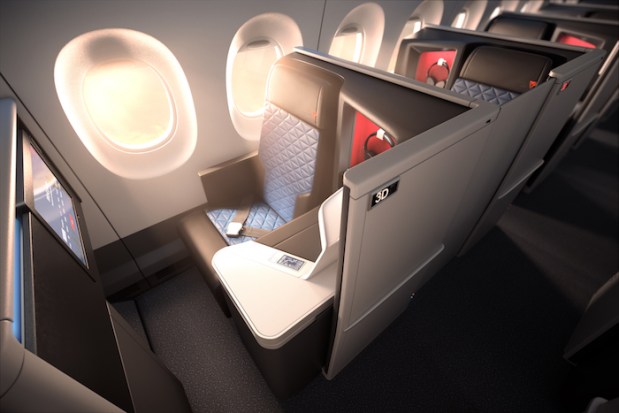
I suppose the most direct comparison would be with Delta One, since they’re both US legacy carriers. I flew Delta One on an A330, which is Delta’s current flagship product, a reverse herringbone seat. (When Delta receives the new A350, they will introduce an upgraded Delta One suite that would probably be my favorite overall product, at least from the looks of it.)
To cut to the chase, I vastly prefer United’s Polaris cabin on the 777 to Delta One on the A330 (this configuration is also available on Delta’s 747, which I haven’t flown). Here’s why:
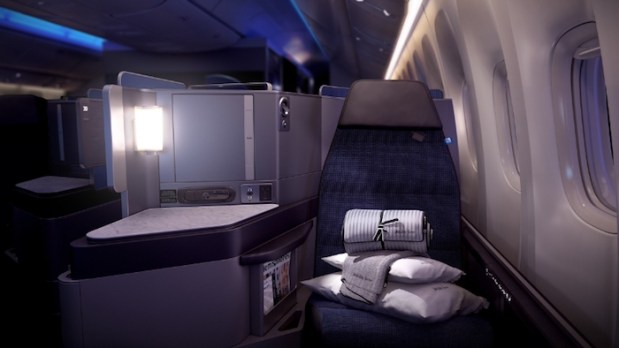
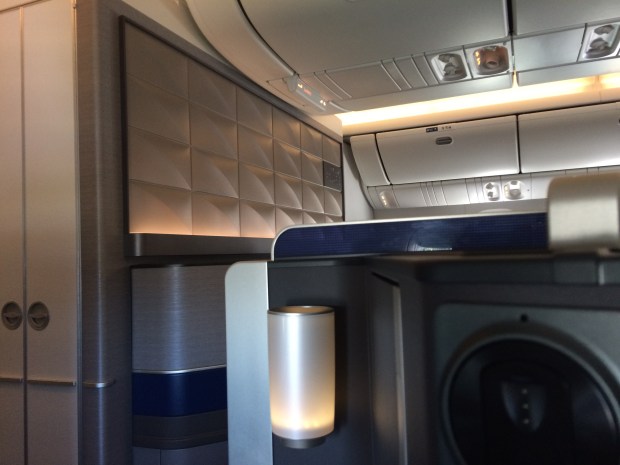
Design – United’s cabin is undeniably sleek with nice, muted finishes and a very considered overall design. Things like the reading lamp, the marble side table, and the storage cabinet are examples of this. Delta’s cabin is very antiseptic, and aside from the smart-looking quilted leather seats, it’s pretty boring.
United’s new seat; image from United.com
Comfort – United’s seat is incredibly comfortable. Before I started flying in premium cabins, I didn’t realize how seat comfort among different products (in terms of ergonomics and cushioning) varies a lot. Leather seats are often pretty hard – this is definitely true for Delta and Virgin America – but you also don’t want a seat that’s too soft, since it will not be sufficiently supportive for a long-haul flight. United’s seat strikes a nice balance between cushion and support and is instantly comfortable upon sitting down.
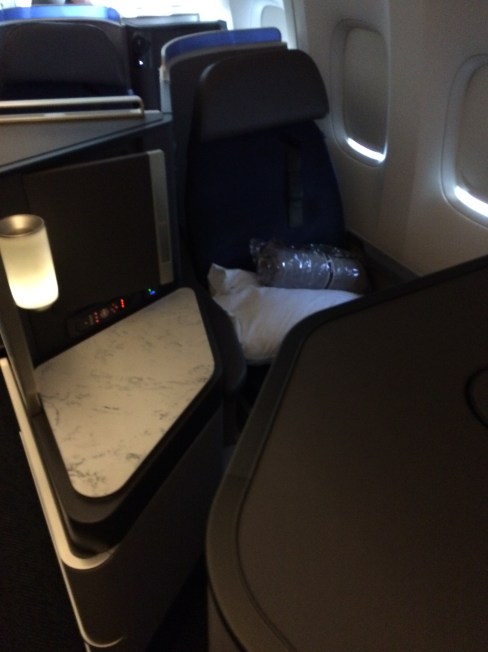
Privacy – I chose a forward-facing window seat, which is the most private configuration in the Polaris cabin. Like the Thomson Vantage XL seat I flew on SAS, this seat has a console along the aisle. The opening is also fairly narrow, so you do feel like you’re in your own private suite for the most part.
This was my seat (9A). The cabin was pretty dark, but you get the idea.
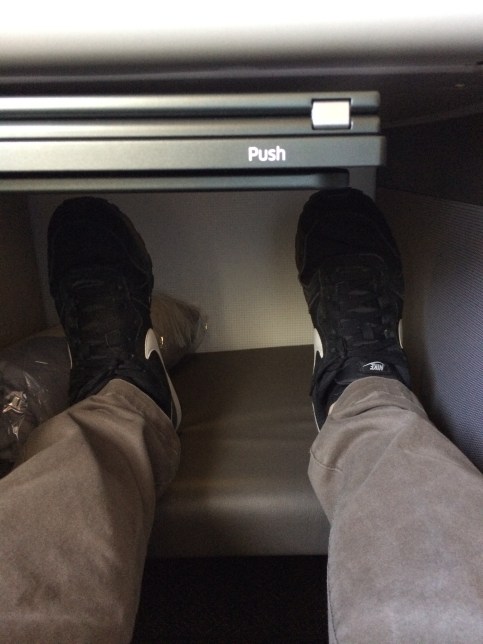
Here’s a photo of my foot in the entryway of the suite, which gives you an idea of how wide it is (not very).
In general, the design of the Polaris seat feels roomier than the sum of its parts. Let’s be honest here – it’s basically a 2-4-2 configuration, since the rows overlap considerably. However, they’ve managed to design the suite so that the space you lose to the passenger behind you doesn’t make the seat feel cramped at all.
I do think it’s funny how there are some people out there who won’t be dissuaded from their hatred of United. In every Polaris review I have read, there’s always at least one guy who says something like, “That looks like garbage from a garbage airline full of garbage and run by garbage people ARGLE BARGLE GAAAAAARBAGE BLEEGHGGHGHG.” As someone with absolutely no reason to heap praise on United for this product, I can say that it is really nice, despite what you may think about United. I suppose it’s fine if people are going to irrationally avoid it, since it means more award availability for the rest of us.
As for which seat you should choose: I highly recommend a bulkhead seat against the window, such as 1A or 9A. 9A is really close to a giant bathroom, although this bathroom was occupied for nearly the entire flight, so you’ll want to be ready for some foot traffic. It’s an impressive bathroom, though – there’s even a full-length mirror on the door. 9A also gives you the benefit of being near the engine, so if you’re an avgeek and like taking photos like this one, you won’t want to be too far toward the front.
The other thing about the bulkhead – foot room. There’s tons of it, and it makes a huge difference in bed mode. Overall, I found the seat pretty comfortable for sleeping – I didn’t actually sleep, but I lay down for most of the flight listening to music, and it was pretty nice. You can see that my size-12 shoes had more than enough room to chillax, which isn’t always the case in business class foot cubbies.
(As a quick aside, notice how the “Push” instruction on the tray table is in the same font as the rest of United’s marketing materials. This is the kind of attention to detail that I can really appreciate – making sure every last little tidbit of the product is reflective of their overall brand identity. Just make sure the tray is pushed all the way in and locked, since it’s really heavy and will slide out and whack you on the knee when the plane takes off. I’m speaking from experience here.)
What didn’t I like? I’m not a huge fan of the leg rest’s shape, which has a cutout to fit around the front of the console. Because of how the seat slides forward as it moves into bed mode, that cutout part really only supports your ankles, meaning you don’t notice how narrow it is. However, in relaxation mode, it supports your thighs, which meant that my right leg kept sliding off. I compensated by trying to keep my legs toward the inner part of the seat, but I repeatedly hit the control wheel, causing my seat to recline further. (Also, I apologize to United for getting my dog’s hair all over the seat. The fabric is pretty grippy (almost like a lint brush), so all the little fur tufts that I carry around with me came right off.)
More importantly, I suppose, is that this seat isn’t representative of the entire Polaris product. Other seats don’t have nearly as much foot room, and only half the seats are this private. I realize that every cabin is going to have a best seat in the house, but in general, I don’t like configurations where only 25% of the seats are desirable, and certain seats are actively undesirable. However, if you’re booking far enough in advance and can get a bulkhead window seat, it’s a really nice product.
Where does it rank among all US carriers? Well, I can’t really speak to it from experience, but knowing my own preferences, I’d say it’s pretty close to the top. To me, it looks nicer than American’s forward/backward configurations, but narrower than the two different reverse herringbone seats that they offer. I do really like a seat with a console between me and the aisle, though, which is one reason the Polaris window seat beats out a reverse herringbone seat. I don’t think that’s enough of a reason to elevate Polaris above the American reverse herringbone seat, though.
As for Delta, as I described above, I like Polaris more than the reverse herringbone seat on the A330, but the new A350 product looks fantastic. It’s basically the Thomson Vantage XL seat with a door, and that’s already my favorite kind of business class seat (even though this is another one where I’d try to avoid 75% of the seats).
I do wonder, though, how United is going to scale it down for the 787 and 767. I’m not backing off my claim that it doesn’t feel cramped, but that doesn’t mean it isn’t a dense configuration, and squeezing the seats together might make the difference between the seat feeling private and feeling claustrophobic. (As another aside, I think it was Lucky who said that the forward-facing window seats feel claustrophobic. I am claustrophobic, and I disagree with this. Even in bed mode, I didn’t feel like I was in a sarcophagus or anything – while you are pretty enclosed, the fact that there is an opening as well as a curve to the console means that you don’t feel too hemmed in. For example, here’s a photo of what the view from your seat looks like. Despite having the console wrap around you, it’s still fairly open.)
Finally, a couple random observations not about the cabin itself:
The flight attendant working my section said she liked the new seats but that there were already some downsides that the crews are complaining about: chiefly that the narrow opening to the forward-facing seats makes it harder to serve those passengers. She also said, “I mean, if you were any bigger, you wouldn’t be able to fit through there.” That’s pretty rude, right? I don’t think she meant it to be rude, but still.
I last flew p.s. on a 757 around a year and a half ago, and the service has improved in certain ways. You get Saks Fifth Avenue bedding – not the whole shebang like on a Polaris flight, but a nice duvet and pillow that are an improvement over what they used to offer. Also, you now get a scaled-down amenity kit (which, most importantly, includes Cowshed lip balm), rather than the flight attendant passing through the cabin with a basket of amenities. The food was decent, too – much better than either Delta One or SAS (although don’t forget that I’m specifically talking about the specialty vegan meal, which is something United has always done pretty well).
What does everyone think? Is Polaris just a bunch of stupid garbage coughed up by garbage heads, or are you looking forward to trying it out? I’m honestly surprised how much I enjoyed it – I’ll get into this in a future post, but I actually preferred it to the Mint Suite that I flew back home. It’s more spacious and comfortable than it looks from photos, and while I was expecting it to feel constrictive, it makes use of the space so well that it feels just as roomy as a less dense configuration. I’m sure it doesn’t compare to a true 1-2-1 reverse herringbone on a 777, but it has to be pretty close.
Not much needed here beyond the title. I guess I could have just tweeted this, instead of making an entire blog post about it.
Anyway, since I have two Amex Platinum cards (a standard one and a Mercedes Benz one), I added both of them to my Uber account and instantly saw $30.00 in credit sitting there. Obviously this isn’t a reason to keep both open in perpetuity, since the credit won’t come close to covering the additional fee, even after using up the airline credits. Still, for the few months I have both cards, it will be nice to get $30 per month to use on Uber rides (or Uber eats).









 Windbag Miles