Disclaimer: My disclaimer isn’t copying the links correctly since I’m posting from a mobile device while I’m on vacation, so here’s the short version. Trump is terrible, go to an earlier post to find out links that you can donate to, and don’t bother disagreeing with me, because I don’t care.
There are a few reasons I love Virgin America first class that are personal to me, but that’s my favorite kind of review to write: one that only applies to me and has no relevance to anyone else. So here I go… A bunch of years ago, my phobia of flying was so bad that the thought of having to fly sent me into a panic attack. I still deal with being scared of flying – which makes sense given my chosen hobby, clearly. I’ve put more work into not being scared of flying than almost anything else I’ve ever done in my life – for a few years, it was like a second job, working every day for a couple hours trying to beat it. I’m sure I’ll write more about why I have a fear of flying and what I’ve done to combat it, because I bet that’s something that might actually be useful to people. I’d at least like to show anyone who’s embarrassed about having a fear of flying that I have it too, so let’s be embarrassed together. That’s beside the point of this post, however. (Although not too beside the point, given that I’m currently writing this on a Virgin America flight to Hawaii that’s one of the bumpiest flights I’ve had in years, and I’m stable enough mentally to write a blog post. Pat on the back to me.)
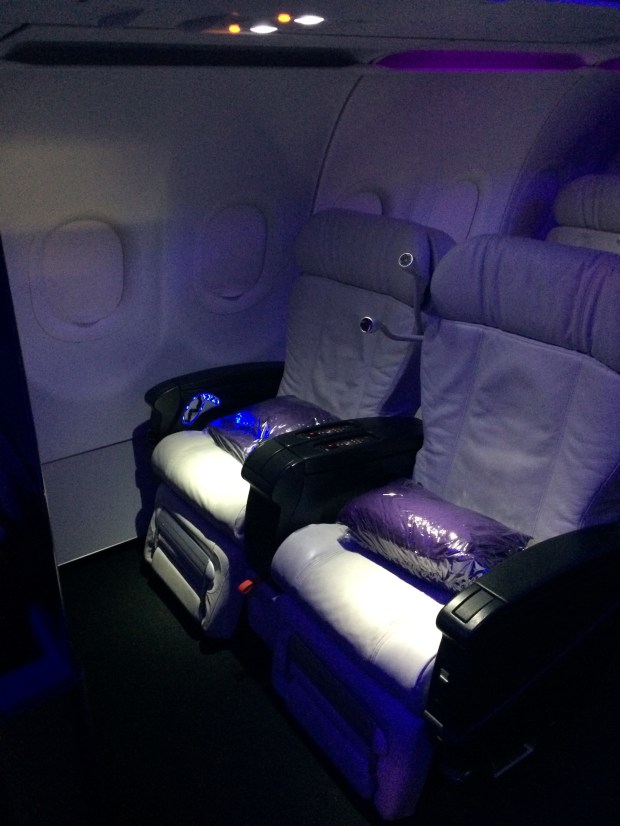
Back to 2010, when the idea of flying to me was like the idea of putting your leg in a bear trap to anyone else. I had to fly to Boston for work, and there was all kinds of weather for the flight home. I was freaking out thinking about the 7 hour flight back (headwind, yo), but to my luck, there were first class upgrades available for $199, which is way less than they sell for now. Even though I didn’t make very much money back then, I jumped on it and figured that at least the flight would be more bearable if I weren’t so crammed in for 7 hours. I was also new to using benzodiazepines to manage anxiety, and so I ended up taking WAY too much Ativan, and I was out for most of the flight. I remember it as this white leather cocoon of safety and security as I drifted in and out of consciousness, and the poor flight attendants had to wake me up at the end because I was the only person still on the plane. Ever since then, the idea of Virgin America first class has always carried this soothing, calming aura. I love it, even on short flights. Sitting in 1F (my preferred seat), even if I’m anxious about the flight, I feel like I’m in control and in my happy place.
Also, the layout of the cabin is great if you’re flying with someone. The bulkhead seats have tons of room in front of them, so you and your companion get a pretty good chunk of uninterrupted space. The fact that the bulkheads are made out of tinted plastic makes the space seem even bigger, since it doesn’t feel walled in at all. Finally, the way the seats are positioned in the cabin leaves some extra space between the wall and the window seat. This is really subtle, but having extra space on the side without crunching up against the wall just adds to the sense of spaciousness. Whoever did the design did a fantastic job.
Of course, there are some cons – most notably that the seats aren’t great when your flight is dragging into the fifth hour and you can’t fall asleep because the seats don’t quite go flat enough for you. (Unless you’re on drugs, which I try to take in very small doses or not at all unless I’m having a really bad day.) As much as I love the layout, it’s true that Virgin doesn’t really compete at the same level on routes where others fly flat beds. Still, though, it’s a trade off, because the lack of privacy on Virgin really makes the first two seats feel like “our space” when I’m traveling with my wife. I don’t get that as much in more modern business class products, although I realize in general that privacy between seats is pretty important in a lot of cases.
Finally, the food on Virgin is consistently good, and I don’t even have to order a separate vegetarian meal. I even took a picture of the cream of mushroom soup, because I thought it was funny how absolutely disgusting it looks. But it tasted good! Also, dinner service was delayed because of the turbulence, so by the time I got the soup, I was feeling just the slightest bit queasy from 90 solid minutes of bouncing. Cream of mushroom soup seemed a wise choice at that point, given that I ate it during a short period of relative calm before the rocking and rolling started up again. Fingers crossed I don’t see it again in the other direction, since there are around 90 minutes left and it ain’t showing any signs of calming down.
Would you eat that mushroom soup? Is there anything I could have done to make it look more disgusting? What’s your take on Virgin first class. Are there any airlines or in-flight products that you have sentimental attachment to?
Disclaimer: We’re dealing with a political situation that makes it borderline crass to talk about first world problems like which first class is best or how to avoid <GASP> flying in economy when there are people who would strap themselves to the wing of a plane just to find refuge in this country if they could. That being said, I also believe that people can think about more than one thing at once, and that me writing about luxury travel and capitalist trappings like credit card loyalty programs is not going to trade off with the volume of necessary journalism devoted to covering current events. However, I would encourage you to support organizations that help refugees, the ACLU, or independent journalism outlets such as the New York Times, Washington Post, or The Guardian, all of which need all the financial support they can get right now. Finally, if you didn’t come here to hear about my politics, then leave, because I’m not going to hold back just because “this is supposed to be a points and miles blog.”
That’s it, I’m fed up with the advice that you shouldn’t try to get more points than you need. Too many people say it, and it’s a terrible idea. It’s true that hoarding for its own sake is dumb – obviously you should use your points to travel, rather than avoiding trips in order to preserve your balance. However, if you’re like a lot of people and only take big trips a couple times a year, you’re likely to earn a lot more than you burn. The argument is that, because miles can only decrease in value, you want to minimize how many miles you’re holding, because they’ll never be worth more than they are today. There’s one major problem with this argument: points earning opportunities deteriorate faster than miles devalue. Your miles will be worth more post-devaluation than if you had nothing at all.
Let’s look at a specific scenario. Assume you’re like me and barely ever fly American airlines. As a result, you’ve never paid much attention to AAdvantage. Two years ago, Citibank had increased bonuses on a couple of AAdvantage cards, and it was possible to earn 155,000 miles in a fairly short period of time. Then AAdvantage devalued – let’s put a round number on it and say the points became 20% less valuable. Now, anyone who took advantage of those limited-time bonuses has an account full of points, but the purchasing power is lower now – it’s equivalent to 124,000 “net points” (that’s 20% off 155,000).
I didn’t take advantage of any of those deals, because I ignored American Airlines altogether. I didn’t want to hoard a bunch of points, and I was proven right in terms of the conventional wisdom when the big devaluation happened. But let’s imagine I now need 124,000 AAdvantage miles for an award I want to book. How do I get there? Citi has imposed a 24-month restriction on receiving the sign-up bonus within a card family, not just per card. Even if they did offer increased bonuses on AAdvantage cards, I’d only be able to get one every two years. That means that, because I waited, I have a much harder path to the post-devaluation net points I would have had if I had decided to hoard points. It’s for this reason that I jumped on the Barclay Aviator Red offer, since 40,000 points for no minimum spend is a great deal. Who knows how long this offer is going to be around – maybe forever, but maybe it goes away in a couple months. Either way, I now have a stash of 40,000 AAdvantage miles that may lose value over time, but it won’t go to zero.
Additionally, there’s no evidence that increased offers necessarily follow devaluations. Customer acquisition is up to the banks, which are buying the miles at a set price from the airlines. Devaluations are up to the airlines based at least in part on the amount of miles in circulation. It stands to reason that as programs become devalued, consumers would require more miles in order to open credit cards, but I don’t think the general customer for these cards understands the relative value of airline miles in this much detail, and I do think banks realize this. Otherwise you would have seen Citi offer way bigger bonuses on AAdvantage cards after the devaluation, and they didn’t. That’s why there’s really no reason to wait until after a devaluation to apply for big bonus, since there’s no guarantee you’ll be able to apply for it at all.
The bottom line is that it’s harder now to earn AAdvantage miles than it was before Citi imposed their restrictions, so even people who had no immediate use for AAdvantage miles are still doing better than someone who waited because they were told not to accumulate more miles than they thought they would need.
Also, raise your hand if you’re so good at forecasting your travel habits that you always know exactly how many miles you’ll need. I certainly can’t. In fact, when I first started the blog, I had a page about where I was planning to take trips, and how I was going about earning the points to get there. Problem was, it was out of date within a few weeks. Things are always changing, and sometimes trips come out of nowhere. I just booked a trip to New York, and thankfully I had a big stash of JetBlue points that I could use on a Mint seat for the return leg. Conventional wisdom would have told me not to invest my time and money taking a round-trip JetBlue flight in order to qualify for the 75k points match promotion, but I did it on the chance that my plans changed and I all of a sudden had a need for the points.
What about 5/24? This is one area where people who were slow and steady were rewarded by being able to apply for the 100k Sapphire Reserve offer (or 80k Ink Preferred offer, or 85k Marriott offer, but – importantly – not all three). However, for people who are so detail oriented as credit card churners, I think people were blinded by all the zeroes in the Sapphire Reserve bonus. (After all, 70k Ink+ bonuses were not uncommon, and people weren’t absolutely losing their shit over that, even though it’s nearly as good.) Let’s say you moved really slowly, and you got a 40k Sapphire Reserve and a 15k Freedom offer (since that’s the combo everyone recommends), plus a 70k Ink+ offer and a generic 50k offer from another bank. Then the Sapphire reserve was the fifth card in two years, bringing the grand total up to 275,000 points. That’s a lot! But have you earned more than 275,000 points in the past two years? Probably. And that scenario above assumes no hotel co-brand cards, no airline co-brand cards, and only one Amex. That customer didn’t have the flexibility to jump on the 100k Platinum bonus when it was around for a couple days, because they were playing it really slow and steady in order to get the Sapphire Reserve bonus.
I got lucky in that I was able to get the Sapphire Reserve bonus anyway, but I would still trade it for all the other points I’ve raked in by not trying to limit applications and stay under 5/24. I also was aggressive with cards (such as the Ink+) that were rumored to go under 5/24 in the future, even though I didn’t immediately need the points from those either. Good thing I did, since I get a lot of value out of the Ink’s 5x categories, and those would be closed to me now if I had waited.
Additionally, the introduction of the Sapphire Reserve highlights a rare instance in which the value of points actually does increase, since they can be redeemed for 1.5 cents toward travel. That means that anyone with a big stash of Ultimate Rewards points suddenly had more purchasing power for their points than before that card was introduced. The enhancements to the Amex Business Platinum card are another example of this, where all of a sudden points were worth 2 cents toward first class airfare.
Finally, there’s the case of the SPG/Virgin/Alaska menage-a-trois that just happened. A 50% bonus on purchasing SPG points, a 20% transfer bonus to Virgin America at 1:1, and a 1.3x conversion rate to Alaska made for some very cheap Alaska miles. I don’t have any plans to use a bunch of Alaska miles, but I wanted to get in on this, because I was afraid the opportunity would dry up. And it did, pretty quickly, when SPG suspended transfers to Virgin. As for the transfer to Alaska, I probably could have held onto the Virgin points, but I didn’t want to risk the ratio changing suddenly. Plus, I’m a lot less likely to need points in the scenarios where Virgin represents a better value than the other way around, so I was willing to sacrifice flexibility in exchange for certainty that I’d get the full 1.3x transfer ratio. In the end, I spent $525 on a bunch of Alaska miles I didn’t need right away, but it seemed like a good opportunity at the time, and now that opportunity is gone.
Bottom line is that I hoard points (or more accurately, I collect points without an immediate use in mind), and I don’t think it’s the wrong thing to do. I have six-figure balances in both Alaska and Delta with no immediate use in mind, so I’m definitely at risk of a devaluation. Still, like I keep saying, those points will always be worth more than no points. Clearly the best way to get value out of your points is to earn when the bonuses are high and then burn before the excess supply of miles prompts a devaluation. However, if you don’t have opportunities to burn, I absolutely don’t see that as a reason to deemphasize earning.
Who agrees with me? And who thinks I’m dumb for exposing myself to so much devaluation risk? Who thinks I’m dumb in general?
Disclaimer: We’re dealing with a political situation that makes it borderline crass to talk about first world problems like which first class is best or how to avoid <GASP> flying in economy when there are people who would strap themselves to the wing of a plane just to find refuge in this country if they could. That being said, I also believe that people can think about more than one thing at once, and that me writing about luxury travel and capitalist trappings like credit card loyalty programs is not going to trade off with the volume of necessary journalism devoted to covering current events. However, I would encourage you to support organizations that help refugees, the ACLU, or independent journalism outlets such as the New York Times, Washington Post, or The Guardian, all of which need all the financial support they can get right now. Finally, if you didn’t come here to hear about my politics, then leave, because I’m not going to hold back just because “this is supposed to be a points and miles blog.”
The Points Guy had an article today on why you should go to the Faroe Islands. I was happy to see the Faroe Islands written about on such a highly-trafficked blog, because it really is an amazing place to visit. However, for a site about points (well, technically it’s a site about a guy who’s known for his points), the article doesn’t go much further than what you’d see in a 1/3-page sidebar in Condé Nast Traveler magazine. Since I love the Faroe Islands and feel really passionately about this subject, I figured I might as well provide some additional info.
(By the way, the four or five people who could be considered “longtime” readers might see me repeating myself a little bit, since I’ve mentioned some of this stuff in previous posts. This will bring everything into one master post that you can use for future reference.)
Windbag in paradise.
Intro: Deciding to go
I first heard about the Faroe Islands from Whale Wars, since they did a mini-season about their campaign in the Faroes in between fighting Japanese whalers in the Arctic. However, unlike in Japan, the Sea Shepherd people were allowed to go on-shore in the Faroes, and so the season gives you a much more balanced sense of who the Faroese people are and why they whale. Clearly I’m not going to the Faroes to eat whales (I’m not going there to eat any meat at all), but I don’t think you can shun an entire country based on cultural practices you may not agree with. Plus, I kind of agree with the Faroese people’s argument that there’s a lot of animal abuse that goes down in the USA for us to take the moral high ground. We don’t need to have a debate about whaling here – clearly, if you feel really strongly about it, don’t go there.
Anyway, one thing Justine and I kept remarking on while watching Whale Wars is how jaw-droppingly beautiful the Faroe Islands are, and how much we wanted to go. Which is kind of funny, given that I don’t think Sea Shepherd intended their campaign against the Faroese to advertise for the Faroese tourism industry, but it certainly did for us. I actually didn’t know how easy it was to go there until I was browsing Google Flights in map mode and kept seeing Vagar come up as a non-stop destination from places like Copenhagen and Bergen. We were in the process of planning a Europe trip at the time, so it was pretty easy to set aside a few days for a trip there.
Should you go? If you love scenery, secluded places, cold & rainy weather, and sheep, then yes. If you love bustling metropolises, beaches, warm & sunny weather, and whales, then no. Considering the latitude, you may not want to go in fall or winter, either. The days get pretty short, although when I was there in mid-September, sunrise and sunset were still at relatively “normal” times.
Getting there
The Faroes are served from a few destinations by their national airline, Atlantic Airways. You can fly from Reykjavik, Bergen, Edinburgh, and Copenhagen, among others. Atlantic took on three A319s fairly recently, so it’s nice that all service is on a mainline jet rather than a crappy prop plane.
In an interesting development for points people, SAS also started flying to Vagar from Copenhagen, which means that Vagar is now a recognized Star Alliance destination. It’s sometimes hard to get Star Alliance booking engines to route all the way there, but it can be done. Being able to book all the way to Vagar would have saved me some money on my last trip, given that the cheapest CPH-FAE fares are around $225 for a round-trip. This also opens up some options for intra-Europe flying if you’re basing in a city other than Copenhagen. For instance, if you start your trip in Amsterdam, you can fly to FAE via CPH on SAS, which is easier and cheaper than, for instance, flying KLM to CPH and Atlantic to FAE. This would come in handy if you used Sky Miles to fly from the US to Amsterdam, especially if Delta’s engine choked when you asked it to give you a stopover in AMS and then fly you onward to CPH.
Where to stay
There’s one luxury hotel that I know of, just outside Torshavn (the capital). The airport is actually on a different island, since there aren’t that many places in the Faroes that are flat enough to put a runway capable of handling a full-sized plane. It’s around 45 minutes drive from the airport to Torshavn, and public transportation is pretty easy.
There are a number of serviceable hotels as well, most of which are in Torshavn or Klaksvik, although I’d strongly recommend renting an AirBNB instead. Tons of people own vacation homes here, so it’s pretty easy to get an entire house in a remote village. There are also rentals for in-law units, which are nice if you want to interact more with your hosts. We stayed in a cottage in Funningur, which I can’t say enough good things about. It’s on AirBNB, but it also has its own website.
Getting around
I recommend renting a car, even though the bus system is pretty good. One amazing thing about the Faroes is that the roads are pretty much universally smooth and in great condition. The only exception is if you try to drive out to depopulated villages (such as Mulí), but as long as someone’s living in the place you’re going, the roads will be nice. Since the Faroes aren’t very big, it’s really hard to get lost, so it’s fun just to drive around looking for what we called “flower roads” – road signs with a flower signify a scenic route.
The road to Mulí, which was abandoned in the last few years.
The problem for points people is that no portals that I know of will find you cars here. If you’re looking to conserve cash, this would be a good opportunity to use Ultimate Rewards points at 1.5 cents per point, or maybe proprietary points in less common programs, like City National Rewards. I tried every rewards program I have, though, and none of them were able to locate any cars. Also, I’m man enough to admit that I don’t know how to drive a manual, so that narrows it down even more. There are a bunch of rental car companies that operate out of Vagar airport (Avis, Sixt, Europcar, etc), but all of them contract with one main service – 62 North. If you want to rent an automatic, it will be around $100 per day. Manuals are less, but still comparatively expensive.
Maximizing points
I’m going to assume that you used points at least to get as far as Copenhagen, so we’ll start there. If you need to overnight at CPH, I actually really liked the Hilton CPH airport, and if you have gold status, they’ll upgrade you to a pretty nice room. It’s not the cheapest hotel, but I got a room for 20,000 Hilton points plus $100, which worked out to almost .7 cents per Hilton point. If you’re flying Atlantic to get to Vagar, you’ll have a good opportunity to use the $250 airline credit from the Citi Prestige card (I did, and the credit posted without issue). You can also book the SAS flight through United, meaning you can use gift registry credit that you built up from the incidental fee credit on your Amex card.
You can book hotels using a rewards portal; unfortunately there aren’t any chains to redeem points at. (What an ironic sentence I just typed… in any other context, the absence of chain hotels would be a great asset for any destination.) However, if you go the AirBNB route, you’re best off paying cash, at least until they partner with Chase and allow you to book using Ultimate Rewards points (fingers crossed).
As a result, planning a trip to the Faroes is a really good reason to look into a card that earns fixed-value points like the Barclay Arrival+ or whatever that PNC travel rewards card is called. Capital One has one too. (You can tell how much I care about this type of card product by the specificity with which I’m talking about them.) The bonus on the Arrival+ and PNC cards combined is worth $800, although you’ll have to spend $6000 to get there. Still, if you’re set on flexible points for the time being, cards like this can save you a decent amount of money. Combine it with a checking account bonus from whoever is offering one in any given week, and you’ll pay for a nice AirBNB cottage for a week.
As far as earning points while you’re there, it’s really no different than anywhere else you’ll travel. Credit cards are pretty widely accepted, although it’s still a good idea to have cash on hand. (The currency is Danish kroner, but the Faroe Islands have their own bills, which are interchangeable with Danish ones.) Oh, and I wasn’t worried about having too much cash at the end of the trip, since CPH airport has some pretty damn good whisky available in Duty Free, so I knew I’d have an opportunity to liquidate whatever money was left over (no pun intended).
Final thoughts
I was only there for a few days, which means I didn’t get to do some of the stuff I wanted to do the most – especially hikes to the Enniberg sea cliff and Kallur lighthouse. Next time for sure. Still, you can really see a lot in a few days, given how easy it is to get around. (For reference, driving from the airport to the northernmost settlement, Vidareidi, takes under two hours. BTW, I’m not sure how to pronounce it, but vidd-are-ay-dee is not even close.) Given its proximity to the rest of Europe, you shouldn’t feel like you need tons of time to explore here. We blocked out four days, and while I want to go back for longer, we didn’t feel like we had massively missed out on anything due to the length of our trip.
Leaving here was tough, and not just because it was six AM when we got in the car to drive to the airport. We both agreed before we even left that we’d be back on our next trip.
Disclaimer: We’re dealing with a political situation that makes it borderline crass to talk about first world problems like which first class is best or how to avoid <GASP> flying in economy when there are people who would strap themselves to the wing of a plane just to find refuge in this country if they could. That being said, I also believe that people can think about more than one thing at once, and that me writing about luxury travel and capitalist trappings like credit card loyalty programs is not going to trade off with the volume of necessary journalism devoted to covering current events. However, I would encourage you to support organizations that help refugees, the ACLU, or independent journalism outlets such as the New York Times, Washington Post, or The Guardian, all of which need all the financial support they can get right now. Finally, if you didn’t come here to hear about my politics, then leave, because I’m not going to hold back just because “this is supposed to be a points and miles blog.”
I posted the other day that the Alaska/Virgin merger has opened up all kinds of first class transcon saver availability (25k Mileage Plan miles each way). Compared to booking the same flight with Virgin America points, that represents nearly a 50% reduction once you transfer those points to Alaska. Given that United and American are really stingy with transcon saver awards, this is a good back-pocket option to have.
After I wrote the post, I started wondering about other Virgin routes that might open up the same possibilities. Hawaii sprang to mind, because first class awards are a real pain in the ass and often very expensive. SFO-BOS is a longer flight than SFO-Hawaii, but you still pay 40,000 Mileage Plan miles for a saver award to Hawaii. I planned a trip to Hawaii last year and was at a loss for how to get there in first on miles, and my budget for the trip wouldn’t allow for me to buy the seats outright. That left a number of sub-optimal mileage options, since 40k per leg was the best I could find. I ended up booking two round trips on Virgin using Virgin America points transferred from SPG for one ticket and then burning around 90,000 ThankYou points at 1.3 cents per point for the other one. It hurt pretty bad to burn that many of my hard-won Citi points, especially because they announced their fuckin 24-month restrictions soon afterward. (The saving grace, however, was that JetBlue did their insane points match promotion right around the same time, so those 50,000 Virgin points also generated 75,000 JetBlue points. That means that 40,000 SPG points became Virgin points worth $1100 and JetBlue points worth $975 – minus $125 for the flight I had to take to complete the promotion – for a total net value of $1950, or 4.9 cents per SPG point.)
Anyway, sorry to bury the lede, but Hawaii availability through Mileage Plan still sucks. Unfortunately, the transcon magic hasn’t repeated here, as every Virgin flight to Hawaii is loaded into Mileage Plan at 80,000 points per leg. Ouch… depending on the fares, that’s at least twice what you’d have to spend in Virgin points. Alaska is pretty good about opening up availability on their own flights at 40k a pop, but I still think that’s high. Given the higher quality of Virgin’s product, 40k is a little more reasonable, especially if the calendar was wide open for that amount, since it would be a lot easier to plan travel that way (as opposed to using Virgin points and having to adjust your travel dates to the days with the lowest fares).
Oh well… It would have been nice if the merger had opened up options to Hawaii, but no such luck.
Disclaimer: We’re dealing with a political situation that makes it borderline crass to talk about first world problems like which first class is best or how to avoid <GASP> flying in economy when there are people who would strap themselves to the wing of a plane just to find refuge in this country if they could. That being said, I also believe that people can think about more than one thing at once, and that me writing about luxury travel and capitalist trappings like credit card loyalty programs is not going to trade off with the volume of necessary journalism devoted to covering current events. However, I would encourage you to support organizations that help refugees, the ACLU, or independent journalism outlets such as the New York Times, Washington Post, or The Guardian, all of which need all the financial support they can get right now. Finally, if you didn’t come here to hear about my politics, then leave, because I’m not going to hold back just because “this is supposed to be a points and miles blog.”
I posted the other day that the Alaska/Virgin merger has opened up all kinds of first class transcon saver availability (25k Mileage Plan miles each way). Compared to booking the same flight with Virgin America points, that represents nearly a 50% reduction once you transfer those points to Alaska. Given that United and American are really stingy with transcon saver awards, this is a good back-pocket option to have.
After I wrote the post, I started wondering about other Virgin routes that might open up the same possibilities. Hawaii sprang to mind, because first class awards are a real pain in the ass and often very expensive. SFO-BOS is a longer flight than SFO-Hawaii, but you still pay 40,000 Mileage Plan miles for a saver award to Hawaii. I planned a trip to Hawaii last year and was at a loss for how to get there in first on miles, and my budget for the trip wouldn’t allow for me to buy the seats outright. That left a number of sub-optimal mileage options, since 40k per leg was the best I could find. I ended up booking two round trips on Virgin using Virgin America points transferred from SPG for one ticket and then burning around 90,000 ThankYou points at 1.3 cents per point for the other one. It hurt pretty bad to burn that many of my hard-won Citi points, especially because they announced their fuckin 24-month restrictions soon afterward. (The saving grace, however, was that JetBlue did their insane points match promotion right around the same time, so those 50,000 Virgin points also generated 75,000 JetBlue points. That means that 40,000 SPG points became Virgin points worth $1100 and JetBlue points worth $975 – minus $125 for the flight I had to take to complete the promotion – for a total net value of $1950, or 4.9 cents per SPG point.)
Anyway, sorry to bury the lede, but Hawaii availability through Mileage Plan still sucks. Unfortunately, the transcon magic hasn’t repeated here, as every Virgin flight to Hawaii is loaded into Mileage Plan at 80,000 points per leg. Ouch… depending on the fares, that’s at least twice what you’d have to spend in Virgin points. Alaska is pretty good about opening up availability on their own flights at 40k a pop, but I still think that’s high. Given the higher quality of Virgin’s product, 40k is a little more reasonable, especially if the calendar was wide open for that amount, since it would be a lot easier to plan travel that way (as opposed to using Virgin points and having to adjust your travel dates to the days with the lowest fares).
Oh well… It would have been nice if the merger had opened up options to Hawaii, but no such luck.
Disclaimer: We’re dealing with a political situation that makes it borderline crass to talk about first world problems like which first class is best or how to avoid <GASP> flying in economy when there are people who would strap themselves to the wing of a plane just to find refuge in this country if they could. That being said, I also believe that people can think about more than one thing at once, and that me writing about luxury travel and capitalist trappings like credit card loyalty programs is not going to trade off with the volume of necessary journalism devoted to covering current events. However, I would encourage you to support organizations that help refugees, the ACLU, or independent journalism outlets such as the New York Times, Washington Post, or The Guardian, all of which need all the financial support they can get right now. Finally, if you didn’t come here to hear about my politics, then leave, because I’m not going to hold back just because “this is supposed to be a points and miles blog.”
I was reading this post on Doctor of Credit (by sirtheta, who has been sending this blog a bunch of traffic by linking it on Reddit, so you know obviously I’m biased and nothing I say or will ever say means anything), and something occurred to me. In the past, I’ve defended Amex by saying that, even though they have their annoying once-per-lifetime policy, they also offer more opportunities to incrementally earn bonus points than any other issuer. The fact that they offer so many cards, and that they don’t seem to mind people having up to nine at a time (although they’ll only let me have eight) further multiplies these opportunities. Their card referral program is one of these opportunities, especially when they offer deals like 7500 bonus points to refer someone to a no annual fee card.
I phrased the title of this post as a question, because I honestly don’t know, and I’m also not sure if I want to poke the bear and risk getting banned. Maybe Vinh over at Miles Per Day will do it a bunch of times and report back! The theory here is as follows:
Activate two-player mode (ht: Reddit) by making your spouse, long-term partner, or nearest oblivious family member a party to your churning habit.
Refer your spouse and collect the sign-up bonus when they get approved.
Cancel your card a little while later.
Have your spouse refer you and collect the sign-up bonus when you get approved.
Have your spouse cancel their card a little while later.
And on and on into oblivion.
On face, it sure seems like this is a way to milk small bonuses out of cards that you’ve had before, basically by giving the bonus to the person sitting next to you on the couch and eventually pooling your points (which Amex makes super easy, since you only need to be an authorized user on one of your spouse’s cards in order to transfer their points to your loyalty accounts). There’s a big reason you may not want to do this, though (in addition to risking a ban) – it costs you a hard credit inquiry for a nominal reward. More and more, banks are starting to care when you have too many inquiries, and even though BofA and Barclay haven’t instituted hard and fast rules like 5/24, there are reports of people getting rejected for cards for having too many inquiries. Even worse, shit-trench banks like Comenity (Comeniturd? Cockmenity?) might approve you for a card and then revoke your approval after a manual review of your credit file. It depends on how much you care about counting your inquiries… if you churn Amex’s referrals a few times a year (spreading the inquiries out between you and your spouse), it won’t matter much, but people in this game can be kind of crazy, and I wouldn’t be surprised to see someone over on Reddit complaining that they can’t get any cards anymore because they opened and closed 36 Amex cards in three months.
Most importantly, Amex’s terms and conditions for referrals specifically mention the other person not being eligible if they currently have the card; however, the dreaded “have or have had” language is absent. See for yourself (emphasis added):
This offer is available online only to Basic Card Members. Please allow 6-8 weeks for the Referral Bonus to post to your account after each referred individual is approved for the Card. You cannot earn a Referral Bonus for those who currently have the Card you recommended or for individuals who have been referred by someone else. Due to the confidential nature of the credit approval process, you will not be notified of whether we approve or decline any application(s) from individual(s) you refer. Also, the individuals you refer may not receive the referral e-mail if they have previously “opted out” of receiving e-mail marketing communications from American Express. Any violation or abuse of this program may result in the forfeiture of the Referral Bonus. In order to receive the Referral Bonus, your account must be active and in good standing at the time of fulfillment. Terms & restrictions of the rewards program corresponding to your Card account apply. NOTE: The value of the Referral Bonus may be taxable income to you; you are responsible for any federal or state taxes resulting from the Referral Bonus. Please consult your tax advisor if you have questions about the tax treatment of the Referral Bonus.
To me, that means that you could volley a card like the Premier Rewards Gold and do pretty well. Consider: year 1, you have the card and refer your spouse; you get 10,000 points and they get 30,000. Year 2, you cancel your card and repeat the inverse. Year 3, you go back to year 1. Since Amex waives the fee on this card for the first year, in that three year span, you’d net 30,000 points as a sign-up bonus and 30,000 points in referral bonuses, not to mention $600 in airline credits ($900 if you time it right). Is it worth amassing three inquiries between the two of you for 30,000 points and $900? That’s up to you, but it does represent a way to churn a little bit from Amex even with the once-per-lifetime rule. (Certainly we’re getting into blood-from-a-stone territory, but that’s the world we live in.) Even better, this also requires no minimum spending on your part, so it doesn’t take away from any of your other churning or manufactured spending opportunities.
I might be reaching here… I personally don’t know if it’d be worth the trouble for me to do this, but I may give it a shot at some point just to see if it works.
Disclaimer: We’re dealing with a political situation that makes it borderline crass to talk about first world problems like which first class is best or how to avoid <GASP> flying in economy when there are people who would strap themselves to the wing of a plane just to find refuge in this country if they could. That being said, I also believe that people can think about more than one thing at once, and that me writing about luxury travel and capitalist trappings like credit card loyalty programs is not going to trade off with the volume of necessary journalism devoted to covering current events. However, I would encourage you to support organizations that help refugees, the ACLU, or independent journalism outlets such as the New York Times, Washington Post, or The Guardian, all of which need all the financial support they can get right now. Finally, if you didn’t come here to hear about my politics, then leave, because I’m not going to hold back just because “this is supposed to be a points and miles blog.”
Interesting news today that WOW Air is going to start offering a premium cabin of sorts, kinda like Norwegian already does. It sounds like it’s going to be fairly nondescript 2 x 3 x 2 seating, but that will still make a huge difference on a long flight like the West Coast to Iceland. I’ve flown Norwegian’s premium class, and I loved it. I still maintain that their food is better than what I had from “real” airlines like Delta and SAS, and the seats are about as comfortable as you can get without being flat beds. At 37 inches of pitch, WOW’s seats will be much closer together than Norwegian and more akin to generic domestic first class, but that’s still pretty good given that I expect fares to be lower.
I don’t have a picture of Norwegian’s premium cabin, but this is what Greenland looks like out your window.
And here’s why I suddenly care: I’m convinced at some point that all mileage programs are going to go revenue-based on the redemption side. Part of this might just be me catastrophizing, in that I now have this thing I love, so I invent scenarios in which it gets taken away from me. However, chart-based redemptions offer too many sweet spots where you can get outsized value, and if there’s one thing revenue management departments love, it’s picking off opportunities for customers to get too much value for too little cost. There are times when business class costs approximately 2x what you pay for economy, but there are also times when it’s much higher than that (and other times when the two cabins are surprisingly close in price). The point is that airlines are giving up an opportunity to maximize revenue by fixing the cost of an award seat when its cash price is variable. The opportunity to achieve outsized value may be something the airlines are comfortable offering to their customers in exchange for their loyalty, but if we’ve learned anything in the past few years, it’s that airlines are even more comfortable rescinding perks if they think it’s going to save them money. I also considered that maybe airlines are satisfied with current charts because points have no fixed value, so only the savviest swath of customers redeem points for “what they’re worth,” while the majority redeem for a free flight whenever they have enough points, regardless of the return. However, it seems like the programs could just price that in when they determine the fixed value of a point. (And if they get it wrong, the could always pull a Southwest and change the value.) Delta’s already doing that, and all signs point to them revaluing Sky Miles at $.01 sooner or later. In the end, it seems like chart-based award programs are holdovers from a past era of loyalty, and now that planes are suffocatingly full, there’s an opportunity to steamroll the revenue management quirks presented by traditional loyalty programs without losing customers. And when a few programs do it, people will flock to the programs that don’t, and then those programs will have no choice but to devalue their charts due to the sudden influx of new members trying to redeem miles. It’s all doom and gloom I tell you!
What does this have to do with WOW air? I’m glad you asked. Here’s my point: I consider the cubic-zirconia business classes you see from Norwegian, WOW Air (pending), and even Spirit’s Big Front Seat as my ace in the hole when chartmageddon happens. See, I hate flying economy. I do it if I have to (after all, I’m not made of money over here, at least not until the sweet sweet affiliate marketing revenue starts pouring in), but I really dislike it. Part of it is that I’m severely claustrophobic (almost literally being buried alive in a building collapse will do that to you), and economy seats make flying an exercise in anxiety management. Another part of it is that I’m not a small man, and while I don’t have spillover problems into the seat next to me, an extra couple inches of seat width makes a HUGE difference. I can tell you that I’m so much more excited to take trips when I know I’m flying in first class. It has made an enormous difference in my desire to travel overseas, and when I do travel, it has turned the flying into a fun part of the vacation rather than an ordeal that must be endured. If my business class gravy train is going away due to award charts all getting nerfed, I’ll at least have reasonably priced alternatives to fall back on. And again, they won’t be as good as what I get to enjoy now, but they’ll be better than economy, which is all I really need in order to be happy.
The task then becomes switching my points earning strategy to focus entirely on cash back, and using that cash back to buy reasonable premium fares on ULCCs rather than banking miles and trying to redeem them for saver business class awards. It gives me some comfort to know that I have fall-back options just by changing up my strategy, and that I’m not dependent on the airlines’ generosity vis à vis award redemptions. Additionally, the optimistic side of me hopes that business class fares will fall similarly to how domestic first class has fallen here. Rather than an upgrade perk for elites and a massive splurge for everyone else, it’s a modest price premium. That’s fine – with a good cash back strategy, it’s still attainable for someone like me who can’t afford to buy the seats outright. And it’s already starting to happen a little bit, especially on British Airways. Last summer, there was even a window of time when Air France business class was $100 more each way than Air France economy. It’s fairly rare, but I would imagine that you’ll see a lot more price flexibility in business class if airlines aren’t still required to exchange award seats for pre-set amounts of miles.
Who agrees with me? Who thinks I’m a fussbudget who should get over myself and fly economy like the rest of the world? What’s your take on the future of loyalty? Break out the Tarot cards!
Disclaimer: We’re dealing with a political situation that makes it borderline crass to talk about first world problems like which first class is best or how to avoid <GASP> flying in economy when there are people who would strap themselves to the wing of a plane just to find refuge in this country if they could. That being said, I also believe that people can think about more than one thing at once, and that me writing about luxury travel and capitalist trappings like credit card loyalty programs is not going to trade off with the volume of necessary journalism devoted to covering current events. However, I would encourage you to support organizations that help refugees, the ACLU, or independent journalism outlets such as the New York Times, Washington Post, or The Guardian, all of which need all the financial support they can get right now. Finally, if you didn’t come here to hear about my politics, then leave, because I’m not going to hold back just because “this is supposed to be a points and miles blog.”
This post is really timely, since by the time you read this, the increased bonus on the Amex Blue for Business card will have gone away. I guess I was absent the day they talked about not writing about things the day they expire in Blogging 101.
Anyway, a reader posted a comment on a post a few days ago questioning whether Amex is actually awarding double points on all purchases in the first year, which is one of the main benefits of the special offer (up to $50,000 or 100,000 points). Given how Amex is doling out the bonus points here, I figured it was worth a look. Specifically, because they award bonus points per transaction, you can compare your Membership Rewards activity statement with your actual statement and figure out if you’re actually earning everything you’re supposed to earn. Even better, Amex lets you download your rewards activity in a spreadsheet (woo!!!), which means you can set up filters to only see bonus points awarded by a particular mechanism.
In my case, I looked at my statement since I opened the card and then downloaded my Membership Rewards activity for the same date range. I filtered the data to only show “Blue 1X MR Pts on all spd” activity, and I totaled the bonus points awarded. Happily, the total was pretty close to the total amount I’ve spent on the card on everything except restaurants. (Restaurant spend wouldn’t be bonused this way, since restaurants have a separate “Blue 9X MR Pts on all spd” mechanism.) However, the picture wasn’t so rosy when I looked at restaurant spend specifically. I went into my Amex activity and isolated the restaurant category, and then I filtered the Membership Rewards activity sheet to show only the 9x bonus mechanism. Unfortunately, only around half of the transactions that are categorized as restaurants on my statement were actually bonused at 9x. I looked a little deeper, and it looks like there must be some additional layer of data transmitted by the actual restaurant, since all the transactions that didn’t get 9x were at restaurant-adjacent businesses, like cafes, bakeries, and so on. Everything that was an actual sit-down restaurant (or a branded restaurant like McDonald’s) received 9x. (By the way, remember that the Blue gives you one point on everything when your statement closes, which is why these individual points transactions are for 1 additional point or 9 additional points. Combined with the points I earn on my statement, I’m getting 2x and 10x.)
This is good to know if you’re trying to milk every last bonus point out of this card, since you may not want to use it at businesses that aren’t actual restaurants, even if Amex classifies them this way on your credit card statement. You’ll still get 2x for these charges, although you’re missing out on a extra bonus point if you have the Sapphire Reserve. The opportunity cost will be even higher if the Freedom card goes to 5x on restaurants starting in August. I don’t know if I can bother keeping track of which card to use, but ideally I will remember to use the Sapphire reserve if it’s not a “real” restaurant. It also means it’s going to take me longer to hit the $2000 limit and get the full 20,000 bonus points in the first six months.
There’s also a chance that this is a glitch that could be fixed with a call to Amex, but explaining something so in the weeds over the phone is not something I’m interested in doing right now. The good news is that the double points bonus seems to apply to all purchases, so the takeaway is just to pay a little bit of extra attention to what constitutes a restaurant when you use the card expecting 10x.
What about you, newly minted Amex Blue for Business cardholder? Have you run into any issues with bonus points earned with this special offer not posting as expected?
It’s true, I bundled all my available airline credits from my various credit cards together and booked a seat on United’s new 777-300ER during the six-week window when it will be used for SFO-EWR transcon service. This wasn’t the most economical way to get across the country, but it wasn’t bad.
Before I jump in, I’m still wondering whether it’s appropriate to devote mindshare to this kind of stuff right now. It’s been like this since the inauguration, with me ping-ponging between feeling like refugees could give a fuck what I think about United Polaris and that I should just shut up for a while on the one hand, and that it’s not a crime to write about what I’m interested in on the other hand. As I’ve said before, I’m going to cling to my points and miles (to paraphrase Obama) in order to find some measure of comfort while the country is run by a sweet potato casserole that you put in the bottom drawer of the fridge last Thanksgiving and then forgot about until it started to stink up the entire nation. I’ll get to Polaris, but I’m thinking of putting the following disclaimer at the top of my posts for the next little while. If you can put up with advertiser disclosures from everyone else, you can deal with this from me.
Disclaimer: We’re dealing with a political situation that makes it borderline crass to talk about first world problems like which first class is best or how to avoid <GASP> flying in economy when there are people who would strap themselves to the wing of a plane just to find refuge in this country if they could. That being said, I also believe that people can think about more than one thing at once, and that me writing about luxury travel and capitalist trappings like credit card loyalty programs is not going to trade off with the volume of necessary journalism devoted to covering current events. However, I would encourage you to support organizations that help refugees, the ACLU, or independent journalism outlets such as the New York Times, Washington Post, or The Guardian, all of which need all the financial support they can get right now. Finally, if you didn’t come here to hear about my politics, then leave, because I’m not going to hold back just because “this is supposed to be a points and miles blog.”
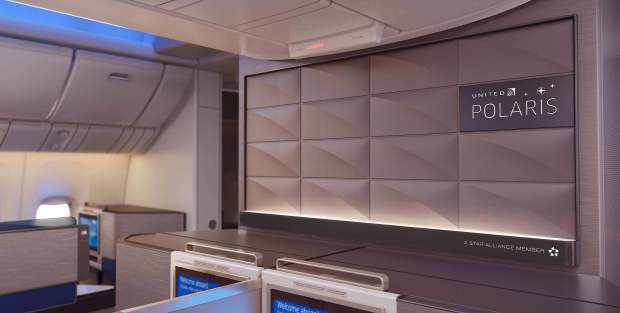
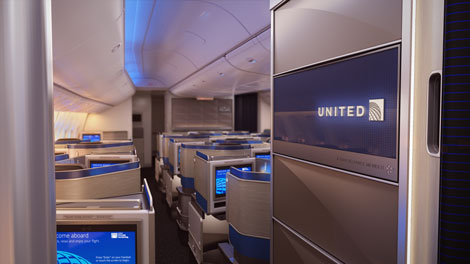
So, Polaris. My thoughts about it. I’ve been leading up to this like I have some dope science to drop, and I really don’t. However, I’ve been thinking a lot about it since I booked my flight last week, and I wanted to give my impression of it before I (or anyone else) has set foot on the plane. (All images from United.)
I don’t think United started marketing Polaris too early. It was never going to be feasible for them to wait to market it until all the planes had been retrofitted, so they might as well trumpet it as soon as they nailed down the timeline of the roll-out. While it might create some confusion having flights in the old seats marketed as Polaris, this isn’t that different from how Delta’s marketing around DeltaOne only shows one configuration (reverse herringbone), when there’s a good chance you’ll fly in a significantly worse forward-facing or standard-herringbone seat. And I’m sure Delta is going to breathlessly market their suite-seats when they come out, even though those will only be on a handful of planes.
I also give United credit for consistency, since American and Delta both suffer from inconsistent long-haul business class products. Some of American’s seats look great, but the forward-backward ones look awful, and I’d be super bummed if I booked a reverse-herringbone seat and got equipment-swapped into one of those. It’s going to take a while to get there, but I appreciate that United is at least trying to be consistent here. I know they won’t get there 100%, since they don’t have plans right now to retrofit new planes like the 787, but in a few years’ time, they should be closer than American or Delta. I’m also curious to see how they shoehorn the seats into a 767, since they already look pretty tight in the 777.
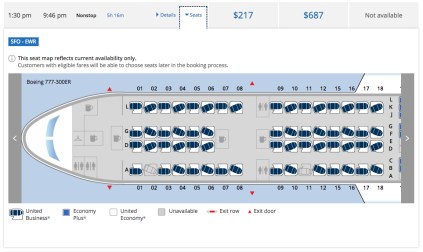
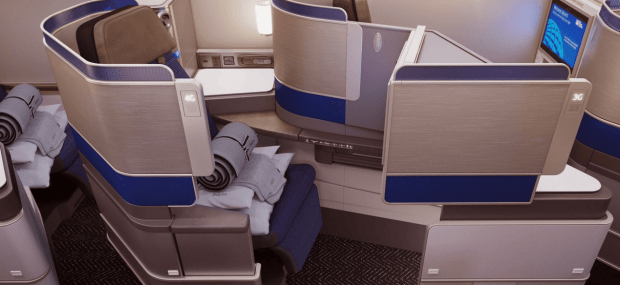
Speaking of the seats looking tight, I don’t think it’s factual to say that they’re in a 1-2-1 configuration. It’s really halfway between 1-2-1 and 2-4-2. Let’s call it 1.5-3-1.5. That’s not confusing at all. Comparing United’s seat map online with the patent drawing of the original design shows how much United is trying to sell it as 1-2-1 when it isn’t. Not to take away what an innovative idea it is, though, as long as they pull it off and the seats are comfortable.
Except this image, which is from Skift.
Speaking of the seats being comfortable, I’m going to guess that the straight seats are way nicer than the angled ones. The angled seats look like they practically dump you into the aisle, and for a product that claims that it’s entirely built around giving you a great night’s sleep, I can’t imagine that the exposure to the aisle is really that conducive to getting rest. On the flipside, the straight seats are really private-looking, kind of like (but not as good as) Apex suites. As long as the Polaris configuration doesn’t make them feel narrow and coffin-like, I think they could be pretty nice.
As a quick aside, one of my pet peeves reading reviews is when the reviewer dings a product because half the seats (or even most of the seats) aren’t great. The Vantage XL seat (think SAS’s new business class) is a good example: half the seats aren’t as good, because they’re right on the aisle. But the seats that aren’t on the aisle are great. So just get one of those seats! Same thing with what people say about Swiss… that’s it’s shitty because Swiss crams 5 seats per row when top-notch airlines go for 4. But there are a handful of throne seats that look fantastic (I’ll confirm this when I fly them this summer), so who gives a crap if most of the seats are bad? Just pay attention to the seat map when you book, and if the only seats are the crappy ones, book another airline. I judge a product based on the best available seat, not the average. After all, I’m not sitting in every seat, so I don’t have to care about the ones I’m not sitting in. I expect a good number of the reviews to ding Polaris based on the angled seats, so I’m just going to say now that you should try to get a straight seat, and then you wont’ have to worry about it.
How much do you care about cabin finishes? I can’t decide how much I care about it, which is code for me saying that I care more about it than I probably should. One of the things I didn’t like about DeltaOne was how sterile it felt. The quilted leather seats look cool, but the rest of the cabin is made out of the same material as a CAT scan machine. It’s so boring, but not in an understated Scandinavian or modernist way, just in a boring way. White plastic with blue plastic trim. Blah sauce poured on a blah sundae with a blah on top. American is marginally better in a folksy, homey way. The wood trim and dark upholstery remind me of a suburban family room, or an upscale psychoanalyst’s office. Still, it’s kind of nondescript and devoid of personality. United really ups the ante in this regard. Of course, the possibility exists that the promotional materials massively overclaim how nice the actual cabin is, and that in reality it’s plasticky and cheap-looking. But from what I can see online, United has applied a particular aesthetic to the entire plane, including the galleys, carpeting, seats, and fixtures. This ties back into the overall consistency of Polaris, and I think it’s something other airlines should aspire to. It’s not just about the seat, it’s about a true “end-to-end” travel experience. I’m really looking forward to seeing the cabin in person, because I’ve been so impressed from what I’ve seen in promotional videos and other advance coverage.
I’m not a United fanboy (I certainly am not going to cheat on KLM in that regard!), but I will defend them for now, since there’s so. much. United. hate. out. there. It’s like people expected them to introduce Etihad-style apartments on their planes or something. I don’t harbor any delusions that United is going to have the best seat – that’s objectively impossible, given that American flies certain planes with 26-inch wide reverse herringbone seats in a true 1-2-1 arrangement. However, I definitely think it’s possible that United has the coolest in-flight ambiance, the most aesthetically engaging end-to-end travel experience, and a very-good-if-not-great seat. Haters gon’ hate, for sure, although I think a lot of it is misplaced antipathy that’s left over from the Smisek era, and it’s probably going to take a while for some people to come around to the idea that United doesn’t actively hate their customers. Fair enough. What I don’t get is when people talk shit about airlines like they’re rival sports teams or something. If United has a great product, it’s not like you’re a New Yorker who’s all of a sudden rooting for Tom Brady (not that I’d compare United to Tom Brady because fuck Tom Brady). I’m digressing (big surprise). Anyway, give Polaris a fair chance, that’s all I’m saying.
I found this image by Googling “Tom Brady Sucks”
Last thing: I’m so fucking excited to go to the Polaris lounge in Chicago. I’m planning to get to the airport 5 hours before my flight so I can take in every aspect. I’m showering, I’m napping, I’m eating, I’m drinking, and if I can save up a number two, I’ll do that too.
I was gonna write a post today, but… for fuck’s sake.
This was at SFO today, where the crowd got so big the police gave up trying to keep us on the sidewalk and let us take over the entire arrivals level outside the international terminal.
If you support what Trump did, get off my blog. I don’t want your xenophobic ass bolstering my stats, and I’m certainly going to delete whatever stupid bullshit you post in the comments.











 Windbag Miles