Atlantic Airways is the national carrier of the Faroe Islands, and Vágar airport (FAE) is their main “hub” (although with three aircraft plus a couple helicopters, it’s pretty low-key). They fly daily to Copenhagen year-round, and they have been expanding their route network in the past couple years, with flights to Reykjavik, Bergen (Norway), Edinburgh, Aalborg and Billund (Denmark) as well as some intriguing seasonal routes to places like Malta or Lisbon. When booking on their website (www.atlantic.fo), you can choose from three fare buckets: Low, Flex, and Flex+. Refreshingly, all three categories offer more service than you get from most European carriers. For instance, Low fares included a checked bag and drink service, and Flex+ fares offer fast track security and lounge access in addition to being fully refundable.
Low fares are usually pretty cheap, and it’s possible to fly each way for under $100 if you book in advance (seat selection costs around $10 if you don’t want to wait until check-in). For schedule reasons, I picked Atlantic on the outbound and SAS on the return, and Atlantic ended up being considerably cheaper, even with the seat selection fee.
Back in the day, Atlantic flew Avro regional jets, but they’ve upgraded since then and fly all routes on one of their three A319/320s. My flight was changed at the last minute to the A320, which is the newest addition to the fleet. I’m not sure what the reason for the change was, since the A319 originally scheduled arrived in Copenhagen in time for the flight. There must have been a mechanical issue or something, since we ended up being delayed for a couple hours while the new plane was fueled up and de-iced.
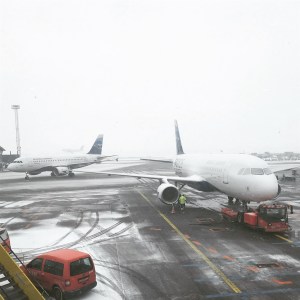
Two thirds of Atlantic’s fleet on a snowy morning in Copenhagen
The interior is in an all-economy configuration with Recaro slimline seats. I’m not sure the exact pitch, but it’s probably around 30 inches. For a two hour flight, these seats are perfectly comfortable, but throw in a 90-minute ground delay and my butt was starting to get pretty sore. The only interesting amenity at the seat is the tablet holder, which I photographed holding the safety card, since it doesn’t fit an iPad Pro.
Here are some pictures of the cabin:
This slideshow requires JavaScript.
Once the plane was splattered with orange de-icing goop, we were ready for takeoff.
Service on Atlantic airways isn’t anything special — the flight attendants were polite, but in a one-class plane, there’s only so much you can do. Still, I appreciated that they made a few passes through the cabin during the flight, first with a drink cart and then a couple more times with coffee. While soft drinks are free, there’s also a farily extensive buy-on-board menu, and because I know how much you care, I photographed every page. I think it’s funny that I didn’t bother to do this on my fancy KLM business-class flight, but that’s just how I roll.
This slideshow requires JavaScript.
I don’t really know what else to say about the flight, since it was a fairly routine two hour hop. Of course, the highlight of flying into the Faroe Islands is the descent, and we got lucky on this flight, flying the “waterfall” approach past the iconic waterfall at Gásadalur. Shortly before we started descending, the captain provided an update about the local conditions, since they change so often. He said to expect light turbulence on the descent, which was nice, since the last time I flew this route, we had some of the roughest turbulence I’ve ever experienced.
The Faroes have had a fair amount of snow this winter and are especially scenic right now, so I made a video of the descent that does a pretty good job showing how cool it is to fly into Vágar. I was hoping to capture some roller-coaster bumps for posterity, but it ended up being pretty smooth outside of a couple jolts when we began the final approach.
Right as the plane lands, you can see the SAS A320 that’s getting ready to fly back to Copenhagen. In a few days, I’ll be on that flight, and then I’ll be able to post a comparison between the two.
Has anyone else flown Atlantic Airways? Tell me if I left out any important details. The bottom line is that Atlantic is perfectly comfortable, offers a comparatively high level of service at a low price, and most importantly, it gets you to the Faroe Islands, which is an amazing destination.
Since you read this far, maybe you want to consider supporting this blog? I’m committed to keeping it ad-free, so reader support makes a huge difference!
There’s an article on Doctor of Credit today about AirBNB’s nascent loyalty program, including the fact that AirBNB’s CEO is soliciting opinions on Twitter. Quick, someone go suggest that they name the program’s tiers “Explorist,” “Discoverist,” and “Globalist” like you just thought of it. I’m not exactly an AirBNB frequent flyer, but I do use them from time to time, and I got to thinking about what I would want in an AirBNB loyalty program.
#1 — Provide certainty around travel
AirBNB has rolled out various badges that hosts can earn, like a “business-ready” badge if they have wifi and some other stuff. However, unless I can absolutely avoid it, I won’t use AirBNB for business travel, because it’s too risky to have the host cancel at the last minute. (It’s also risky for personal travel, but personal travel is usually more flexible, since it isn’t organized around a big meeting or trade show.) This happened to me last summer, and I was scrambling to find lodging for my boss and I in small-town Germany a few weeks before a huge trade show that sucked up every hotel room for 50 miles in any direction. We ended up getting split apart, and the place I found for myself had spotty wifi and no air conditioning, despite it being in the high 90s during the day.
Solution: create an AirBNB elite badge for hosts as well as guests. When hosts earn the badge, they have to honor certain benefits (one of them being a guaranteed stay) — but only to elite guests. If a normal guest books that property, the owner isn’t under any additional obligation beyond AirBNB’s normal terms. That way, it incentivizes hosts to offer up more to AirBNB’s best guests in order to get preferred access to those guests. Everyone wins.
#2 — Provide a customizable version of the hotel elite experience
Part of why I like AirBNB rentals is that they are different from hotels. You can be much more specific about your location within a city, and you get the privacy and space associated with a $1000/night hotel suite for a fraction of the cost. However, if I’m going to swear off hotels entirely, I’d need AirBNB to pick up some of the slack in terms of offering elite benefits that I’d get from my preferred chain.
A bunch of people have suggested the idea of a concierge, which AirBNB says they’re considering. However, I’d take it a step further and incorporate local businesses that want to have a preferred relationship with AirBNB’s top guests. In San Francisco, AirBNB is pretty controversial, because they’re seen as absorbing available housing inventory that is actually more profitable to run as a short-term rental. Working with local businesses would be a way for them to show that they’re helping improve the neighborhoods with high concentrations of AirBNB rentals by promoting the nearby businesses to their guests.
(However, San Francisco being what it is, I’m sure millions of people would protest this move for whatever reason. “AIR BNB EXTORTS LOCAL BUSINESSES — PAY US MONEY OR OUR GUETS WILL BOYCOTT YOU” sounds like a sufficiently alarmist take on this idea, although AirBNB has a pretty good marketing department and plenty of lobbying clout, so I think they could handle it.)
Here’s how it could work: AirBNB finds businesses in various categories, and it encourages them to offer incentives to elite members. Obviously restaurants would be a good choice, as would gyms, theaters, nightclubs, etc. It’s the Groupon model, where the business gives a little to get (hopefully) a lot… and it would cost the business much less than Groupon. AirBNB would handle the commerce end, so the guest would pay for a gym pass, dinner, breakfast, or whatever else through their AirBNB account, and the business would honor that voucher when the customer went in to redeem it (getting paid back later by AirBNB).
The catch is that each voucher would include some sort of discount or freebie to incentivize the customer to patronize businesses on AirBNB’s elite platform rather than walking around and finding a place to eat like some kind of weirdo from 1993. A free drink at a bar could easily turn into three or four, and I know for me, a free pancake at a local cafe could easily turn into three or four. This way, AirBNB generates additional revenue, businesses get preferred access to high-value (and potentially repeat) customers, and the elite AirBNB member gets a “golden ticket” to use in an unfamiliar city.
Obviously this couldn’t work everywhere, but in AirBNB’s main markets, it makes a lot of sense. It also gives the guest an opportunity to customize their experience in a city that you don’t get when you’re confined to the hotel’s gym, restaurant, bar, etc. It’s totally in keeping with the spirit of AirBNB, and it one-ups the idea of the hotel concierge, rather than just mimicking it.
#3 – Recognize different types of travel
Here’s another way AirBNB could differentiate its loyalty program. Most hotel program recognize nights and stays, which is great for business travelers that hit the same markets again and again. (Or folks who are on the road constantly and are loyal to a chain like Hilton with properties every 15 feet throughout the globe.) However, AirBNB represents a little more adventurous approach to lodging, and their loyalty program should reflect that.
The basic way to do this would be to recognize nights and stays as the main hotel programs do, but to add in bonuses for things like the number of countries visited, or the types of lodging used. Personally I would never stay in an AirBNB unless it’s a private home. However, maybe if there were an incentive to rent out a shared room and actually meet some people in the place I’m going, it would help me bite the bullet… and maybe encouraging me not to sequester myself would help me get out of my shell a little bit and engage with the community at my destination a little more, social anxiety be damned.
Another way to incentivize guests while staying true to AirBNB’s social ethos would be to give elite credit for social integrations, like posting about your travels on Instagram or Facebook (similar to what Barclay does with its Travel Stories platform).
#4 — Cut the fees and include a nod or two toward concrete value
I realize that a point system that builds up to free nights is difficult to manage given AirBNB’s widely varying costs, since they’d need some way to control how much they reimburse the host for each award stay. I believe AirBNB could even operate a loyalty program without any free stay benefits, as long as the rest of the benefits were rich enough. One concrete way to encourage loyalty would be to offer discounts on the service fees and cleaning fees for elite members. An AirBNB super-user could potentially save more on fees over the course of the year than they would get in value from free stays anyway.
Another way to provide concrete value would be to offer points that were treated as a payment method, just like having a credit on your account. It may go against the spirit of the program they’re trying to provide to basically create a rebate structure where every stay yields X% toward a future stay, but they could get around that by restricting the credits to the extra experiences described in #2. That way a stay is a stay no matter the status of the guest or the level of loyalty, but for elite guests, a benefit of continued loyalty is additional freebies through the local business immersion program. Kind of like how hotels offer incremental benefits to top tier elites like additional free night certificates, personal concierges, and other fancy stuff.
Okay, so that’s my four-part plan for AirBNB’s loyalty program. They should definitely listen to me, since I’m a random guy on the internet with no prior experience in the hospitality, consumer loyalty, or tech industries. I’m sure these four ideas are all unworkable in their own way, but that’ll teach Brian Chesky not to ask internet weirdos how to make a loyalty program.
Do you stay in AirBNBs when you travel? Would you use AirBNB more if they adopted the Windbag four-point program of success?
Since you read this far, maybe you want to consider supporting this blog? I’m committed to keeping it ad-free, so reader support makes a huge difference!
I know, I know. I always say this isn’t a review blog, yadda yadda yadda. But I like writing reviews, and people like reading them (if my stats are to be believed). I’m taking a trip at an unspecified point in the near future, so here are some reviews I’ll write either during the trip when I get some downtime, or after I get back, or months from now when I finally get around to it.
KLM Business Class – Other reviews range from calling it the worst business class in the sky to calling it pretty good. Will it be everything I hoped for?
Waldorf Astoria Amsterdam – it gets universally great reviews, but I will also write about how Diamond status affected my stay, so this could be of interest to other new Hilton Aspire cardholders.
Atlantic Airways to/from the Faroe Islands – I’ve flown this route before, and it’s completely unremarkable. Still, there aren’t very many reviews of it online, so why the hell not.
Crowne Plaza Copenhagen Towers – Another one that I’m expecting to be perfectly serviceable, but I might as well review its usefulness as an IHG free night certificate option.
Eventyr Lounge CPH – Since we have a long layover in CPH, I’m excited to try this fairly new lounge. It just joined Priority Pass, so a lot of people will be able to make use of it. The main pro is that it’s after immigration, which can be pretty slow.
British Airways Club Europe – my first time in intra-Europe business class! I expect this one to be more “rant” than “review.”
Sofitel LHR Terminal 5 – It would have been a great opportunity to use my Hyatt free night certificate at the Hyatt Place near Heathrow, but I really didn’t want to deal with taking a bus away from and back to the airport. As long as the ceiling isn’t so low I have to duck, the location of this hotel should outweigh any negatives.
British Airways Concorde Room – It can’t be as lackluster as everyone says it is, right? I really want to like it, but if the internet is any guide, it’s about as swanky as public toilet.
British Airways First Class – Again, expectations have been tempered — as 1000 other reviewers have already told you, BA First is just a really nice business class. But this is at least the 787-9 version, which is the nicest iteration, so I still have high hopes.
That’s the trip in a nutshell… It’s basically a repeat of a trip we did 17 months ago (minus a week in Paris), but with everything else upgraded slightly (KLM business class vs. Delta; BA First vs. SAS business; Waldorf Astoria vs. Intercontinental, etc). We have a hot tub overlooking the water at our AirBNB in the Faroe Islands, too, so I have a feeling the trip will be worth it just for that.
Bank of America has never really been a big component of my churning strategy. They have a pretty good travel rewards/cash back hybrid card, although that card is not nearly as good as it sounds from advertisements like this one. My main issue with it is that it’s basically a Chase Freedom Unlimited unless you have a ton of money on deposit with BofA, in which case your return on everyday spending will be over 2.5%. It’s not like BofA invented the idea of a credit card pitched toward people who do a lot of business with a bank – HSBC and UBS both have similar cards, and of course there’s always the J.P. Morgan Reserve card for people who have $10M on deposit with Chase.
The difference with the BofA card is that it sets up a tiered structure, rewarding different levels of deposit, and it applies across account types, rather than it being a card for people with X dollars who can afford to set up X premium checking account. It also signals that growing the deposit base is important for BofA, which is a trend I really hope the other banks don’t follow.
Reason number one, to quote Miles per Day, is that you shouldn’t shit where you eat. A lot of the stuff we do is legal in a literal sense but against the spirit of the rewards programs we’re gaming, and banks have exceptionally wide latitude to shut you down for any perceived violations of their terms. If your banking is all with Chase and they shut you down for ramping up your gift card purchasing, it’s going to be a huge pain in the ass for you to recover and start over with a new bank. On the flipside, if you have your main account with a credit union or a lesser-used bank (in churning terms), you are much safer if you do want to test the limits with the big credit card issuers. If BofA wants their cardmember base to overlap with their deposit account customer base, it’s going to require those cardmembers to play a lot safer.
Reason number two is perhaps more worrying, which is that in addition to rewarding people with lots on deposit, BofA also may be punishing people who don’t bank with them at all. I don’t have a lot of data points here (well to be exact, I have three data points here), but it seems to be increasingly common for BofA to deny credit card applications for “Limited deposit and/or investment balances with us and/or our affiliates.” My friend applied for the Premium Rewards card this past fall and was rejected for this reason, and reconsideration was no help. The line was simple – don’t apply for any new cards (from any issuer) and establish a banking relationship with BofA, and you may get approved for it later.
I recently applied for my fourth Alaska Visa card (my fourth one ever — I only have one other one open right now), and today I received my first ever credit card rejection in the mail. Now, that’s pretty good given that between business and personal, I’ve applied for around 35 cards over the past few years. I know that BofA has some restrictions on how many of their cards you can open, but I’m well under those limits, so I didn’t really think I’d have a problem. Turns out I do have a problem: not only do I have “too many recently opened accounts,” I was also rejected for the “limited deposit” reason.
This is weird, since I have always been instantly approved for every BofA card I have applied for. I already have an Alaska card open with BofA, and it has an enormous credit limit, so clearly they aren’t worried about my creditworthiness (although the rejection letter did come with a fairly condescending letter about how if I focus on paying my bills on time, I can restore my good credit rating and maybe get a card down the road). I’m hoping this will help me with the reconsideration call, since I may be able to move credit off of my current card onto the new one. However, even if I get this card, I don’t think I’m going to be able to continue opening an Alaska card every six months, which makes me retroactively super pissed that I hadn’t been opening one every two months for the past few years.
It’s no secret that it’s getting tougher to mine sign-up bonuses, and my concern here is that on top of BofA’s 2/3/4 restriction (described in the Doctor of Credit article linked above), they’re using the “limited deposit” thing as an all-purpose banhammer to make it harder for churners to get their cards. It’s a real bummer if this is the case, since the Alaska card was one of the last true churnable cards that I know of (although I’m sure there are other cards that I don’t know about, since they’re only talked about in secret forums on the dark web or something).
I will update this post once I have a chance to call reconsideration on Monday, but I’m not super confident about it. It seems like the tide at BofA is turning away from liberal approvals and toward a focus on profitable customers, which makes perfect sense for any business… but still sucks for you and me.
Any one else have data points here on recent rejections chez BofA? I’m specifically interested in people who are under 2/3/4 but who still have been rejected for either the “too many accounts” or “limited deposit” reason.
Update: I called reconsideration, and they were no help. I tried everything I could think of, including reallocating credit lines, and they weren’t convinced. My new card applications are going to slow to a trickle due to some big minimum spends I’m working on right now, so I may try again in a few months and maybe even open a BofA checking account too. At this point I want to see how easy/hard it is to overcome their new restrictions. BOOO!
Support your windbag!
This site is ad-free, because I think ads are ugly. That's why I rely on readers for support! If only one person per year gives me $5, then I'll have $5 more per year. Everyone wins!
Yes, another post about emotional support animals on planes. Here’s part one and part two. And I’ll also offer my standard disclaimer that this is about people who abuse the ESA system, not those who legitimately need a support animal.
I’m asking myself, “Jordan, is this really the hill you want to die on?” And my answer is, “Yes, Jordan, I get so outrageously angry at this whole ‘pretend to have a disability so you can con your way into the sweet sweet perks EVEN IF IT MAKES LIFE WORSE FOR PEOPLE WHO ACTUALLY HAVE THAT DISABILITY’ thing that I will rant about it until I’m blue in the keyboard.” There are certain things I just can’t let go. The continued love for the horrible torture-porn move A Christmas Story, for instance. (You do know that the kid from A Christmas Story grew up to be the scientist from Human Centipede, right?) And the abuse of the emotional support animal system is right up there as well.
So today, a member of the crack Windbag Miles research squad sent me the following email, and it’s a good thing I read it on the toilet, because otherwise I would shit my pants with rage.
TherapyPet has the answer to the new ESA Delta Airline Changes!
Delta Airlines recently announced that they are fine tuning their guidelines for bringing your ESA’s in the main cabin of a plane. The adjustment to the guidelines now say that in addition to a letter from a licensed therapist (which TherapyPet can provide), the owner of the ESA must sign off liability on the behavior of his or her pet.
What does this mean for an ESA owner? Simply put, make sure your ESA is well behaved, does not cause harm to others or disturb other passengers. The question is, how can you be sure your pet is on their best behavior during your travels?
TherapyPet has the answer for you! Introducing the Airline Approved, ESA Safety Kit. The Safety Kit consists of everything you possibly need to make sure your pet is on its best behavior.
Included in the Safety Kit is:
-1 Mouth Guard – Protector against biting and barking
-1 Pet First Aid Kit
-1 Leash to go with the mouth guard
-1 Roll of travel pet waste cleanup bags.
Best of all, this Safety Kit is approved and recommended by the Airliners as an acceptable way to ensure that your animal will be pleasant to travel with. By mentioning to airlines that you have taken steps to ensure the comfort of other passengers while your ESA travels with you, they will be much more accommodating and welcoming.
For only $39.99, you can have peace of mind that your animal will be a welcomed guest at the airport. Please let us know if you have any questions about any ESA needs including letters, vests, accessories or laws…we are here to help!!
Click Here To Get Your Airline Approved ESA Safety Kit Now!
And look at the fucking webpage they have set up for this ridiculous sham:
Where should I even start? Do I even need to point out that it’s highly likely that this kit wasn’t recommended by US Airways? I’m surprised they didn’t slap a PanAm logo on it for extra authenticity. Also, it’s pretty rich to charge $40 for a leash, a muzzle, a $2 first aid kit, and a roll of poop bags. It’s almost as if they know that the people who abuse the ESA system are as stupid as they are morally bankrupt.
To boil it down, they’re basically saying that, now that you’re responsible for the conduct of your dog when it flies on a plane, you may want to muzzle it. (I’m assuming this is specific to dogs, since there’s no kit with a pig muzzle.) The logical conclusion, then, is that there are a bunch of people with aggressive dogs who didn’t really care to put muzzles on them until the airline told them they could get in trouble if the dog bit another passenger. You know, in case you needed any more evidence that these people are the most selfish assholes to ever walk the earth.
Of course, these concerns are all underscored by the obvious fact that this kit doesn’t even satisfy Delta’s regulations. In fact, if I were Delta, I would send them a cease and desist letter for abusing the trademark and implying that Delta in any way recommends or endorses this bullshit. It’s true that you do need a letter from a therapist (which TherapyPet can provide!!!!), but you also need some evidence that your dog isn’t a vicious animal… evidence that goes beyond a simple US Airways-approved muzzle.
You still need to file the forms with Delta 48 hours in advance of traveling, you still need to have your vet fill out the vaccination affidavit, and you’re still subject to the discretion of the airport staff regarding whether your service animal is fit to fly. Slapping on a muzzle (and a leash, because apparently people were flying with unleashed dogs???) and bringing a first aid kit is probably going to make the gate agent less likely to let your dog on the plane, not more.
At least there should be some decent schadenfreude when a person who wasted $40 on a bunch of garbage waltzes into the airport thinking they’re covered because the CEO of Delta worked in close collaboration with TherapyPet.com to provide this airline-approved kit, only to be told that they never filed the appropriate documentation, and also the dog is humping the teenager manning the Cinnabon counter, so maybe don’t bring it on the plane?
Anyway, it’s going to get worse before it gets better. In my last post, I foresaw something similar to this — that the people who still tried to take advantage of the now-stricter regulations would really be the worst of the worst. What I didn’t think of was the cottage industry of ESA outfitters hitting back like this.
However, I feel like maybe I could provide a useful service here, rather than just 1000 words of angry ranting. So, I’m going to offer anyone who found themselves duped into buying this kit a FREE 1-for-1 exchange for the official Windbag Miles ESA Superstar MegaPack.
In the Superstar MegaPack, you get:
A framed photo of my dog with Delta logos over her eyes to show you that Delta approves of the Superstar MegaPack
A first aid kit with all the contents taken out, because seriously if your dog bites someone, it’s not like the airline is just going to forgive you because you handed the victim a few antibacterial wipes
A poop bag with a piece of shit in it, since you’re a piece of shit
A small shipping and handling fee of $74.99 applies, but once you send proof of payment along with tracking information on the return shipment of your TherapyPet ESA kit, I’ll send out your Superstar MegaPack right away, I promise.
Since you read this far, maybe you want to consider supporting this blog? I’m committed to keeping it ad-free, so reader support makes a huge difference!
I don’t know how much this has been covered elsewhere, since I’ve actually never used Alaska’s companion fare before (despite having held three separate cards over the past couple years)… mostly because my wife and I almost never fly together unless we’re going on a vacation that involves using points for longhaul business class. I figured I’d use it at some point to position for a flight leaving from LA or Seattle, but we’ve never needed to. And when we went to Hawaii last year, the flight was long enough that it seemed worth it to wrangle first class seats despite the mind-crushingly bad use of points that first class seats to Hawaii usually requires. Anyway, I don’t view it as a huge loss, since I always apply for the Alaska card via a dummy booking on Alaska’s site, which gets me a $100 statement credit, covering the annual fee. I never hold the card after the first year, so it’s not like I’m paying for benefits that I don’t use.
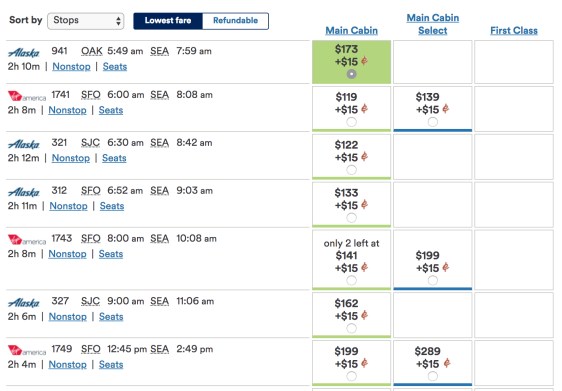
Back to Virgin America, though: my penchant for first class notwithstanding, Main Cabin Select is an excellent product. You get more legroom and perks than premium economy on most other airlines, and it’s not always that much more expensive Economy Plus/Main Cabin Extra/etc. Looking at the flight matrix above, if you can stomach a 6AM flight out of SFO, you can get two main cabin extra seats for a $20 premium. If you were only looking at Alaska flights, you’d need to pay $78 for two upgrades to Premium Class, but since they’re still booking Virgin MCS into its own fare class, you can cover the cost of one upgrade with the companion certificate.
This may go away at some point, although my hope is that Alaska eventually harmonizes their own Premium Class with Virgin’s Main Cabin Select, enabling you to use the companion certificate for either one. It makes logical sense that they’d do this, given how they’re trying to position the extra legroom seats as a separate class, rather than a buy-up perk (even though that separate class is still just a buy-up perk at this point). For as long as it lasts, though, this is a great enhancement to the companion certificate – especially given that they’re still offering $0 certificates as a sign-up bonus (as opposed to the $99 that the companion fare usually costs).
As an aside, is it too much to ask for BofA to introduce a premium Alaska card? I’m thinking of something along the lines of the Amex Delta Reserve, with a companion certificate that could be applied to first class flights, Board Room membership, and maybe some other perks as well. I’m not sure I’d be able to get it, since BofA is reportedly getting tighter with approvals lately — in fact, my application for a 4th Alaska card yesterday went to pending, which is the first time that has happened. (For reference, I only have one other card open at this point, which is why I was surprised that I didn’t get auto approved.) If I do get rejected, I’ll make sure to exhaustively document the ensuing retention call.
I’ll get around to that post about the Travel Codex article soon, although the realization about Main Cabin Select seemed more exciting, so I figured it warranted its own post. Has anyone used a companion certificate this way? Was it amazing? I sure hope so.
Since you read this far, maybe you want to consider supporting this blog? I’m committed to keeping it ad-free, so reader support makes a huge difference!
You may have noticed lately that posts have slowed to a trickle. That’s for a few reasons – first, I’ve been working on a big bookbinding project for the first time in a couple years, so most of my non-work productivity has been going to that. Second, I’ve been trying harder than normal to fight off the creeping depression and despair that has plagued me at various times in my life. Trying and succeeding, I should say, but it takes a lot of mental effort. Third, and probably most importantly, I haven’t had a burning desire to write about points and miles topics lately. When something catches my interest, I usually live up to the name of the blog and vomit a couple thousand words about it, but I don’t like to post about stuff just to keep to a regular schedule.
(It’s ironic, I read a post on TravelBloggerBuzz recently about how all the people writing about the new Lufthansa livery were scraping the barrel in terms of content just so they could have some slurry in which to mix credit card pitches. I know he wasn’t specifically referencing my blog, but I do think it’s funny that one of the only posts I wrote in the last month was all about Lufthansa… only to find out that (at least to one person) it’s the most boring thing I could have written about!)
Anyway, the point I’m trying to make is that I like to write about what interests me (and I LOVE airline design). Of course, this is still pretty much a points and miles blog, rather than a personal blog, but I’m wondering how the handful of readers who come here regularly would feel if I started branching out with off-topic posts (that were flagged as such in the title so you didn’t waste a click). Possible topics include:
Whisky reviews
Music (and music equipment) rants and raves
Day job musings (small business operations, sales, and marketing)
Really dry stuff about design and typography
Book collecting, and more aviation/travel-themed book reviews
Let me know in the comments. I pretty much feel like I should just write about whatever I feel like as long as I’m not clickbaiting you into something you don’t care about. However, I’m curious if you like your points and miles blogs to be fairly narrow in scope, or if you enjoy hearing random internet people’s perspectives on things you may not be specifically trying to read about.
I swear I’ll get back to miles/points programming sooner or later. I even have a couple posts loaded in my mind right now, but I just haven’t had the motivation to write them yet.
Just yesterday I was poking around my Amex account looking for a referral bonus on the Hilton Aspire. I figured I had just missed it, since all my other Amex co-brand cards showed referral bonuses immediately. For whatever reason, it took a few weeks to show up, but Amex now has a pretty decent offer:
Come to think of it, my first statement just closed today, so maybe they wanted to wait one billing cycle before letting me rake in points from referrals. Little do they know I barely have any friends, and the few friends I do have aren’t the kind of people who are an easy sell on a $450 credit card, no matter the benefits. (The friend who got me into churning just crammed herself and her 6’3″ husband into Norwegian economy seats to fly from Oakland to Rome for like fifty bucks, so I don’t have high hopes.)
Anyway, if you want to throw me a bone, you can use my link to apply for the card. I’m not going to hype this up more than it already has been – if you were thinking of getting the card anyway, I could use the extra points, but I’m not going to do a whole spiel of why it’s such a good deal. It’s a lot of money for a credit card, and it’s not for everyone, but I’m happy with it so far.
Despite there not being much interest in my past posts about airline visual design, it’s one of my favorite things to write about. These posts also take much more time to write than my normal posts, which is why I’ve been fairly quite for a little while (well, that and laziness). However, airline design is in the news this week now that Lufthansa has rolled out not only a new livery, but an entirely new visual identity.
The reaction to it has been pretty negative, although if there’s one guarantee in commercial aviation, it’s that a new livery will never be universally well-received. People have a strong emotional attachment to airlines and what they represent, and changes threaten to sever that attachment by making the airline unrecognizable. The more drastic a change, the more polarizing a new design becomes, and I can think of none more drastic in recent memory than American Airlines. I’ll get back to Lufthansa in a minute, but the reception of American’s identity has some interesting parallels. From a graphic design perspective, I don’t totally hate American’s new livery, although it has some major problems… and of course, I detest the new logo.
Most of the hate for American’s new logo was around the abandonment of the eagle, which had been an iconic symbol of the brand since the very early days. However, what most people don’t mention is that Mossimo Vignelli, who created the previous logo, wanted to ditch the eagle all the way back in the 1960s. I’ve read a lot of commentary lamenting AA’s current management junking a visual identity produced by one of the great corporate design gurus of all time, but to Vignelli the eagle was an anachronistic holdover from the days when flight was a novelty, and it went against the streamlined modernity he wanted to project. It was only after employees rebelled against the new logo that American’s management figured out away to shoehorn a stylized version the eagle between the two “A’s” (without Vignelli’s approval), and when you view it in this context, the eagle does look fairly out of place in the AA logo. Vignelli also would have found it especially objectionable that the new eagle was often used on its own, since he intended the simple “AA” to be the universal symbol of the brand.
Given the history, the abandonment of the eagle may have been overdue, although the fact that there was another huge uproar from both the public and American’s own employees suggests that, just like last time, people weren’t ready to let it go entirely. Management paid lip service to the old design by allowing employees to vote on a version of the new livery that preserved the old logo, but the option presented looked ridiculous with its two mismatched fonts and competing logos. The old logo is incompatible with the new design, so keeping it on the tail made no sense. Would they honestly have gone with this livery if the employees had voted for it? Maintaining two separate logos is just weird, so I’m at least glad they committed to the new design for better or worse.
The bummer of it all isn’t that the eagle is gone, it’s that the eagle beak logo just looks so boring. If there’s one trend I hate in airline visual design, it’s these limp-looking shapes that are supposed to be suggestive of motion or adventure but instead look like nothing at all. Air France is guilty of this, as is Iberia and a host of others. The worst in my opinion is British Airways, who for many years had one of the all-time best logos – the Speedbird. I mean, the Speedbird was so closely intertwined with BA’s identity (and BOAC before the merger) that it’s still used today as their ATC callsign. However, the demands of modernity for some reason convinced their management that they needed to junk the iconic symbol and instead fart out the wet noodle they call the “Speedmarque.” Blegh. (I should note that the Speedmarque was originally pointy and was an attempt to evoke both the Speedbird of old as well as the Union Jack, which was a component of BEA’s shitty logo at the time of the merger. Its current iteration is as bland as bland can be, and it’s all the more tragic given the excellent logo pedigree of both BOAC and pre-1970s BEA.)
American went the same direction, and what they came up with is softer, less evocative, and it pays homage to their history so wanly I’m surprised they even bothered. It’s not quite an eagle and not quite an “A,” but it’s definitely a boring slanted shape. Air France eat your heart out.
For those that aren’t aware, this is actually Air France’s logo. Seriously.
Okay, so getting back to Lufthansa. First of all, they kept the crane logo! Huge sigh of relief. Given the state of airline design refreshes lately, that alone is reason to cheer. The Lufthansa crane has more or less maintained its form since 1918, and it’s worth celebrating that they didn’t go down the road of so many others and ditch a truly iconic symbol for some dumb blob or swoosh. Ditto the font. Lufthansa’s identity has always communicated German precision, and the bold sans-serif font (Helvetica Black) was a major part of that. (Not for nothing, Helvetica was also the main component of Vignelli’s identity for American, so it tracks that along with his logo, American would ditch that font altogether in favor of something weaker and more generic. Thankfully, Lufthansa didn’t mess with something timeless just for the sake of it.)
The two most striking changes they did make was to extend the blue color of the tail onto the fuselage, like so many other airlines have done. I’ve seen it pointed out that they basically “copied” Qantas, but Qantas is far from the only airline to use the tail-onto-body visual convention. In fact, I’d say that tail-onto-body has become the cheat-line of the current era.
This slideshow requires JavaScript.
There are differences in exactly how the tail merges with the body in these examples, but it’s more or less the same concept across all the airlines that use it. I’m sure there are plenty more examples that I’m not thinking of, too.
So Lufthansa caught up with the times by adopting the most of-its-time visual convention. It’s not great, but to be honest, Lufthansa has never been an airline to adopt cutting-edge identities. It’s last big refresh was by Otl Aicher (another of the titans in the history of corporate design), and although the new identity introduced a timeless aesthetic for Lufthansa, it more or less brought them up to date with competitors like Swissair and Pan Am who had implemented modern corporate identity programs years earlier.
I don’t think Lufthansa would consider the newest design a failure for being too safe. In fact, it’s likely the opposite, and they’re happy that they now have a clean and current looking design that puts the focus on their two most recognizable features – the crane logo and the no-nonsense wordmark. American could have taken a page from their book instead of putting that jarring piano-key thing on the tail, completely overwhelming their new logo. I’ve seen a number of comments about how Lufthansa had the chance to break new ground and become a design leader with this design refresh, but that’s not how I see them as a company. Dating back to the Aicher visual identity, the focus is on simple, effective, precise communication, and that’s exactly where the new livery lives as well.
There’s also something to be said for the comprehensiveness of the new design. One of the most remarkable things about the original Aicher identity was how rigorously it was studied, and how exhaustively it was documented and then applied throughout their network. And again today, they have issued a comprehensive set of guidelines that touches everything from planes to boarding passes. This is a lot more than a new livery, and it speaks to the deliberateness and technical precision that Lufthansa has always touted.
The second big change is the abandonment of yellow as a component of the livery (except for some nearly invisible iconography on the doors). It does make Lufthansa oddly monochromatic, and it’s kind of interesting that they’re reaffirming their commitment to yellow via signage, boarding passes, and other printed materials while mostly removing it from the plane itself. It’s hard to argue that customers associate a certain color with your brand if you don’t use that color as a key component of the livery.
Here again, though, there are some echoes with Lufthansa’s past. All the way back in the 1960’s, Aicher identified yellow as an important color to highlight as well, given that blue was a fairly common color in airline liveries. He proposed a few designs that featured yellow very prominently, and Lufthansa’s management rejected all of them. As Lufthansa tweaked the design over the next 25 years, design teams continued to propose using more yellow in the livery, and management never approved it. Here are some photos from a couple books I have about Lufthansa that show what might have been:
This slideshow requires JavaScript.
Just like AA being ambivalent about the eagle, Lufthansa has a history of resisting yellow. In that historical context, it doesn’t altogether surprise me that they went with a two-color livery.
So here’s my confession: I like Lufthansa’s new livery. I’m pretty objective, given that I’ve only flown them one time (great flight, BTW), and I don’t have a personal attachment to the old livery or the company itself. If I did, I’m sure I’d be right there alongside everyone else who hates the new design. And I agree that it’s derivative of Qantas and others. Stripped of context, though, I think the mostly solid dark blue triangle cuts a dramatic profile (I prefer it to the Qantas red), and I like the bold choice to keep the lines perfectly straight, rather than curving them toward the bottom of the fuselage like you see on most of the others that use this basic design.
And finally, I appreciate that Lufthansa isn’t just painting some planes and then walking away. While the livery is obviously the most visible aspect of an airline’s identity, Lufthansa set a benchmark almost sixty years ago for how to implement a corporate visual identity from the top down, and they’re continuing in that tradition today.
If you’re interested in this stuff, you should check out the book Lufthansa + Graphic Design, published by Lars Müller. It has tons of photos of Lufthansa’s planes and other corporate materials through the ages. And I know I’ve mentioned it many times before, but Matthias Hühne’s Airline Visual Identity may just be the best book ever published on any subject. Lastly, for some neat reproductions of Aicher’s design manual for Lufthansa, check out Manuals Volume 1, published by Unit Editions.
Since you read this far, maybe you want to consider supporting this blog? I’m committed to keeping it ad-free, so reader support makes a huge difference!
Longtime readers of this blog may remember my last “you’re a piece of shit if…” post about people who travel with fake emotional support animals, and my rage toward these pieces of shit (the people, not the animals) has only intensified since then. It makes my blood boil that for some reason a seemingly large percentage of pet owners thinks it’s okay to fake a disability in order to game the system and bring their pet on a plane. Of course it’s selfish (other passengers may be allergic to your dog (or duck)), and of course it makes flying just that little bit more annoying for everyone else, but it’s that brazen subversion of an ethical norm that really gets under my skin.
Well, it was only a matter of time before airlines would do something about it, since planes are basically turning into pet stores with wings. Delta made news last week by being first up to the plate, and they’ve instituted some very common-sense regulations. Here’s a basic rundown:
The first thing that bothers me about this doesn’t have anything to do with Delta. I’m mad at the cocksnipes who insisted on pushing the limits of the loophole until airlines (Delta in this case) had no choice but to crack down. Now a blind person who requires a service animal to fly has to jump through a coupe more hoops just to get their dog on the plane, thanks to those cocksnipes. As if it isn’t hard enough to fly with a disability, now there’s this paperwork requirement, a 48-hour deadline, and having to have a gate agent give the final approval (since we all know how gate agents have impeccable and consistent judgment 100% of the time), all so some perineum could take his golden doodle on vacation with him.
(As an aside, can we all agree how stupid the name “golden doodle” is? I get “labradoodle” since it’s a contraction of labrador and poodle, but there’s no “D” in the middle of the word “retriever.” It’s not like a “doodle” is a breed of dog. The following would be more acceptable, if we’re following the same rules as those that created “labradoodle”…
Golden poodle
Goldoodle
Golden Repoodle
Pooden Retriever
Just get a rescue, you cocksnipe)
Looking at the actual forms that Delta requires you to fill out, the requirements for trained service animals aren’t actually that onerous – and I’m sure that has to do with the ADA’s fairly strict rules about how businesses can’t create any undue burdens for passengers with disabilities. In fact, the only paperwork required is a veterinary health form documenting that the animal’s vaccines are up to date. (Boy I hope Jenny McCarthy doesn’t need a service animal, amirite?)
Since most people gaming the system are in the emotional support animal camp, it makes sense that additional documentation would be required for them. However, part of the ADA as I understand it is that a business can’t ask you what your particular disability is or why you need a service animal. So, given that these ESA abusers are already huge selfish pieces of shit, I’m wondering what percentage of them will just insist to the poor gate agent that their golden retroodle is a trained service animal and “YOU’RE NOT ALLOWED TO ASK ME THAT AND I’M FILMING THIS ON YOUTUBE AND YOU’RE HARASSING ME AND GET READY TO BE ON FACEBOOK LIVE!!!!!”
So far, we haven’t seen people try to pass their animals off as trained service animals, because it’s just easier to claim it’s an ESA and leave it at that. Now that Delta is requiring a signed letter from a doctor and an affidavit that the animal has completed training, I wonder how many people will just buy a service dog vest off eBay and try to claim that it’s a true service animal instead. I hope Delta trains the shit out of its check-in agents to be able to tell the difference between a noble german shepherd and my bratty husky who’s too busy sniffing around to care that I may be having a seizure (let alone a panic attack). However, seeing how they rolled out this policy with no notice, I’m guessing not. It goes into effect on March 1st, so there is actually a good chance that Delta will have its collective shit together. This isn’t the muslim ban, you guys.
Not that you couldn’t easily fake the doctor’s note to get around the new ESA documentation requirements. I guess the difference is that there’s nothing at all required right now, so making people jump through even the most minimal of hoops will probably cut down significantly those who abuse the system willy nilly. The people who still try to game the system post-regulation are really going to be the absolute worst of the worst, though.
Anyway, this is good news for us flyers. I’m just mad that it had to get to this point in the first place, and that all the fuckpacks I called out in my last post actually did end up ruining it (or at least making it harder) for people with a legitimate need for these heroic creatures.









 Windbag Miles