Windbagging full-circle: My review of the Hyatt Regency Paris – Étoile

If you’re reading this blog, there’s a good chance you would never have found out about it had I not uncovered a mistake rate at the Hyatt Regency Paris – Étoile last summer. Before that, I received maybe 10 views per week (!), although given that I posted once every couple months (or not even), that’s no surprise. The Hyatt thing became my claim to fame, and I didn’t even realize at first that I had struck gold… A hotel on the outskirts of Paris proper wouldn’t be of interest to anyone, would it? Turns out, yes it would.

I’m finally staying at the hotel, nearly 10 months after I originally booked it. Back then, I was casually looking through various hotels I could book on points, since I had scheduled myself a few days in Paris in advance of a work trip in Germany, and I wanted to spend as little as possible out of pocket. There are a number of nice Holidays Inn in Paris, so I figured I’d probably book one of those using IHG points plus the annual free night from my credit card. At least, that was the plan until I looked at award availability at the Hyatt Regency. As a Category 5 hotel, it didn’t seem like an amazing deal on points, even with a high per-point value due to an eye-watering $550 daily room rate. However, Hyatt’s normal premium room award (daily rate plus 3000 points) was available, only the room rate was incorrectly entered as 18 euros. For 9000 points and ~$60 for a 3-night stay, this was a no-brainer.

The deal died within a few hours of going wide, which – again – seemed funny to me, since this isn’t a hotel I’d ever consider staying at outside of the context of a trip where I was trying to save money. The location is just too far away from everything I like in Paris, although I suppose I should have taken into account that my preferences in Paris skew toward things that aren’t part of the normal tourist circuit of the city. (Nothing against tourists, by the way. I’ve just spent a lot of time there, so I’ve already put in my time at the Eiffel Tower, Notre Dame, etc.)

Here’s why the location of the Hyatt Regency is good: it’s right next to both the Métro line 1 and the RER C train. The 1 is a through-line through the center of Paris, meaning you have direct access to the Arc de Triomphe, Champs-Elysées, Louvre, Marais, Bastille, etc. The RER C complements this by skirting the Seine on the other side, taking you to the Eiffel Tower, Invalides, Musée d’Orsay, and so on. Basically, you have a direct line to many of Paris’s key attractions.

Here’s why the location of the Hyatt Regency is bad: it’s really far away from most of those attractions. It’s nice to have direct access, but you’re looking at a 20-30 minute ride each way. One of the things that makes Paris so great is the bustle of all the little neighborhoods, and it significantly adds to the experience if you’re staying amidst all of that, rather than just visiting via the train. (I had the same complaint about the Park Hyatt, but that’s mostly because I hate the Vendôme area, not because the hotel itself is out-of-the-way.) Most of the stuff I love in Paris is in the eastern part of the city (Rue Charonne near Bastille, the Canal St-Martin area, the Parc des Buttes Chaumont in the 19th, the hipster bookstores in the Belleville/Ménilmontant area, etc), and it’s nearly an hour from here to there via public transport.

So, location is in the eye of the beholder – if you’re not too particular about where in the city you stay, and you want to stay at a full-service hotel that doesn’t cost an arm and a leg, then the Hyatt Regency will be fine. However, I would definitely wait until the renovations are complete before booking a paid stay here. For the purposes of this review, let me be clear that I didn’t expect much from the Hyatt – I was practically getting my room for free, and what’s more, I dicked the hotel over by unleashing a flood of other people who got the same deal. They barely owed me a bed to sleep on, as far as I’m concerned.

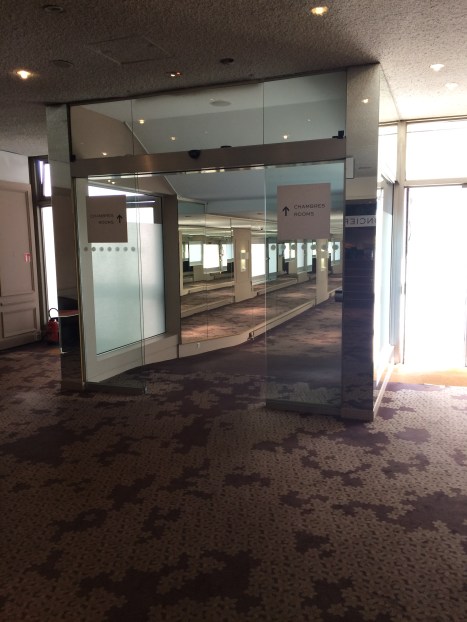
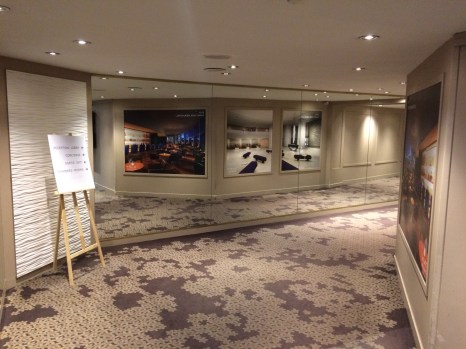
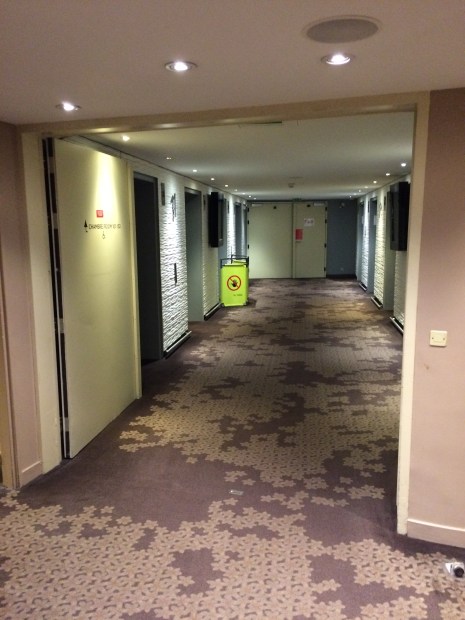
The ongoing renovations significantly affect the experience, though, starting with the temporary entrance. There’s no lobby right now, so you actually enter into the mall to which the hotel is attached. From there begins your insane trek to your room – first through the mall to a set of elevators, up to the fourth floor, through one hallway, through another hallway, into a third hallways, followed by a fourth hallway that leads you to the elevators that access the guest floors. (If you’re checking in, you’ll take a detour in between the second and third hallways into a nondescript hotel conference room, which is where the check-in desks are located.)

hy1
Your trek begins in the entrance to a mall…
hy2
…you then arrive at this bank of elevators…
hy3
…which delivers you to this long hallway…
hy4
…that then leads to this long hallway…
hy5
…which in turn feeds you into this long hallway…
hy6
…arriving finally at the elevators up to the guest room floors.

Since the common areas are all under construction, the Regency Club is also closed, although it too has been relocated to another conference room that has been converted into a dining/bar area. Instead of key-controlled access, it offers breakfast in the morning and hors d’oeuvres in the evening, and you access it by giving your name and room number to the attendant at the door. If I had paid for a club room outright, I would have been severely disappointed; as it is, I’m fine with it. The breakfast spread is pretty good – not quite up to Park Hyatt standards, but not actually that far off. I didn’t take a bunch of photos of it, because you can probably imagine what a big spread of pastries, bread, jam, cold cuts, sausage, waffles, cereal, fruit, eggs, juice, and coffee looks like. A special highlight was when the woman next to me accidentally knocked an open jar of mustard onto the floor, causing it to bounce off the floor and flip over in such a way that it flung a stream of mustard into the air and literally rained down upon her in big globs.

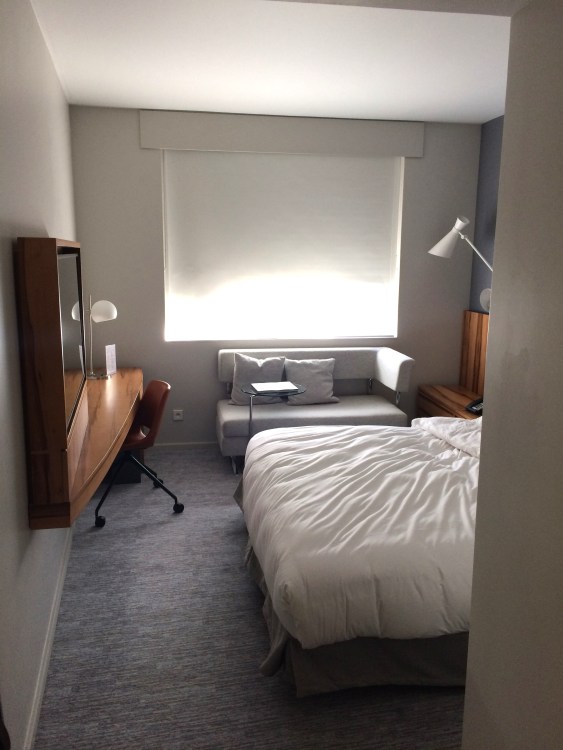
I’m staying in one of the renovated rooms, and it’s decent overall. It’s small, but not abnormally so for Europe. The furnishings are clean and modern, and the view (from the 22nd floor) is outstanding. Little touches that I like: the air conditioning runs continuously if you want it to, so it’s possible to make the room constantly 65 degrees (a blessing when it’s in the 90s outside). The bed has floor lighting that’s motion-activated, so if you get up in the night, you won’t trip over the crap you left all over the floor. The wifi is free and fast, and there are plenty of outlets (including USB outlets, cutting down on the need for travel adapters). There’s a mini-fridge, though no minibar – nice for my wallet but annoying when I want a drink and have a 25-minute round trip down to the cafe in the mall to get one.
hyroom1
I told you I’m bad at taking pictures of hotels, but here you go.

Some nitpicks: the desk is really shallow, so if you’re the type that does a lot of work in hotels, you might get annoyed that there isn’t enough space. The king-size bed is actually two double beds pushed together – not unusual for Europe but also not something I expect at hotels that are this expensive. The bathroom is cramped, and there aren’t many surfaces to lay out all your beauty accoutrements. There’s a coffee machine, but it only makes powdered coffee… maybe I’m spoiled, but a Nespresso machine would really hit the spot.

hyroom2

The bottom line is that the hotel itself is perfectly comfortable, the renovated rooms are modern if a little on the small side, and the service has consistently been up to Hyatt’s normal standards. Once the common areas are finished, the whole thing will be pretty swanky. However, until that point, I’d recommend other accommodations, since the disjointed layout (not to mention the construction noise between 10 and 6) take away from the experience. The location is also something you’ll need to consider. The actual surroundings of the hotel are fine, but some effort will be required to get around.

I know a bunch of people who read this blog also took advantage of this deal, so I’m curious what others thought of the hotel. I don’t know the next time I’ll be back in Paris, but after two consecutive stays in high-end hotels, I’m ready to go back to a little AirBNB apartment by the Canal St. Martin – the more I think about it, the more I feel like the fancy hotels pull you out of the milieu that makes Paris what it is.


My new favorite lounge in the world – the Thalys lounge at Brussels-Midi

Hi from Belgium, blog readers! I’m tired. At this point, I’ve been up for just inside 24 hours, and I’m feeling it big-time. I’ll write more about my United First experience that got me over here, which was extremely positive… but despite what was mostly a great flight, I didn’t sleep a wink. People who do this for a living must just learn how to sleep on planes, but so far mid-flight sleep eluded me once again. Not for lack of effort, and I may have drifted in and out for a minute here and there, but there was nothing that would really qualify as sleep. It also didn’t help that the flight was pretty consistently turbulent – not so much that galley carts were falling over, but enough that ever 30 seconds or so you’d get a good jolt that shook you out of whatever slumber you were threatening to fall into.

When I planned this trip to Europe, I gave myself a challenge. I flew into Brussels because of the wide availability in United First out of Chicago (70k Aeroplan miles with no fuel surcharges = good deal IMO), and never having been to Brussels, I decided to schedule my train to Paris in the late afternoon. I knew this would be a gamble, since I usually don’t sleep at all on planes, and I was unsure whether I’d actually have enough energy when I got here to try to see a brand new city. Especially after a stressful flight (I’m more or less over my fear of flying writ large, although prolonged turbulence is really draining for me, since I have to work pretty hard to keep myself from having a panic attack), I was pretty sure as we were descending that I was going to crash out and go for my backup plan, which was to get a day room at the Sheraton attached to Brussels airport.

IMG_2620

I managed to rally, however, and I took the airport train to Brussels Centraal, which is just a few steps from the famous Grand Place, a UNESCO World Heritage site (and for good reason). I ate French fries on the Place like a real local would (I’m assuming), and my spirits were in good spirits. I even went off in search of the Mannekin Pis statue, which is funny, since there’s not much you can do in Brussels that’s more touristy than that. But I figured what the hey, I’m only a block away, and I’m not above nakedly touristy experiences from time to time…

IMG_2622

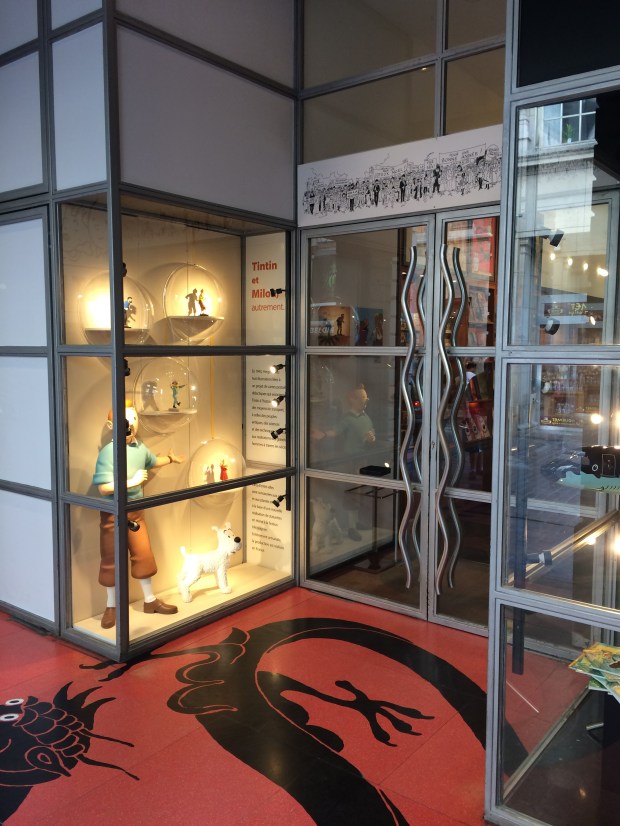
After a few hours of walking around Brussels, though, my feet started to hurt, and I started to realize I wasn’t going to make it until 5. I packed it in after buying a very expensive limited edition book at the Tintin Boutique (my visit to the Tintin Boutique was more like a pilgrimage, and one day I’ll finally make time to head out to the suburbs to go to the Hergé Museum like a real fan should.)

IMG_2617.JPG

I made my way back to Brussels Centraal and hopped a quick train to Brussels Midi with the hope of “flying standby” on an earlier train. (For those who aren’t familiar with Brussels, the Centraal train station is in the middle of the city, but the “Midi” (south) station is the one from where most of the long-haul trains depart.) Quick detour here to give props to Brussels… in my limited experience, things are so efficient here I might as well be in Germany. Immigration took less than 5 minutes at the airport. At the train station, I had to take a number and wait for the customer service counter to call me, and it took under 2 minutes. (I went through this same process in Paris a few years ago, and it took over an hour.) It has been really nice not to have to wait in long, pointless lines being as tired as I currently am.

Okay, so back to the topic of this post: it turns out that the fees to change my ticket would cost me the same as my original ticket, and I wouldn’t even be in first class anymore. Not that it really matters on such a short trip, but the prospect of paying $75 AND getting downgraded seemed like a double-whammy, so I resigned myself to waiting three more hours for my train. I figured I might as well check out the neighborhood around Midi station, but I am just completely and totally out of gas at this point. I wasn’t sure what to do, so my best option seemed to be to leave the train station and find a cafe that I could kill a bunch of time at.

I noticed some signs on my way out of the train station that said “Thalys Lounge,” though… and the thought of any sort of lounge at that point was pretty much the best thing I could imagine. It took me a few minutes to find the lounge, since it’s not actually in the train station – you have to exit the station entirely and go across the street into a separate building. I wasn’t sure if I’d be able to get in, since I had a feeling it was more something for frequent travelers or a pay-in type of thing, but the desk agent confirmed for me that anyone with a first class Thalys ticket could enter, and she opened the automatic gate to let me in. (Anyone who has been to an airport lounge in Europe will be familiar with this type of gate.)

IMG_0152

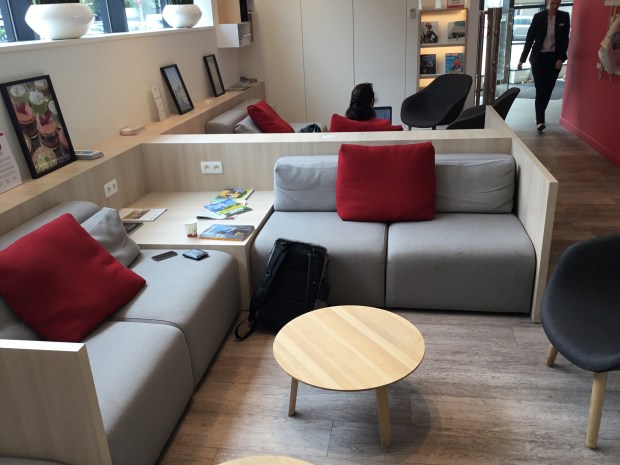
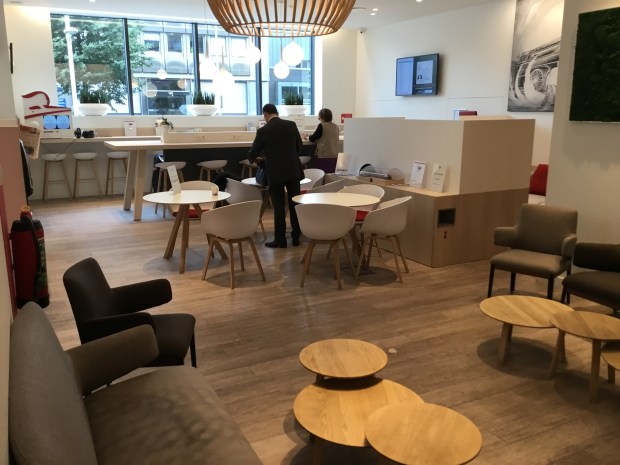
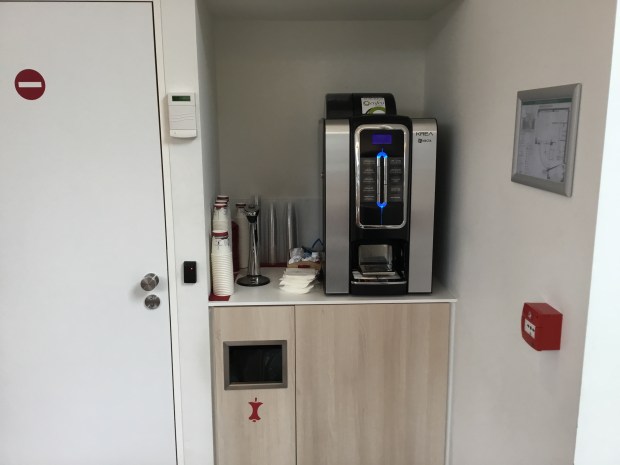
I felt kind of stupid buying a first class ticket in the first place when I booked this trip – my rationale was that it was only around 20% more than a 2nd class ticket, and first class seating is 2×1 rather than 2×2. This would mean (I hypothesized) that my extremely tired self would thank me for allowing him to relax in a one-by seat with no one next to him for the hour-plus trip to Paris. However, extremely tired me is now overflowing with gratitude that I splurged, since this lounge is so relaxing I could almost cry. It’s not anything special, by the way. There are no snacks, just filtered water (still and sparkling) and an automated coffee machine that just made me a very decent espresso. There are plenty of newspapers and magazines, including a bunch of issues of Air France’s magazine. It’s also very small, but it’s almost empty despite a steady stream of Thalys trains leaving this afternoon. I don’t know, maybe it will pick up later on, but for now I have a whole bank of couches and chairs to myself.

IMG_0159.JPG

This trip started with a bunch of hours spent in the Polaris lounge in Chicago, and honestly if I had to pick which one I preferred, it would be the Thalys lounge. Not that Thalys competes with Polaris on any amenities whatsoever… but I didn’t *need* a lounge in Chicago before my flight, though it was certainly nice to have. I really needed this, though, and it basically made my day that I found it.

IMG_0154

Bottom line – if you happen to be in Brussels and have a first class Thalys ticket, don’t go out of your way to visit this lounge before your trip… but if you are tired, have time to kill, and need somewhere to kill it, you probably won’t find anywhere better.

UPDATE: THERE ARE FREE BANANAS. THEY JUST BROUGHT OUT FREE BANANAS. I’m going to eat a banana.

IMG_0155
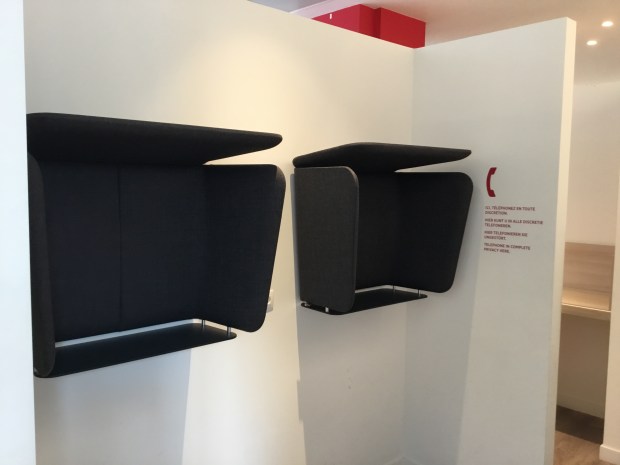
The Thalys lounge also features these weird voice-dampening boxes so you can talk on the phone in privacy, although a guy is using one right now and I can hear everything he says.
IMG_0160
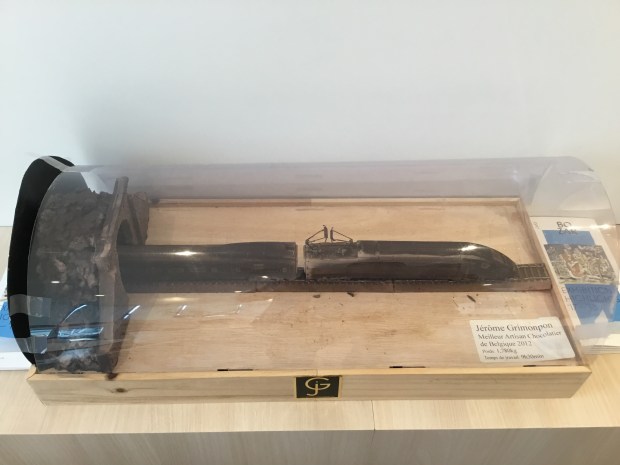
The coup de Belge… I thought this was a snack of some sort from far away, but it turns out it’s a chocolate sculpture of a Thalys train.

One last update on Amex FXIP before I stop talking about it

This is the third installment of my gripping trilogy about my experience with American Express’s foreign wire transfer service (FXIP). Here is a brief recap of the other two installments, since you’ve already forgotten:

  • Installment one: in which I receive an email solicitation advertising up to 30,000 Membership Rewards points if I sign up for Amex FXIP but abandon my application after it looks like my business isn’t legitimate enough to qualify.
  • Installment two: in which I continue my application at the urging of a friendly Amex FXIP rep and get approved after jumping through a couple hoops (although other, more deserving people are not so lucky).

I went ahead and initiated a wire for 100 Euros, and I received a confirmation email about it today, so everything is proceeding apace on that front. However, I also got a call and then an email from an account manager welcoming me to the program and explaining the terms of the 30,000-point bonus offer. Turns out you need to make a wire transfer of at least $500 in the first 30 days to get 15,000 bonus points and then three more $500 transfers over the next 90 days to get the other 15,000. This was a surprise to me, since I read the fine print before I applied, and no minimums were mentioned. (However, I should also note that the original fine print also mentioned needing to apply before April 30, 2016, so I was aware that it might not give me all that strong of a leg to stand on.)

In any case, I emailed the rep back letting him know that this was the first I learned of the $500 limit, and after checking out the link to the original offer, he agreed that I wasn’t informed of the minimum requirement beforehand and manually approved my first wire transfer to qualify for the bonus. I expect the points to post within a couple days, although if they don’t and it turns into a whole shit show, maybe I’ll post a surprise fourth installment to my saga.

Anyway, there are two bottom lines here: first, if you did take advantage of this offer, either make sure your first wire transfer is over $500, or be prepared for some email back-and-forth. For me, this was super painless, but as my last post pointed out, Amex FXIP isn’t always easy to deal with. Second bottom line is that Amex FXIP reps are more accessible and faster to respond than any I have encountered since I started churning. The difference is that individual people contact you and provide direct phone numbers and email addresses, so you can work with a single person, rather than simply working with a department. It’s not a reason to sign up or not to sign up for Amex FXIP, but I’ve been impressed with the service I have received so far and at least wanted to point it out.

LOL, Amex FXIP actually approved an account for my minuscule hobby business.

A few weeks ago, I wrote a post about an email promotion American Express buried at the bottom of the newsletter about my Blue for Business card through which you could earn points by setting up an account with their foreign exchange international payments (FXIP) service. Since I sometimes need to make foreign wire transfers and actually had a couple coming up, I decided to apply, especially since the bonus – 15,000 points after one wire and another 15,000 after three more – was pretty enticing… even moreso given that they didn’t put a minimum transfer amount on it.

Unfortunately, it turned out that the application process is much more rigorous than a normal business credit card application. In addition to a bunch of information about your actual business (website, business category, annual revenue), they also want a tax ID (not a Social Security number) and a business (not personal) checking account. The application has six parts, so after completing the basic information on the first part, I gave up, realizing that this service was definitely not intended for peons like me.

(I’ll take this opportunity to plug my hobby business (Chance Press) really quick, since I’m sure you’re all dying to know what it is. In my spare time, I’m a fine art printer and bookbinder, and I sometimes get around to selling my wares, hence the “business” part of “hobby business.”)

Since wires through FXIP are so cheap (free for the first ten, then $10) compared to what banks offer, I assumed that the exchange rates would be terrible, or that there was some hidden catch somewhere, like a monthly fee if you don’t wire a certain amount of money each month. Luckily, OG Windbag commenter MangoJasmine noted that she was going to push all the way through the application process, so I’d at least be able to get some second-hand info about the program.

That’s where it stayed for a week or so, but then the FXIP people started trying to get in touch with me. Since I had completed the first section of the application, they had all my contact info, and they left me a couple messages encouraging me to finish what I had started. I politely emailed back telling them that I’d like to use the service, but that my business is probably too small, since I don’t have a tax ID number or a business checking account. To my surprise, they responded almost immediately that I could just use my social security number and personal checking account, as long as I use that personal checking account for my business, which I do.

I went ahead and filled out the rest of the application and waited another week or so before they sent me an email asking for a business license to verify my fictitious business name. I don’t actually have a business license, so again I figured I’d just drop it. (I’m currently in the process of getting one, since the city where I live fined me for not having one and for not paying the local gross receipts tax that I didn’t know existed… HOBBY BUSINESS!) Not wanting to give up this close to the finish line, I decided instead to upload a photo of my resale certificate, since that establishes that my fictitious business name is at least registered in some form with the State of California.

Fast forward another week, and they kept sending me emails asking for the business license, so it seemed like my resale certificate gamble had failed. However, I started getting calls from them again over the weekend telling me to call them to provide additional verification, and when I finally called back today, I just had to confirm my email address, business name, and affirm that I had actually applied for an FXIP account, and I was approved. What?! Good stuff.

Also, pretty hilarious, since Mango hasn’t had it so smooth. Here’s her comment from the original post:

An update on the Amex FX Payments program-

I submitted an application over the weekend with my state business license and business bank account information, and it looks like the application is just the beginning.
The hurdles may be possible to cross for the most MR hungry, but it doesn’t look like this would be feasible for anyone who doesn’t have an actual business with documentation and can demonstrate the need for the FX program.
See below.

“Hi xxxxx,

Thank you for choosing American Express Foreign Exchange for your international payment needs. We look forward to working with you; your future business is wanted and appreciated.
Currently your application is under review. As the Foreign Exchange market is a heavily regulated industry, we require some additional information in order to complete your application.

Please reply to this email with the items below:

· A copy of your active business license with DBA (Doing Business As, Trade, Assumed or Fictitious) name registration for XXXXXX.
· You indicated on your application that your business does not have a website. Please explain how your business operates and advertises.
· A brief description of your line of business and how you will be using our Foreign Exchange International Payment services.
· 2-3 of any of the documents below in your business name and dated within the last 3 months that demonstrate your need for our Foreign Exchange International Payment services.
· Contracts
· Invoices
· Service agreements
· Previous international wire receipts
· Business plan
· Marketing Materials (i.e. Brochures, Fliers, etc.)

I look forward to your response, and if you have any questions or concerns you can email me directly. Again, thank you for choosing American Express.

Best Regards,

xxxxxx”

Aside from the request for the business license, I didn’t have to provide any of that stuff. I’m not sure what the takeaway is here… maybe make sure your business has a website before you apply? Still, it’s not like I have a website that even gives the impression that Chance Press is a going concern – I mean, the last update is from 2014 (although it does have a link to my online store). I don’t know why they decided to grill her and let me through with minimal scrutiny – it could just be luck of the draw based on what auditor is assigned to your account, or maybe the website thing really is a sticking point.

So, what happens once you get approved? First, I got an email with my new username for the FXIP site, followed by a second email with a temporary password, followed by a third email for a one-time PIN to enter after the temporary password. Once in my account, I was immediately able to send my first wire. The conversion rate was $1.00 to 1.1617 Euro (versus the xe.com true conversion of $1.00 to 1.1271). Not great, but actually pretty close to Chase’s rate of 1.1609. At around 8 cents more per hundred Euros, it’s well worth taking advantage of Amex’s inferior rate to avoid Chase’s $45 fee.

I executed the wire, although I haven’t received email confirmation that it has gone through yet. We’ll see how long that takes, and I’ll update if I run into any snags. It also remains to be seen whether the points ever post – I should get 15,000 for sending my first wire once the payment goes through, but there’s nothing anywhere in my FXIP account noting any sort of connection to the Membership Rewards program, so it might be for naught.

Bottom line is that I’m happy to have access to this service regardless of any bonus points, since I will be able to save tons of money on future wire transfers. However, it certainly isn’t a straightforward process, and you’ll at the very least have to upload some supporting documentation… and at worst, you’ll have to go before the grizzled, becloaked Amex FXIP elders at a formal tribunal and plead your case directly to them.

Travel Diary (OAK Escape Lounge, Alaska Airlines, SEA Centurion Lounge, Grand Hyatt Seattle, SEA Delta Sky Club)

I’m on a work trip right now, and I wanted to jot down some thoughts about different aspects of the trip. I don’t really have enough about each individual item to warrant a full post, so I decided to combine everything into one long post, SEO be damned.

My trip started in Oakland yesterday with a very early (for me) 9AM departure for Seattle. I got to the airport around 15 minutes before my flight was going to begin boarding, and I figured that the airport wouldn’t be that crowded early on a Sunday. Well, I was wrong, and the place was a ZOO. Worse, it was all leisure travelers going to Hawaii or Orlando or other such sunny places, meaning that the crowds were both voluminous and disoriented. At security, the TSA Precheck line was enormous, but the premium/first class line was completely empty, meaning at least I didn’t have to wait in line. However, Oakland security won’t let you go through the Precheck lane from the premium line, meaning you have to choose one or the other. Wait in an insanely long line or breeze through only to take off your shoes and underpants and go through the nude-o-scope. I don’t know if other airports do this or not, but it’s nuts to me that Oakland forces you to forego either the premium line or the Precheck lane – especially when the premium line is for frequent flyers who most likely also have Precheck. Oh, and they were real dicks about it too, which put me in a good mood to start the day.

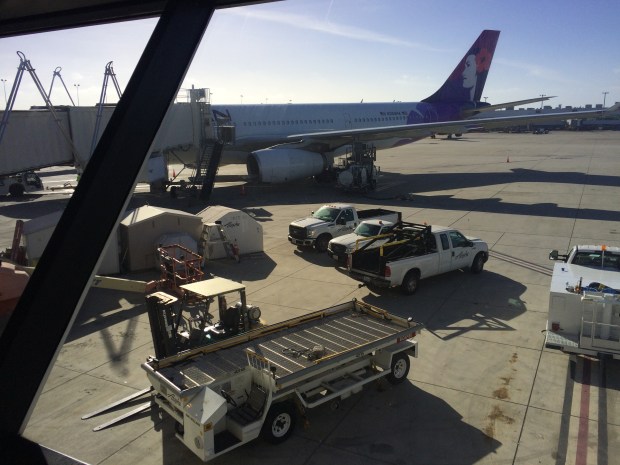
Anyway, once I was through security, I decided to check out the Escape lounge, which is the first (and only) lounge at OAK. It recently opened up to Amex Platinum cardholders, which is a really nice bonus for me, being based out of Oakland. The agent at the entrance checked me in quickly and seemed well-aware of the new access policies. My flight was already boarding at this point, but I wanted to get some bottles of water before heading to the gate. I sat down for a minute to enjoy the lounge, and it was surprisingly nice, especially for an independent lounge. The food spread was pretty basic but looked appetizing, and the furnishings were clean and modern. There was also a nice view of a Hawaiian A330 right outside the main window. Is this the biggest plane to serve OAK? I can’t remember which is bigger between the A330 and the 787.

IMG_2589

When the new Amex access policies were first announced, I read a couple blogs that expressed concern that the Escape lounges would become overcrowded with the new influx of users. At least on a Sunday morning at 8:15, that was definitely not a concern. In fact, there was only one other person in the lounge (although a couple was in the process of checking in as I was leaving).

IMG_2590.JPG

At the gate, I had missed first class boarding, so I got stuck behind a scrum of people jockeying to get on the plane early enough to still have overhead bin space available. I got settled in my seat near the end of the boarding process, only to find out that there was a maintenance issue that would end up delaying us by about 90 minutes. The captain was really forthcoming with the info, although that didn’t stop an irate woman from berating the flight attendants about how her cruise wasn’t going to wait for her if she was delayed. (Maybe don’t schedule your flight to arrive 30 minutes before your cruise leaves if they’re that inflexible???)

This was only the second time I’ve flown in Alaska’s refurbished first class (and the first time without horse-level doses of anxiety medicine), and I liked it. The seats were really plush – easily the cushiest first class seat I’ve had in recent memory (compared to Virgin’s roomy but worn-out seats, Delta’s new 717 seats, and United’s new A320 seats). I was in the bulkhead, and the wall was a little closer than I would have liked – United gives you an impressive amount of room in the bulkhead row, while Delta puts the wall inches from your nose. Alaska wasn’t nearly that bad, but I didn’t have room to extend my legs. In-flight, that turned out not to be so bad, though, since I was able to get into a pretty relaxing position by putting my feet up on the wall. As always, the flight attendants were great, and as I deplaned, they apologized profusely for the delay.

IMG_2591
One of Alaska’s special liveries at the gate next to me in SEA. You can’t really see from the photo, but inside the green stripes is the signature of every employee who works for the airline.

I landed in Seattle and decided to get some food at the Centurion Lounge before I headed into the city. Note that they’re no longer referring to it as the Centurion Studio – they’ve added some square footage and a full bar, so I guess it’s a full-on lounge now. I had complained about the view in the past, but the new section faces the south satellite, which is where all the interesting planes depart from. The construction work around Delta’s new Sky Club doesn’t obstruct the view anymore either.

IMG_2592

The new space in the lounge (sorry, no photo) is still pretty small, so I’m glad Amex is trying to get even more room. At peak times, I would still expect seating to be an issue. It’s nice that they have a full bar, though, including Bruichladdich and Port Charlotte whisky (same as other Centurion Lounges), which are both outstanding.

I also didn’t get photos of the Grand Hyatt, since I don’t like photographing hotels, but overall I was impressed. It’s not going to win any design awards, but the rooms do the “warm and luxurious” thing pretty well. The bed and chair are both comfortable, it has good blackout curtains, and the bathroom is enormous, with a giant soaking tub (even in a standard room). As a Discoveratrix, I was “upgraded” to the quiet floor, but that was it. I was only in town for a night, though, so I didn’t really care. I used my free night from the Hyatt Credit card, which ended up being a great deal given the cash rate of around $350 per night after tax. (It’s possible to get this hotel for much cheaper – this weekend just happened to be expensive.) Seattle is a great city to redeem the free night, since both the Grand Hyatt and the Olive 8 right around the corner are Category 4 hotels. The location is pretty good too, since it’s only a couple blocks from the Westlake Link station and less than a mile walk from Capitol Hill.

When I booked my return flight, I picked a later departure, since I usually like to hang out in Seattle after my work stuff is over. However, all of my meetings today were in Kent, south of the airport, and once I was done with them, I was way too tired to bother going all the way into the city and then back to the airport for my flight. Instead, I came straight here and went directly to Delta’s new Sky Club, which I’ve been excited to try out. Holy shit, you guys… this place does not disappoint. There are plenty of posts with great pictures, so I’ll just post these couple to give you an example of the view you get through the two-story floor-to-ceiling windows.

IMG_2593

IMG_2594
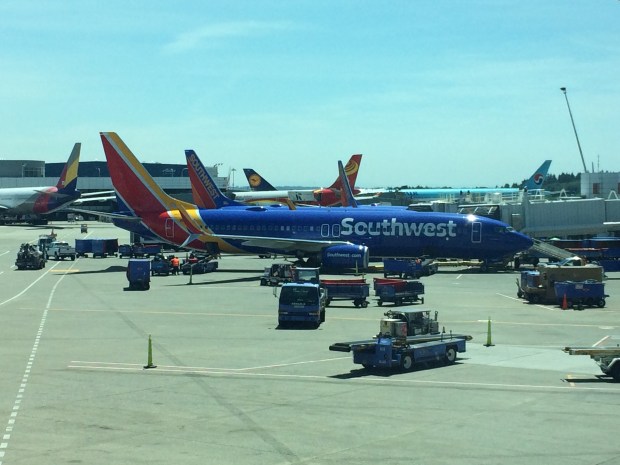
Overlooking Southwest gates is blah, but there are some interesting tails back there…

The lounge is humongous, and not even remotely crowded on a Monday afternoon. The upstairs mezzanine section is closed, but I imagine they’d open it up if things started to get busy. There are tons of food options, including a couple of really nice vegan salads as well as a tasty-looking non-vegan pasta dish, cold cuts, etc. Even better, they have normal chocolate chip cookies…. this is big for a Sky Club, given that ever other one I’ve ever been to tries to fancy it up with some macadamia nut white chocolate bullshit.  I’ve been sitting in a chair right in front of the window for the past 2 1/2 hours, and it has been really tranquil and relaxing – way better than the low ceilings and bustle of the Centurion Lounge nearby.

I booked my return flight on Delta specifically because I wanted to try this lounge, and at the time, I thought it was a silly thing to do. Normally I prefer Alaska, since their miles are better, and the service is always top-notch. Without a Sky Club membership, though, flying Delta is the only way I can get access to their lounges (via the Amex Platinum). After spending some time here, I’m actually considering going out of my way to fly Delta home from Seattle in the future because I like it so much. When I first reviewed the Centurion Studio, I talked about how it was a referendum on the Amex Platinum card, since plenty of cards include a Priority Pass membership that grants access to Alaska’s Board Room (ergo, I reasoned, to justify the additional cost of the Amex Platinum, the Centurion Studio would need to be miles ahead of the Board Room). My original conclusion was that the Centurion Studio was nice, but not so far ahead that it would be a reason in and of itself to carry the Platinum. (This was also back when Delta’s Sky Club was inconveniently located in the South Satellite and wasn’t anything to write home about in the first place.)

However, with the opening of this new Sky Club, and with the Alaska lounges starting to restrict access to Priority Pass due to overcrowding, the Amex Platinum is now the undisputed champion for lounge access in Seattle. I’d even go so far as to say that this is the nicest lounge I have ever been to, although I suspect its reign at the top will be short-lived, since I’ll be visiting the Polaris lounge in Chicago next week. (I also haven’t been to *any* of the world-famous lounges, so taking my top spot isn’t that great of an accolade.)

I’m flying home in a couple hours, but I’m going to post this now, since I’m not expecting anything about my flight on Delta to be notable. I’ll update later if something cool happens, though.

Interesting Amex offer – buy 20,000 points for a penny each

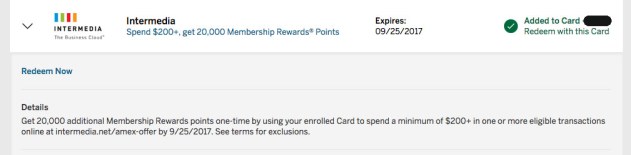
I came across a new Amex offer today for a company called Intermedia, and it’s very interesting: 20,000 bonus points for $200+ in spending. That basically means you could buy 20,000 points for a penny each, and I consider that a good deal. If you have a Business Platinum card, you’re already going to come out ahead after the 50% (or 35%) rebate on points redeemed for first class airfare, and it’s pretty cheap for transferrable points as well.

intermedia2 copy

I’m not sure if I’ll take advantage of it right now – I’m not super flush with cash at the moment, and Amex points are fairly easy to earn without having to buy them. Also, Intermedia is a cloud email provider, so you can’t just buy $200 worth of trinkets and be done with it – you have to go to the trouble of setting up a bunch of email accounts. If you do 24 accounts on the basic monthly plan, you’ll pay just over $200 per month – enough to trigger the bonus. Since I haven’t been through the process, however, I can’t report back on how easy it is to cancel, how much work it takes to set up, or anything else.

Anyone else get this offer or have experience with Intermedia? Am I crazy for going to all this trouble in order to buy points that are fairly easy to earn in the first place?

Always hang up and call again. ALWAYS! (Waldorf Astoria Amsterdam edition)

One thing that always surprised me when I was first getting into points and miles is how inconsistent things are. Bank terms and conditions seem pretty set in stone, so it’s counterintuitive that two reps called one after the other may tell you totally different stories… but it happens all. the. time. The acronyms “HUCA” and “HUCB” are thrown around the forums, because it’s such a common tactic to hang up and call again (or hang up and call back) that it’s annoying to keep writing it out. (However, since I have a long-documented aversion to churning acronyms, I’ll keep writing it out. )

The first time I hung up and called again, it was for a retention offer on an Amex Everyday Preferred. The first rep told me she couldn’t see any offers on my account, and that Amex had a policy against retention offers on the this particular card, because it was such a good card. Having followed the rolling thread on FlyerTalk about Amex retention bonuses, I knew this was bullshit, but rather than arguing the point with her, I thanked her and ended the call. I immediately called back, said exactly the same spiel about how I was thinking of canceling the card, and the second rep immediately offered me 2500 points immediately and 5000 more points after spending a nominal amount (I think it was $500). Since I was definitely planning on keeping the card, I accepted the free points and went about my day.

wa_exterior3_2_745x420_fittoboxsmalldimension_center

Today, however, was the funniest hang-up-call-again experience I have ever had. I just received my Citi Hilton Reserve free weekend night certificates last night, so I called in today to redeem them at the Waldorf Astoria in Amsterdam. I knew going in that this was a crapshoot, since award availability at this hotel is terrible, and they’re notorious for playing games with inventory. For those not that familiar with how hotel loyalty programs work (or let’s say for those even less familiar than I am), keep in mind that most hotel chains don’t own most of the hotels. Instead, property management companies pay a license fee to the hotel brand in order to operate the hotel as a Waldorf Astoria. When a Hilton member redeems a free night award, the hotel receives compensation from Hilton for that room. Some hotels don’t want to give away free night awards, but they can’t just black out all the rooms, since most hotel loyalty programs advertise no blackout dates. In other words, in most programs, if a standard room is available, you can book it on points. The operative here is “standard” room – if a hotel doesn’t want people to be able to redeem free night awards, they just have to make sure there aren’t very many standard rooms. The Andaz Maui is infamous for this, since the only standard rooms at that hotel are the janitor’s closets, and everything else is a premium room. As Freequent Flyer said on Twitter, at the Waldorf Amsterdam, “every room with a toilet must be a premier room.”

wa_kgsuperiorbd_42_745x420_fittoboxsmalldimension_center

To minimize potential disappointment, before I applied for the Citi Reserve card and then again a few times since then (as well as this morning), I made sure that there were standard rooms available at the base redemption rate of 90,000 points. I was fairly confident when I called that I would be successful, but the rep told me that he could only book the free night award if I already had 90,000 points per night in my account. He explained that this hotel required enough points to be in my account in order to redeem the certificate, but that the points would be refunded to me as soon as the certificate was applied. This made no sense to me, and I should have hung up right there and tried again. Instead, I asked to speak to a supervisor, and after a short hold, he came back and said that his supervisor approved him “lending” me the points in order to make the booking. Fine, go ahead. However, he then came back a second time and said that there was no longer availability during the dates I wanted – someone else had booked the room I wanted while I was on hold. This sounded even more ridiculous, but when I went online and checked, the cheapest award was a premium room for 156,000 points per night. I asked him to check again, since I figured the hotel was just shuffling around inventory or something. It seemed weird that the calendar view showed 90k availability every day in February and March of 2018 except on the days that I was trying to book. Anyway, after some back-and-forth, I refreshed the search results and saw the 90k availability come back. By this point, I was getting annoyed, since it seemed like the system was showing phantom availability. He said I would need to talk to his supervisor, so he transferred me.

wa_peacockalley04_8_745x420_fittoboxsmalldimension_center

When the supervisor came on the line, she said that she couldn’t use the certificates on the room, because it was a King Superior Plus room, which is a premium room. I countered that, online, the room showed as being bookable with a “Standard Night” award for 90,000 points, meaning it was a standard room. Her response was that the standard room at that hotel was a King Deluxe room, which was only bookable with a “Premium Night” award for 156,000 points. She said that the certificate could only be used for a standard room, and that a standard room and a standard night award are two separate things. In other words, it’s the hotel’s prerogative which award redemption levels they want to attach to a particular room. In this case, the Waldorf had decided to make the standard rooms only available for premium redemptions, and the premium rooms only available for standard redemptions. I hemmed and hawed about how this not only made no sense, it also meant that the hotel was functionally restricting free night certificate redemptions, which was a bait and switch, since the hotel isn’t included on the list of ineligible hotels. Her response was basically a polite version of saying “tough shit.” She even tried to use my certificates to book the King Superior Plus room, and she said the system wouldn’t let her.

wa_pool02_11_745x420_fittoboxsmalldimension_center

That was that, and I figured I had been outfoxed by the Waldorf’s silly games. I didn’t call again, because I figured that if a front-line rep and a supervisor both tried and failed to book the room, then I was out of luck. A couple hours later, however, I decided to give it another go just for shits and gigs. This time, I gave the dates I wanted to stay and my certificate numbers, and the rep immediately booked the King Superior Plus room. I fully expected her to say she couldn’t, so it was pretty shocking when she just went ahead and did it with no pushback from the system at all. I even got a confirmation emailed to me while I was still on the phone with her. Now, I don’t want to celebrate too soon about this – I suppose it’s possible that the hotel will cancel my reservation because I wasn’t actually supposed to redeem my certificates after all. I learned that lesson after I wrote an excited blog post about booking a particular seat on Swiss only to have my seat assignment moved without my knowledge.

wa_lobbyreception_4_745x420_fittoboxsmalldimension_center

Still, this is probably the best example yet of the utility of hanging up and calling again. This time, a supervisor actually went to the trouble of trying to book an award for me and telling me that the system physically wouldn’t let her. Was she lying? Is the system so inconsistent that she actually did try and fail to make a booking that a different front-line rep was able to make so easily? It makes no sense to me. I’d love it if someone who was more familiar with the inventory management software a chain like Hilton uses could chime in in the comments to let me know how this is possible. For now, though, I’m pretty pleased with myself… at least until my reservation gets canceled with no notice and I show up in Amsterdam with nowhere to stay.

Off-topic: Vendor negotiations with Amazon.com

I had an interesting experience with Amazon recently, and I figured I’d share it here. I know a lot of semi-professional resellers in the point & miles community use Amazon’s marketplace and fulfillment tools to facilitate sales, but I don’t know how many actually deal with Amazon directly. From experience dealing with Amazon in many capacities, I have noticed that there’s a hierarchy of shittiness in how Amazon deals with you – as a retail customer, you get the best possible customer service. As a 3rd-party seller and/or fulfillment customer, you’re still technically a customer of Amazon’s, but they care much less about you, and the service is often non-responsive and unhelpful. As a vendor, Amazon pays you money, which means they treat you with utter contempt.

amazon

I have dealt with all kinds of retailers in my professional life, and while some are known for being tough or difficult, I have never encountered an entity that treats their business partners with the same mix of contempt, arrogance, and dismissiveness as Amazon. It would be impressive if it wasn’t so irritating – and as Amazon is well aware, they generate such a huge chunk of business for their vendors that it’s hard not to acquiesce to whatever ridiculous bullshit they try to pull.

I recently got a reminder of this when they sent over 2017-2018 terms for one of the companies I work for. (This wasn’t part of my main gig – this was an offshoot company that sold a completely different line of products and had a separate sales organization that I managed.) For a number of reasons, we had decided to close the company this year, so I didn’t plan to keep the Amazon business going past June, regardless of how the terms negotiation shook out. That gave me the opportunity to negotiate with Amazon from a position of giving no fucks whatsoever, and it honestly was really instructive.

The terms they sent over were beyond onerous – they asked for around 27% off the wholesale price, which was already 55% off of retail. The additional 27% was a mixture of freight and defective allowances, marketing co-op fees, and early payment discounts. Unlike most companies that ask for 30-day payment terms, Amazon wants 90-day terms, and they want a discount for paying earlier than 90 days. I get how capitalism works, so I’m not complaining per se, though I do think it’s shitty how Amazon puts the screws to small businesses. Sure they’re within their rights to do it, but if things keep going like this, in ten years there will only be a handful of companies left that are big enough to go toe-to-toe with Amazon, and innovative products made by small companies will be a thing of the past.

In the past, I would have been trepidatious about pushing back on these terms, but with imminent closure on the horizon, I told them exactly what I thought. Readers of this blog can probably imagine the emails I sent to them – I’m particularly proud of telling them that any company stupid enough to accept their terms would go out of business anyway, so I didn’t care if they stopped buying from us. I also told them that I was so incensed that they’d ask for 27% in markdowns that I wanted them to close our vendor account on principle. It was pretty fun, I have to admit.

Anyway, as is the normal course with Amazon, we played the game where they respond with a form letter, I respond by copying and pasting my initial response, they respond with a form letter, copy-paste, form letter, etc. Bigger brands have actual buyers based in the US to talk to, but small companies usually just deal with people from the accounting department based overseas. However, after a bunch of back-and-forth, I got my first concession: free Amazon Vine enrollment and A+ content for five products. That’s actually pretty good, and if I had been writing on behalf of a going concern, I probably would have taken it. Vine and A+ are expensive and probably would have helped generate more sales – at the very least, at that point I could consider the additional markdowns as a marketing expense. However, I told them to pound sand, and oh my god was it satisfying.

The same back-and-forth volley happened with this email, and then I didn’t hear anything for a while. They threatened a few times to stop ordering products if I didn’t sign the terms, but POs kept rolling in on schedule, so I think those were hollow threats. Finally, a new person emailed me a revised terms agreement that cut the markdowns in half and got rid of the early payment discount. Again I told them to blow, and again they threatened to stop ordering, though they haven’t stopped issuing POs. That’s where thing stand now.

If you run a small business who has been on the receiving end of Amazon’s heavy-handed tactics, try resisting – you may be surprised at how flexible they can be. Assuming I accepted the revised terms and continued selling to them for another year, the concessions would have saved me thousands. Clearly, this is only one case in one department, so don’t go and fire off a flurry of F-bombs and then come back here wanting my head on a platter because you lost a huge chunk of your sales. However, their MO in these negotiations is always just to bombard you with the same thing over and over again, and if you refuse to budge, there’s a good chance they’ll blink first.

Anyone else have a similar experience? Any horror stories dealing with Amazon as a seller or a vendor? I’m always interested in what others have to say, since I spend so much time dealing with Amazon in various ways. It’s crazy how much mindshare they take up in terms of sales, marketing, and operations, but they aren’t going anywhere, so I’m resigned to it by now.

Why you should sure pass on the Amex Hilton Surpass and get the normal Amex Hilton instead; also, why you should stop listening to normative statements altogether (except for that last one, which you should listen to… and this one too, I suppose, but that’s it, I swear).

If you’ve been anywhere near the points and miles blogosphere this week, you no doubt have seen that there’s one week left to earn 100,000 Hilton points by signing up for the Amex Hilton Surpass card. Because 100,000 of anything is an incredibly good deal, this is something you absolutely must not sleep on. It doesn’t matter how worthless Hilton points are, since you’re getting 100,000 of them. Stop reading this and go apply for the card. DO IT NOW!

Lately I’ve been more immersed in Hilton-land than normal, because I’m trying to put together a nice redemption at a Waldorf Astoria. You need a metric ton of points to get a few nights at a Waldorf through Hilton’s program, but it isn’t hard to earn Hilton points by the truckload, so that’s what I’m currently working on. Unlike most hotel programs, Hilton is served by both Citi and Amex, meaning that you can open up a bunch of cards at once and rake in the bonuses (although Citi recently restricted bonuses to one per card family, constraining the aggregate earning opportunity). Turns out I had decent timing, too, since Amex is offering elevated bonuses on both of their Hilton cards – 100K on the Surpass (the premium option) and 80K on the standard no-annual-fee version.

Most of the blogs have focused on the Surpass, which could be due to more affiliate links or better commissions.* In any case, I don’t actually think the Surpass is the best option right now, assuming you only want to get one card. I’m mired in minimum spends as it is and also maxed out on Amex credit cards, so I had to choose one. I’d imagine a lot of other people are in the same boat, so here’s why I think the regular Hilton card is the better play here. I’ll preface this, however, by saying that overall the Surpass is the card to keep long-term. It gets you Gold status and comes with a free night every year, and the annual fee isn’t bad. I do plan to get it eventually, but my focus right now is getting a lot of points quickly. To that end, there are a couple reasons why the regular card wins out. First, there’s no annual fee vs $75 for the Surpass. 80k points for free or 100k for $75? Or more accurately, 20,000 points for $75, which comes out to .375 cents per point – pretty close to the actual value of the points in the first place. Second, the regular card has a $2000 minimum spend vs $3000 for the Surpass. That means you’re earning 40 points per dollar on the regular card and 33.3 points per dollar on the Surpass. Also, assuming you’re meeting the minimum spend through everyday spending, you’re foregoing $1000 of spending in another program in order to earn that extra 20,000 points. Let’s say that would normally have gone on an Amex Everyday Preferred – that’s 1500 Amex points you aren’t getting. If we’re generous and give Hilton points a value of .5 cents per point, you’re getting $100 in value from the 20k Hilton points you earned with the extra $1000 in spending. However, if you value Amex points at 1.5 cents per point, that’s $22.50 that comes off – plus, you also paid $75 in fees, so again, you’re really just breaking even.

In the end, while 100k is a nice, round sexy number, 80k for less money and less minimum spending works out to be way better. Oh, and there’s one more thing: if you’re really dead set on getting 100,000 points, you’ll be excited to know that Amex is also offering a 20,000-point referral bonus on the basic Hilton card until May 31st. (That seems insanely high for a no annual fee card, but Chase and Amex have really been duking it out lately with these referral bonuses, so I suppose it isn’t unexpected.) And, since Hilton just debuted free points pooling, you can double down by referring your life partner, hitting a second minimum spend, and combining all the points into one account. Now you’ve just earned 180,000 points for $4000 in spend and nary an annual fee in sight. Not bad, right?

*If you thought I was about to go into a screed against affiliate links, think again – there’s very little that drives me crazier that blog commenters who leave snarky bullshit on Boarding Area blogs bemoaning the fact that bloggers earn commissions on credit card sign-ups. EVERYONE KNOWS THIS. THAT’S WHAT BOARDING AREA IS. Would you walk into a Nike store and bitch about how Adidas shoes are cheaper and why aren’t the salespeople mentioning Adidas, and why is everyone so biased towards Nike, and it’s such a disservice to the shoe shoppers to ONLY TALK ABOUT NIKE YARGLE BARGLE BRUMBLE GRUMBLE!!! So yeah, maybe the blogs are pushing the Surpass because those blogs are fronts for credit card sales – who gives a fuck, no one is forcing you to read them, and it’s not like they don’t have very prominent disclosures informing anyone who might not be aware in the first place. I guess it’s stupid for me to defend blogs that sell credit cards, since I don’t have any ads on this site. In fact, I should take up some big moralistic stand against affiliate bloggers, since I only get like 100 hits a day and no bank would touch this blog with a ten foot pole. That way, I could disguise my own lack of commercial viability behind an ironclad guarantee that I’LL NEVER SELL OUT TO THE MAN, MAN! But instead, I’m just annoyed at people on the internet who would never dream of paying for content but who then begrudge content creators for trying to find a way to earn money. We can’t all be Doctor of Credit or Freequent Flyer after all.

Airline Design Files part 2: Leaning forward to step back at BEA

This is a continuation of an earlier post about the KLM logo. In that post, I looked at the designer FHK Henrion and his groundbreaking work to bring KLM’s brand identity into the jet age with a timeless logo that has persisted nearly unchanged for over 50 years.

klm-logo-evolution
KLM logo evolution, copyright LogoK.com.

In this post, I’ll be looking at BEA (British European Airways, a precursor to British Airways, which was formed when BEA merged with BOAC), although it makes sense to refer back to the KLM logo, since BEA’s brand identity was also designed by FHK Henrion. However, Henrion was not able to make magic happen twice, and I happen to think his BEA identity was a flop. I may not be the only one that thinks so, by the way – a recent collection of vintage airline posters from British Airways’ considerable archive doesn’t contain a single poster from the FHK Henrion era of BEA.

FINAL_full_jacket_ WITH TRIM.indd
I highly recommend this book – it has tons of rare posters dating back to the early days of Imperial all the way through to the Concorde.

Before getting to Henrion, though, I want to look at the design that Henrion was tasked with updating, since it’s one of my two or three favorite airline identities of all time. It was designed by Mary de Saulles in the late 1950s to replace BEA’s original “key” logo, and its key element is elegantly simple: the letters “B-E-A” in an italicized sans-serif font inside a red square.

s-l300
The original BEA logo
BEA_logo_1965
Mary de Saulles’ red-square logo

The updated BEA logo is everything a logo should be: easily recognizable, easily reproducible, and beautifully efficient. Plus, the choice of font looks modern and even suggests a plane’s vertical stabilizer via the abrupt 90-degree angle of the right-hand leg of the “A.” The logo was applied to planes along with an updated livery (oh how I wish British Airways would paint a current plane with this throwback livery), and it was also expanded to ticket offices, lounges, in-flight products, and advertisements. One of the neat things about this logo is that it was able to stand on its own, but it could also be combined with an equally-sized square with either a plane or the word “fly” inside. This allowed the airline to adjust the logo presentation based on the space available in each application. Here are some photos from my copy of M.C. Huhne’s outstanding Airline Visual Identity as well as the aforementioned British Aviation Posters :

This slideshow requires JavaScript.

After a decade or so, BEA management wanted to update the logo, fearing it had become stale. Enter Henrion, fresh off his incredible success over at KLM. Henrion had a few main critiques of BEA’s logo (by the way, most of this info comes either from the Henrion retrospective published by Unit Editions or directly from pages in the BEA design manual that Henrion produced, some of which are reproduced in full in that same Unit Editions book). First, he felt the square was staid and wouldn’t resonate with a younger generation. Second, he didn’t like that BEA didn’t have a symbol to go along with its logotype. The KLM logo is a great example of they synergy between a symbol and a logotype – the letters are bold and distinctive, and the symbol is simple while conveying the brand’s history and heritage.

File_001
A page from Henrion’s design manual for BEA arguing that BEA’s logo is inferior to its competitors.

This is actually pretty rare, when you think about it. Most airlines have a logotype and a distinct symbol (British Airways, Air Canada, Lufthansa, Air France, United back when they had the tulip logo, and many, many others), and others have a logotype that is simple enough not to require an accompanying symbol (SAS, Etihad, and a many low-cost carriers). However, it’s rare for the logotype and symbol to be integrated so seamlessly into one combined mark – JAL comes to mind, but I don’t know of that many others among current airlines (suggestions welcome) – obviously Pan Am is the standard bearer here if we’re looking into the past.

Henrion specifically cited BOAC and the Speedbird logo, which went through a few transformations but more or less survived multiple design regimes at the airline (originally designed in 1932, it wasn’t discontinued until 1984).

Speedbird
This is the modernized Speedbird that came about in the 1960s. 

It’s true that the Speedbird is one of the great logos in aviation history (which is what makes it all the more disappointing that British Airways mutated it into the completely forgettable “speedmarque” that currently graces their planes). As an aside regarding the speedmarque, it isn’t that it’s ugly or anything, I just find it non-communicative from a graphic design perspective. I’m sure if I had grown up in the UK, I would have a lot of positive associations with it… but I didn’t, so I don’t. There are a number of logos these days that are really just nondescript shapes, and I don’t like any of them – for example: Air France, ANA, American Airlines, and the atrocity that JAL committed when they changed their logo to this (before coming to their senses and changing it back):

jal_D_20110119070411.jpg

Anyway, back to BEA. Henrion wanted to create a symbol to go along with a new BEA logo, but duplicating the Speedbird was always going to be a tall order. Instead, Henrion took elements of the Union Jack and sculpted them into a symbol that communicated motion and modernity that he called the “speedjack” – more appropriate for the jet age than de Saulles’ stuffy square. In practice, the speedjack is weirdly asymmetrical and chunky, and due to its many colors, it doesn’t resize very well. That’s important, since it means that the speedjack could never be used next to the BEA logotype like BOAC used the Speedbird.

Henrion’s main issue with the square was that the extra square required to form the “Fly BEA” branding was too big, threatening to overwhelm the logo. He saw it as a confusing presentation and felt that the symbol and logotype should either balance each other in a single logo mark (like KLM), or the symbol should be clearly subordinate to the logo type (like BOAC). Ironically, however, due to the awkwardness of the speedjack, he ended up recreating the exact problem he was trying to solve. Notice in this photo how the speedjack overwhelms the presentation and pulls focus away from the BEA logotype on these timetables, for instance:

File_002

I want to talk about the logotype itself, which is where this all really falls apart…

BEA_logo (1)
The genesis of the logo is actually pretty cool, which is what makes it such a shame that it turned out so ungainly. Henrion “deconstructed” the red square, pulling chunks off of the top and bottom to create a leaner, more motion-focused logotype. Unfortunately, typographically speaking, it’s just weird. First, the letters aren’t spaced equally – the “B” is further away from the “E” than the “E” is from the “A.” The “E” and the “A” are connected for no reason. The right-angle on the “A” that I liked in the square logo now looks clunky, and the areas that bleed into white make the logo ultimately look unfinished. In the first post, I wrote about how Henrion did multiple blur tests with the KLM logo and selected the ultra-bold font because it was easy to recognize the letters even when the plane was in motion. Here, with the logo standing completely still on a computer screen, the “BEA” letters already look abstracted and messy. At least the square would have been recognizable as such from a distance.

File_000
Henrion’s “deconstruction” of the square BEA logo to form is new logotype.

And there’s my key disagreement with Henrion: I disagree with him that the original BEA logo didn’t have a symbol. The red square was the symbol. Sure it’s a nondescript shape like I was complaining about before, but BEA claimed it before anyone else was doing anything of the sort, and by virtue of being first (or at least very early), they claimed all red squares as emblematic of their brand. That’s a stroke of genius that can only come about through great design and rigorous application & consistency, and it’s even harder to reproduce. Getting rid of the red square cut off a part of BEA’s identity, which is all the more disappointing given that Henrion was British and should have had a field day with this one.

(Here’s a good point to stop and say that I’m not a design professional, and Henrion is one of the most famous corporate designers of all time. It’s entirely possible that I’m wrong and he was right, since I don’t have any credentials to fall back on. So before you light me up in the comments (or on Airliners.net), realize that I’m not writing this post as a hatchet job on Henrion or BEA – I just think this stuff is really interesting and have some opinions about it. I’d love to hear from others who disagree with me, especially from people who have first-hand experience with these liveries and didn’t just read about them in books.)


In the end, I see this as the airline wanting a solution (a “modern” logo) and then trying to find a problem. Unlike the pre-Henrion KLM logo, which did look old-fashioned, the BEA identity developed by de Saulles was groundbreaking when it was introduced and certainly didn’t look out-of-date alongside competing European airline liveries a decade later. Patrick Smith (probably my favorite aviation writer) has a bunch of great articles on his Ask The Pilot blog bemoaning the sad state of airline design today. Chief among Smith’s concerns is the dependence on swooshy, curvy flourishes that connote vitality and motion, at least according to today’s leading graphic design firms. Even my beloved KLM got in on the action, needlessly bending their distinctive stripe toward the nose of the plane really for no reason at all.

15623758_364489330572833_3836614815736922112_n
Image from KLM’s Instagram.

I see the new BEA logo coming from the same misplaced need to represent “motion” more literally. In a vacuum, yes a square is boring. No, a square doesn’t really mean anything. But BEA appropriated the square as part of a comprehensive corporate identity program, and at that point those abstract purported shortcomings didn’t really matter. Not having been alive at the time, I can’t speak to how people thought of BEA back in those days – maybe it really was a problem that the square made them seem behind-the-times compared to BOAC. Still, in the pursuit of a more modern logo, BEA sacrificed a part of their brand in which they had built up considerable equity, and that seems like a misstep from today’s vantage point.

How ’bout we finish this off with a poll? I don’t have a poll widget on this site, but whatever. Which livery transition is the hardest for you to stomach?

  • BEA, from de Saulles to Henrion
  • Continental, from the “proud bird with the golden tail” livery to the anodyne white/gray/blue that has carried forward to United
  • American, from the Vignelli-designed livery to whatever they call the current thing