Windbag Book Review Corner – Pan Am: History, Design & Identity by Matthias Hühne

My biggest hobby (outside of points and miles, of course) is books. Most of my online presence is focused on my hobby business as a bookbinder and printer (as evidenced by my Kickstarter campaign), so if you found me on Instagram and wondered why all the pictures were of books, now you know why. I spend what some would consider an outrageous amount of money on books, but I don’t have a TV or a stereo, and that money had to go somewhere.

While these two hobbies sometimes seem like they have nothing in common, there is the occasional overlap – often courtesy of Callisto Publishers. They’re the ones who published that jaw-droppingly gorgeous book of airline posters a couple years ago that got some coverage in the blogosphere. Callisto is an interesting publisher, in that they themselves are a hobby business of sorts, owned by Matthias Hühne, whose main gig is running a successful real estate development group. Hühne started Callisto to publish the airline posters book, which is mostly based on his extensive collection. He also went ahead and wrote book as well, and he provides a really great overview of airlines’ corporate design in the 50s, 60s, and 70s. As a sometimes publisher/bookmaker, I couldn’t help but marvel at Callisto’s audacity, releasing a 15-pound book of airline posters with a $400 price tag as their first book.

A2-buch_Airline_Vers3_41357_0

Their latest book is Pan Am: History, Design & Identitywhich is a deep-dive into Pan Am’s genesis in the early 20th century and development into a global icon that has never been repeated in the American aviation industry (and arguably around the world, although that’s a more fraught claim). It is richly illustrated with archival photos, advertisements, posters, luggage tags, menus, timetables, brochures, annual shareholder reports, and pretty much anything else with Pan Am branding on it. As he did in the last book, Hühne provides an extensively-researched history to accompany all the graphical material.

One of my favorite parts of the book is in the introduction, when Hühne remarks that so much of Pan Am’s corporate ephemera has been lost to history that the book almost wasn’t possible to compile… until he heard of a mega-collection of Pan Am material coming to the market and bought the entire thing in order to make the book. That’s commitment to your side-gig as a publisher, and it attests to how passionate he is about the subject matter. (I wonder how many points he earned for that one.)

Thankfully, for those interested in Pan Am but hesitant to spend a good chunk of their monthly budget on a single book, there is a reasonably-priced edition that’s smaller in format. However, as soon as the book was announced last spring, I preordered the deluxe edition, since I’m a mega-fan of Callisto and Hühne and wanted the the book in all its intended glory. There’s plenty in here for printing geeks, including special varnishes to recreate the look of the original silkscreen printed posters and the photo-litho ones that appeared later, as well as spot colors to recreate the original colors more faithfully. Plus, the book comes in a handmade clamshell box with a blue glass cover that looks like something straight out of Pan Am’s official corporate archives.

I could go on and on about this book – the graphic design is clean and purposeful, the typography echoes the best applications of the Swiss modernist style, the paper is heavy and luxurious, etc. It’s part of why I love Callisto – their books are end-to-end works of art, and the attention to detail and quality is uncommon, to say the least. I point all of this out (to an audience who I have a hunch doesn’t care about books as much as I do, but I may be wrong about that) because it’s not unlike the way people looking for aspirational redemptions judge airlines not only on the seat, or the food, or the lounge, but the entire end-to-end experience. Tarmac transfers in luxury cars, chauffeur service, lounges, service on board – there are very few airlines that excel in all phases, and those are the ones people fall over themselves to praise. I find the same thing with books, and I honestly can’t remember the last time I encountered a commercial press that puts as much attention to detail into their product as Callisto.

So, if you’re interested in aviation design history, I recommend both of Callisto’s books with my highest level of praise. And if you’re really into it, spring for the deluxe editions!

Here are some pictures, taken from Callisto’s website:

This slideshow requires JavaScript.

And here’s the happy Windbag with his windbook:

IMG_2397


I selfishly love Amex’s new lounge access policy #nokids #blessed

If you follow the points & miles blogosphere, chances are you’ve seen at least one person (with a bunch of kids) tweet something like “Amex announces they hate your children and also VACCINES CAUSE AUTISM!” (Okay, maybe not that last part.) Apparently to cut down on overcrowding in Centurion lounges, Amex is only going to let you bring in a total of two hangers-on, whether they be your friends or your kids. If you have three kids, you have to leave one sitting by themselves in the terminal with a sign around their neck that says “Not abandoned, just waiting for my parents and the two children whom they love more than me to get back from the Centurion lounge.”

I don’t have kids, nor do I plan to have kids, but I’m not one of those people who bitches about kids incessantly. I get annoyed when some parents (*SOME*) act like they’re doing me some great favor by perpetuating the species. (The planet has enough people, thanks.) I get really annoyed when parents don’t sufficiently plan their travel and expect other people to accommodate them simply because traveling with children is hard. HOWEVER, before you get your pitchforks, I also hate smug childless people who go on and on about how terrible kids are. People who shoot mean glances to parents whose kids are crying deserve their own place in hell. And don’t get me started on whatever intolerant asshole convinced parents that they have to hand out fucking goodie bags before a flight. Basically, 70% of humanity is a piece of shit, and that includes both the parents and the non-parents.

Personally, I don’t mind kids when I travel – I mean, if a little kid is crying and whining on a transatlantic flight, that at least means that the kid is seeing the world and being exposed to other cultures, and I appreciate his or her parents trying to make sure their child doesn’t turn into a xenophobic Trump supporter. That being said, because I have this magnanimous, noble attitude in general, I reserve unbridled disdain for parents whose kids are obviously misbehaving while they tap away at their phones. (And again, before you accuse me of being a child-hater, remember that I made the same claim about people with their emotional support dogs.) The last time I was in the SFO Centurion lounge, there were two separate large families, both of whose kids were running (literally running) around the lounge being loud and annoying. AND THE DESIGNATED FAMILY ROOM WAS GODDAMNED MOTHERFUCKING EMPTY. That gave me an idea: maybe instead of cutting off free access for families, there should be a rule that any group with more than three people needs to stay confined to the family room the entire time. That way, they don’t have to pay fifty bucks to enter the lounge with their kids, but Amex gets to solve its overcrowding problem at the same time.

Playroom1200x600
The family room at the Miami Centurion lounge. Image from American Express, who had to pay models to pose in the room because it was probably empty when they went to take pictures of it.

I’m being snarky in this post deliberately, so I hope the parents out there don’t get too riled up. I realize that traveling with kids is a special kind of difficult, and a confined space like a lounge makes things less stressful, at least until it’s time to stuff the rugrats into a pressurized tube. It sucks that Amex is imposing this change without much notice, and it does seem kind of ridiculous that they’re placing the blame for overcrowding on families. In all honesty, I can’t see this helping all that much, and I personally wouldn’t care if they just cut the guest allowance to one person or immediate family (something that I’m pretty sure would have a more pronounced effect on capacity than kicking out the kids).

Still, the thought of those sugared-up banshees swooping here and there while I tried to get centered before my last flight sticks in my memory, and I’m not going to miss that. #sorrynotsorry

United promotion for San Francisco peeps – up to 16x miles per dollar on fares. Oh sorry, I meant “AMAZING NEW UNITED PROMOTION, CLICK HERE FOR ONE WERID TRICK TO RACK UP MILES!!!”

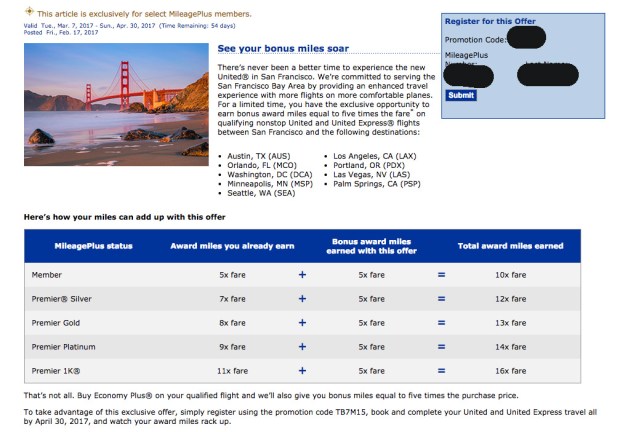
Not much to say about this… plus I want to post it before someone scoops me! I logged into my United account today and saw a targeted offer that seems to be focused on people based in/around San Francisco. In fact, the promotion is called “The new spirit of United arrives in San Francisco.”

Jeez, they’re really pumping this “new spirit of United” thing… which is fine, I suppose, especially since the addition of Basic Economy makes them more like Spirit Airlines. Probably an unintended coincidence, but we’ll know for sure if the next marketing campaign is targeted at people based in Austin and is called, “The new Spirit of United opens up a new Frontier for flyers in the Southwest.”

Anyway, here’s the details on the promotion. It’s not a world-beater, but these are pretty common destinations, so if you have travel coming up, this could be a good option to earn between 10 and 16 Mileage Plus miles per qualifying fare dollar. Registration is required, and travel must be completed by 4/30/17.

unitedtgt

Anyone else targeted for this? I’ve been a Mileage Plus member for a while and don’t remember a promotion this good in the last couple years, although it could be that some came and went without me ever seeing them. It’s interesting that I had to log in to my account to find this, rather than getting an email about it. Either way, I have some travel to Seattle coming up, so I may end up getting in on it.

United promotion for San Francisco peeps – up to 16x miles per dollar on fares. Oh sorry, I meant “AMAZING NEW UNITED PROMOTION, CLICK HERE FOR ONE WERID TRICK TO RACK UP MILES!!!”

Not much to say about this… plus I want to post it before someone scoops me! I logged into my United account today and saw a targeted offer that seems to be focused on people based in/around San Francisco. In fact, the promotion is called “The new spirit of United arrives in San Francisco.”
Jeez, they’re really pumping this “new spirit of United” thing… which is fine, I suppose, especially since the addition of Basic Economy makes them more like Spirit Airlines. Probably an unintended coincidence, but we’ll know for sure if the next marketing campaign is targeted at people based in Austin and is called, “The new Spirit of United opens up a new Frontier for flyers in the Southwest.”

Anyway, here’s the details on the promotion. It’s not a world-beater, but these are pretty common destinations, so if you have travel coming up, this could be a good option to earn between 10 and 16 Mileage Plus miles per qualifying fare dollar. Registration is required, and travel must be completed by 4/30/17.

unitedtgt

Anyone else targeted for this? I’ve been a Mileage Plus member for a while and don’t remember a promotion this good in the last couple years, although it could be that some came and went without me ever seeing them. It’s interesting that I had to log in to my account to find this, rather than getting an email about it. Either way, I have some travel to Seattle coming up, so I may end up getting in on it.

I don’t have ads on this site, but that doesn’t mean I’m not going to tell you about my Kickstarter project.

In my spare time (ie: the time spent not working or writing my irreverent points and miles blog), I enjoy writing other stuff, like essays about semi-obscure Italian artists. One such essay has become fairly popular – not Million Mile Secrets interview popular, but still pretty good. I’m currently raising some money over on Kickstarter to publish a new edition of the essay, since I originally wrote it a long time ago and it’s really out of date.

GO HERE GIVE ME MONEY OKAY THANKS BYE

If you like the posts where I blather on about literary theory, you’re going to LOVE the essay I wrote, since that’s basically all it is. It doesn’t have anything to do with points and miles, but one of the prices you pay for this blog not having any ads is that I will use it to advertise my own shit when appropriate. Your regularly scheduled programming will resume tomorrow.

ser1


Why I think it’s funny that people get so aggro about Amex’s overly complicated bonus structures

An entire industry has evolved around making things simple for people who want to earn free travel with their credit cards. The most disingenuous, in my opinion, is Capital One, since they overclaim how complicated loyalty programs are while simultaneously aping those programs’ terminology by calling their points “miles.” Despite what Jennifer Garner wants you to think, you’re earning 2% cash back, but not even, because you can only spend it on travel. Pass. This focus on simplicity also extends to cards that earn cash back in rotating categories – the Capital One pitch is that you can earn 1.5% cash back everywhere, rather than having to spend every waking hour trying to remember for the life of you what the bonus category is this month. I mean, it changes FOUR TIMES PER YEAR! That shit’s hard! It’s hard enough for me trying to walk and chew gum at the same time, so it’s no surprise that I can’t possibly memorize arcane quarterly bonuses in categories as random as “groceries” or “restaurants.” Sheesh.

Of course, this focus on simplicity is a reaction to something on the opposite end of the credit card market, and while I think that Capital One overclaiming the complexity of normal travel reward cards and loyalty programs is cynical, it’s true that some banks are worse than others with their Byzantine programs. As you probably guessed from the title, Amex is the worst in this regard. Or should I say best?

Amex gets tons of flak on FlyerTalk and environs for making it a pain to use their cards. A common question on forums (I refuse to say “fora”) is whether it’s better to earn 1.5 Ultimate Rewards points per dollar with the Freedom Unlimited or 1.5 Membership Rewards points per dollar with the Amex Everyday Preferred. A common answer on those same fora is that the Freedom Unlimited is better, because Amex, those cruel and heartless bastards, make you use the card 30 times per month in order to unlock the 50% points bonus that yields 1.5x per point.

How about the Amex Platinum airline credit? Citi gives you $250 per year to use on just about any airline expense (including tickets) and Chase gives you a $300 travel credit that is so broad that I wouldn’t be surprised if they credited back Zappos purchases because shoes are used for walking, and walking is a form of transportation, which counts as travel. On the flip side, Amex gives you $200 to use only for airline incidentals and only on one airline. People constantly complain about this, like Amex is putting $200 on the ground and then kicking you in the butt when you bend over to pick it up.

The new Platinum benefits include an Uber credit that gives you $15 per month and doesn’t carry over month-to-month (why don’t you shit in my car while you’re at it, you jerks). It’s another example of Amex including a benefit but not quite going all the way with it, similar to offering 5x on hotel bookings, but only those bookings made through Amex Travel (and even then, only prepaid bookings). And they have never gone so far as to offer a bonus on all travel, like many other cards do – it’s always airfare directly with  airlines, etc.

However, here’s why I don’t care that Amex does shit like this: because I’m the person in the best position to figure out how to take advantage of it. Everyone in this hobby is. The whole point of these structured bonuses is to minimize the number of people taking full advantage of them. I think it’s significant that Chase lost a fuckload of money rolling out the Sapphire Reserve (and I think they stand to lose more when a bunch of people cancel their cards this year without paying the fee a second time), and Citi had to roll back the benefits on the Prestige card. Meanwhile, Amex has been improving their premium offerings (while increasing the fee, yes, but still – they’re the only ones moving forward right now). I stand by my earlier point that the Chase Sapphire Reserve isn’t that great to begin with – it’s basically a Sapphire Preferred that earns more points and has Priority Pass. And really, would you be surprised if Chase trimmed the travel credit or dropped the earning at some point? I wouldn’t, and I certainly wouldn’t expect them to add any benefits.

Amex has been losing a bunch of money, but it seems like they’re able to improve their cards because of how many people can’t figure out how to use their Everyday Preferred card 30 times in a month, or people who forget to use their new Blue for Business card on restaurant purchases, or whatever else. Meanwhile, churners are the ones that stand at the self checkout kiosks paying for each grocery item individually; they’re the ones who used Mileage Plus Explorer to get Amex to reimburse them for Amazon gift cards under the airline credit until that went away, and then they switched to United Gift Registry credit.

For their trouble, churners earn 1.5x Membership Rewards points on everything, 3x on gas, and 4.5x on groceries, whereas people who value simplicity above all else use the Freedom Unlimited and get 1.5x on everything and no bonus categories. Any time a churner says that one card is better than another because it’s simpler, remind them that anything that is complicated can also be gamed, and gaming things is how you get outsized value in the first place.

I’m not going to lie and say I don’t appreciate the simplicity of the Sapphire Reserve’s earning structure. I also wrote a post last month about how I refuse to get so into the weeds that I pull out a calculator to figure out my earnings per point every time I make a purchase. However, I think a lot of this stuff can be mastered without all that much mindshare being devoted to it, and given the attitude of most people (“Jennifer Garner said that’s WAY too complicated to ever understand”), I’m happy to be one of the relative few who bother to learn the ins and outs of all these cards and programs.

In the end, I fully expect that someone will figure out a way to combine Amex Platinum Uber credits or game the 5x bonus on hotel bookings, and it sure as hell isn’t going to be some Richie Rich who uses his Platinum card for everything because he likes the concierge service.

(This is probably a topic for another post, but speaking of gaming the new hotel bonus: it has occurred to me in the past that Amex’s convoluted way of awarding bonus points might present an opportunity for the more ethically dubious among us to try canceling prepaid bookings way after the fact to see if the bonus points get clawed back. It depends on how they ultimately award the points. Right now the Platinum card earns bonus points on airfare that are factored into the card’s base monthly earning, whereas certain promotions – like the Blue for Business bonuses or the shop small promotion – award points incrementally. In my experience, when you get a refund on a purchase that earned points this way, Amex doesn’t revoke the bonus points. If the bonus on prepaid hotel bookings posts as a separate 4x bonus, I wouldn’t be surprised if canceling the booking leaves the bonus intact. I’m sure repeated abuse would get you shut down, but I’d be interested to find out. For a friend.)

Did the Mercedes-Benz Platinum Card just become Amex’s best value? Probably not, but you know, maybe.

Update: Nope, it didn’t. Turns out the customer service rep I spoke to was mistaken and the fee will be $550 after all. A chat rep not having the full story a day after the new card benefits are published? SCANDALOUS.

Today The Points Guy published a Q&A that everyone thinking of keeping or getting an Amex Platinum card should read, given that there are some changes coming to the card. Like most, I’m feeling meh-to-bad about the changes, but I’m not going to go into them in detail, since that’s been done to death already. Instead, I want to look at the Mercedes-Benz Platinum card specifically.

I picked up a MB Platty last summer when they offered 75,000 points after 3K spending. This was a public bonus that was around for a few months, and I considered it a great deal. Since my plan is to hold the Platinum card long-term, I intended to cancel the MB Platty after a year, netting 75,000 points for $75 after receiving $400 in airline credits across the two calendar years of card ownership. (The MB Platty has a $475 annual fee, which includes a $100 credit toward junky shit with the Mercedes logo on it and 5x towards purchases made directly from Mercedes.)

As is common knowledge by now, Amex is increasing the Platinum’s annual fee from $450 to $550, beginning for cards whose fees are billed after 9/1/17. That means that my above-mentioned plan to keep the normal one and cancel the MB has flipped, since my fee for the MB Platty hits in July, and the normal Platinum fee hits in September. Based on that 9/1/17 deadline, the fee on the MB won’t go up until 2018.

In the TPG Q&A today, they specify that the new annual fee will be $550 across all Platinum cards, including Mercedes. However, I had asked Amex about the fee on that card before I read the TPG article, and they gave me a different story.

I’m 100% sure that TPG is right, since the rep that their staff communicated with was probably way higher up the food chain than the chat rep I talked to. On the other hand, though, chats are technically “in writing,” so maybe I can be a dick and harass Amex about this when it becomes relevant. That won’t be for a while, since I won’t be charged $550 to renew this card until July of 2018. By then, I’m sure the actual fee will have been well-published, eliminating any case for confusion stemming from a web chat two days after the changes were announced. Still, at least in the early days of the new Platinum roll-out, I wanted to publish this at least to show that Amex hasn’t buttoned up their messaging quite yet.

Earn 2.5 AAdvantage miles per dollar on groceries + 1.5 miles per dollar on dining and travel! Or don’t; it’s not my job to tell you what to do.

Kind of like my Fantom Blue post from the other day (god I hope that takes off), I’m going to write about another opportunity that probably isn’t very good but still worth looking at. Why write about an opportunity that isn’t very good? Well, given how often things change, there’s always the chance that a mediocre opportunity becomes a good one, especially if it can be stacked with a limited-time promotion. So bear with me.

What I’m writing about today is Hyatt’s point transfer feature, which is kind of a poor man’s SPG. I had forgotten that you could even transfer Hyatt points at all, and I figured that the ratios were so bad as to make it a terrible deal. I noticed a thing about it on the new World of Hyatt homepage when I logged into my account, though, so I decided to give it a look to see what’s what. Before I get started, look at the tagline here. WTF? If anything, doing this would push you further away from earning a free night. How long before someone notices this and changes it?

ptsintomiles

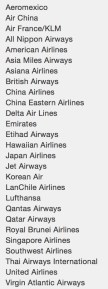
Getting back on track, the first thing I noticed is that Hyatt has a decent range of transfer partners, including programs that don’t partner with any transferrable currencies. Here’s the list:

list

With some exceptions, the transfer ratio is 2500 Hyatt points into 1000 miles. Not great, although Hyatt does offer a 25% bonus if you transfer 50,000 Hyatt points, bringing the ratio to a straight 2:1. Okay, so what idiot would convert Hyatt points to miles at a 2:1 ratio, right? Well.

I pick on the SPG card sometimes, because I think people like it too much. I have one myself, but I just get frustrated with its low earning rate. I get that the points are great, but without manufacturing spend, I just don’t spend enough money to make a meaningful contribution to my SPG balance each year. I love the SPG program, but the card’s 1x per dollar earn rate is a snoozer to me. I sometimes consider changing my earning strategy to focus more on SPG, but I always decide not to, since I’d rather earn other points more quickly.

The reason I bring it up is that I started thinking, what if the SPG card had category bonuses? If they offered 2x on gas and 3x on dining, would I use it more? I can pretty much guarantee that I would. So then I started thinking about that in the context of Hyatt’s airline transfers and Chase’s card portfolio. Is it possible to mash a bunch of Chase cards together, transfer the points to Hyatt, and create a kind of bastardized SPG sitch? Sorta. Of course, the first caveat is that SPG’s transfer partner list is better. However, both SPG and Hyatt benefit from having transfer partners that are incredibly useful strategically, including Lufthansa, Japan Airlines, and American Airlines. The second caveat is that in this thought experiment, you’re burning all your Chase points this way. There’s a reason no one tells you to use your SPG card for everything: with its low earn rate, it’s only good for unbonused spend. And I’ll acknowledge that in the scenario I’m describing, you’re probably getting a sub-optimal return on your Chase bonus categories.

But, for discussion’s sake, here’s how it would look. Say you have the Chase Sapphire Reserve, Freedom Unlimited, Freedom, and Ink Cash. That means your earning looks like this:

  • Travel & Dining: 3x
  • Cell phone & internet: 5x
  • Office supplies: 5x
  • Rotating categories (currently gas, etc.): 5x
  • Everything else: 1.5x

Looking back at the Hyatt transfer ratio, cut everything there in half and that’s your earning ratio when using Chase cards to earn airline points via Hyatt. Not great, but not nothing either. Hear me out: American Airlines doesn’t partner with any bank points right now, which means that it’s hard to earn more than one AAdvantage mile per dollar unless you’re using a co-brand card – and only then if you’re spending money on AA tickets (or on business bonus categories if you have the CitiBusiness card). However, using this method, you can earn 2.5x AAdvantage miles per dollar for cell phone or office supply purchases, or 1.5x on dining and travel.

JAL is a good example too. Last year when Alaska sodomized the Emirates first class redemption prices, JAL became the best program to book Emirates awards. The difference is pretty ridiculous: 135,000 R/T from JFK to Dubai via JAL vs. 300,000 for the same route via Alaska. Imagine your friend is getting into churning and is dying to fly Emirates first because they heard it’s the nicest one. You tell them to get an SPG card, and they earn 35,000 miles (because you told them to do it while SPG has the elevated bonus). Maybe they’re going to be really aggressive, so you tell them to get the Marriott card too, and to convert the sign-up bonus points to SPG. Great, so after the min spend requirements, they have around 68,000 SPG points and need to come up with another $40k or so in spending (factoring in the SPG transfer bonus) before they have enough for Emirates – and earning 1 point per dollar, that becomes a slog.

That’s when Chase can come to the rescue – the Ink Preferred bonus is good for 40,000 JAL miles. Tack on 27,500 more from the Sapphire Preferred bonus. Is this the best redemption you can think of with these Chase bonuses? Probably not, but in this hypothetical, there is a very specific goal, and the oft-overlooked Hyatt airline transfer program offers a pretty decent strategic opportunity to accelerate the progress toward that goal.

I also think it’s kind of funny that Alaska made those redemptions so ungodly expensive that it’s actually cheaper to convert your Chase points at 2:1 to JAL miles (270,000 vs 300,000). Thinking about it that way, I guess what I’m saying is that Hyatt’s transfers add an interesting strategic opportunity for Chase points that other bank points don’t offer. Chase’s Hyatt partnership gives them a stable of “Tier 2” partners that – while they don’t have great ratios – could definitely make sense in the right circumstance, which only further enhances Chase’s value in my mind.

Finally, it should be obvious by now that there’s no reason to think of it as Chase/Hyatt OR SPG. If your goal is to earn points in programs like American Airlines or JAL that are common to both SPG and Hyatt, you can combine both, earning up to 2.5x on certain categories but never less than 1.25x.

Bottom line: can you imagine how people would lose their shit if Amex announced that the SPG card would now start earning 2.5x in quarterly rotating categories? Boarding Area would explode. However, if your travel goals happen to line up with the programs that SPG and Hyatt have in common, that’s exactly the opportunity that this presents.

So now the requisite question for the commentariat… Am I super late to the party here? Does everyone already know about this? Is there a reason you never really hear about this as an asset for the Gold Passport World of Hyatt program? (As an aside at the end of an already long post, I want to make it clear that I don’t fashion myself as some lone voice in the wilderness. I’m sure people talk about this, and I don’t really read FlyerTalk or Reddit, so I miss a lot of stuff that gets talked about there. This is more about how I discovered something for me, which I hadn’t really thought about before. If it’s useful to you, then great, but I’m not standing here trying to pat myself on the back for being the smartest guy in the room or anything.)

Time to share my timeshare presentation experience at the Westin Ka’anapali [2022 UPDATE]

2022 Update: Most of this post is no longer relevant. How’s that for an update? First of all, the deal that I got in exchange for the timeshare presentation no longer exists and hasn’t for years. Also, a lot of the perks were specific to SPG hotels, and SPG no longer exists and hasn’t for years. I would assume there has been some conversion to Marriott Bonvoy, but I don’t know any specifics. Also, I’m sure that the prices I referenced in the original post are long gone. However, I have not received any other timeshare offers from SPG/Marriott/Vistara since saying no to buying a timeshare back in 2017 (which is when this post was originally written), which means that I haven’t had any opportunities to follow up on any of these details. All this is to say that the original post has questionable value today, although I suppose it could be useful if you’re curious what a timeshare presentation is like if you do happen to take advantage of one of these deals. [End of Update]

I remember I was traveling for work when Justine called me up and said we had received an offer in the mail for a Hawaiian vacation. Thinking this was the normal mailbox spam that only exists to keep the postal service in business, I didn’t really think any more about it until we both realized that it was actually a pretty good deal: $795 for five nights, a $75 resort credit, and a free 6-day car rental at a Westin in Maui. Neither of us had ever been to Hawaii before, so we figured “why not?” and put a deposit down to reserve one of the packages. Now, the Westin Ka’anapali Ocean Resort Villas (full name necessary since there are two Westins in Ka’anapali) is a vacation ownership property, so it occurred to me when booking that I might be roped into a timeshare presentation as part of the package. However, the phone rep told me I’d be invited but would be free to turn it down. Easy enough.

Fast forward a bunch of months, and we arrived in Hawaii and were give a window to stop by the vacation ownership office to pick up our $75 certificate. It would have been simple enough just to apply the credit to my account, but they make you meet them in person to get the $75 so they can rope you into the timeshare presentation. I was initially dismissive of it, but they laid the guilt on pretty thick when I said I didn’t want to do it. Stuff like, “You do know that’s why you’re here right?” Or, “We won’t send you any more special offers anymore if you say no.” And even, “You’re worse than Hitler, and you might as well drown some puppies in your in-room hot tub.” She also offered 7000 SPG points if I agreed to the presentation, so I figured I might as well learn something, since I actually had no idea how timeshares work.

westin1

The presentation itself was fine – they didn’t hard-sell us at all, took no for an answer pretty easily, and gave us free snacks. I’d say it was worth it to earn 7000 points, if only because I now know how timeshares work. And I figured that if there’s anyone else out there who’s curious, I’d pass along what they told me. Bottom line, it’s really expensive, and the economics don’t make as much sense if you pay for hotels with points. See, the whole crux of their argument is that you’d spend as much on hotels over 20 years as you’d spend on your timeshare payments, so wouldn’t you rather own something after that time, rather than owning nothing? But if you aren’t paying a few thousand bucks a year out-of-pocket to stay in hotels when you take vacations, the logic isn’t as sound.

One thing to point out at the beginning: they kept saying, “What sets this opportunity apart from other timeshares is the SPG program.” When I walked down the hall to use the restroom, I heard that same line come out of a few other offices too, so it’s obviously something they coach their sales reps on. However, when I brought up the Marriott takeover, they didn’t really have a clear answer for me. Here’s how it works: Vistana Experiences manages the vacation ownership property, and they license the Westin brand, as well as the SPG program. According to them, Marriott isn’t taking over the timeshare side of SPG’s business, which means that apparently Vistana will continue to be a licensee of the Westin brand. (This doesn’t make sense to me, though, since Marriott would have to be the licensor here, so it doesn’t sound like anything is really changing, except the party from whom Vistana is licensing the Westin brand. SPG doesn’t own the timeshare business now, so I don’t know what there would be for Marriott to take over in the first place.) In any case, the SPG program will not survive the merger, so even if Vistana continues to operate a Westin property, they won’t have a loyalty program to go along with it, unless they take on Marriott’s program. I asked about this to three different people and got mixed answers, but it would make the most sense that they’ll move over to the combined program like anyone else. However: right now Vistana issues SPG points that operate a little differently than normal SPG points in that they have a hard six-year expiration date, regardless of account activity. I don’t know how this would work with Marriott – will they just start issuing triple the points? Unfortunately, I don’t think Starwood has really explained any of this, because even the most senior person I spoke to didn’t know. I’ll get into this more at the end, but they kept trying to throw points at me in order to get me to agree to stuff, and some of these offers were promises that I would earn points in 2-3 years. I kept asking how they could promise me 50k SPG points in two years, when SPG won’t exist in two years, and they didn’t know.

So here’s how the timeshare worked (at least as they offered it to me): If I purchased it, I would get the right to spend one week per year in a two-bedroom suite at the new Westin Ka’anapali Nanea property, which is currently under construction. That right would be represented by a certain number of points (not SPG points; these are separate timeshare-only points) – I would receive 148,100 points per year, and a week in the two-bedroom at Nanea would cost 148,100 points. The points would expire at the end of the year, so I couldn’t hoard them over a few years and then rent the room for three weeks. Any time points are involved, my devaluation alarm goes off, but they assured me that my timeshare deed would guarantee me the number of points required to book the unit I “bought” when I signed the contract.

One of the things I didn’t know about was that timeshares are flexible. I initially thought I’d never want one, because I wouldn’t want to go to the same place every year. However, my 148,100 points could be used at any Westin or Sheraton vacation ownership property, or even redeemed for hotels through their exchange program after paying a $175 conversion fee. The exchange values aren’t terrible either; it’s not like spending Membership Rewards points for Bose headphones or something. Also, since Nanea is pretty expensive, my points might actually go further at other resorts. Even at Nanea, if I wanted a one-bedroom instead of a two-bedroom, I could reserve that instead and get two weeks. Or one week in a one-bedroom and two weeks later that year in a studio. I didn’t go through the whole list of exchange hotels, since they were listed in what looked like a phone book; suffice to say that it looked like quite a lot of choices. Finally, if I decided that I didn’t want to take a vacation one year, I could cash out my points for 80,000 SPG points – the only restriction there is that it can only be done once every other year. (Again, I don’t know how that will work once SPG goes away.)

westin2

All in all, they did a good job selling it to me, since I went in thinking there was no fucking way I’d ever want a timeshare, and I came out thinking that I would consider it if my financial situation were different. And there’s the rub – it may be a “good value” according to the economic scenario they lay out (which is, of course, specifically calibrated to make the timeshare seem like a good deal), but it’s also a huge pile of money every month for ten years. Here are the numbers:

Option A (Annual timeshare):
$57,019 list price
Down payment required: $5702
Closing costs: $745
Total due at signing: $6447
Monthly payment, 10-year term: $794
Monthly payment, 15-year term: $679

Option B (Bi-annual timeshare):
$32,212 list price
Down payment required: $3222
Closing costs: $745
Total due at signing: $3967
Monthly payment, 10-year term: $448
(No 15-year option)

Additionally, they offered me the following incentives for booking while I was staying at the hotel:
– Lifetime SPG Gold status
– 100,000 SPG points
– The opportunity to buy 90,000 points for $1875, 4x per year
(The rep mentioned that this was the cheapest that anyone anywhere could buy Starpoints, and I mentioned to her that I had just bought 30,000 points for $525 when Starwood ran a 50% targeted bonus. Oops.)

We thanked them for the offers but said it wasn’t in our budget, and they didn’t really press us on it, which was nice. The last hurdle to jump was the senior senior manager coming in at the end to offer us a consolation prize, which was to come back within the next two years on another special package, this time for 7 nights and with a bonus of 50,000 SPG points. However, this package was priced at $2495 (due immediately), which – even with the points – was a significantly worse deal than the one that had originally brought us to the hotel in the first place.

Bottom line, I’d recommend taking the 5-night/$795 offer in a second. The hotel is a steal for ~150 per night, especially with the free rental car and $75 credit. The rooms have kitchenettes too, so you can eat pretty cheaply if you get groceries from Safeway instead of relying on overpriced restaurants. The grounds are really nice, the room was very spacious, and the area is gorgeous. My only issue is that the rooms don’t have showers, so you’re stuck spraying yourself with a shower head while sitting in a tub, which is super awkward and annoying. Aside from that, it’s a great place to spend a week. I’m hoping I get an invite for the Sheraton Maui next, since I’d definitely do it again.

westin3

Anyone out there own timeshares? I’d be curious if it’s actually as easy as they made it sound, or if rooms are often unavailable when you try to book. I’m also wondering if the point system really is as smooth as they described it, or if it’s harder to split points into two different stays or across multiple resorts. It’s not a huge area of concern for me, since I’m not in a position to take on a 10-15 year obligation like that, but who knows where I’ll be five years from now. By then, maybe I’ll be up to my ears in blog revenue and will have to buy a timeshare just to get rid of all my extra money.

Taiwan, anyone? Availability is really good, and your options are even better.

I can’t remember why I was looking at availability to Taiwan yesterday, but I was, so here we are. I don’t have any upcoming travel there, so I guess I was just curious. The nice thing about flying to Taipei is that you have two really nice options to get there. China Airlines just started flying their new A350, and EVA flies a handsome 777-300ER. Aside from airlines with a dedicated first class cabin, these look like two of the comfiest ways to cross the Pacific.

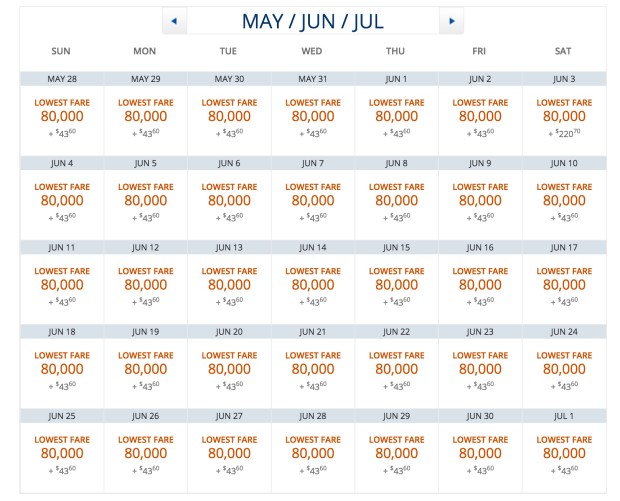
On the SkyTeam side, China Airlines SFO-TPE is wide open for small groups (most days have 2-3 seats).

tpedelta1

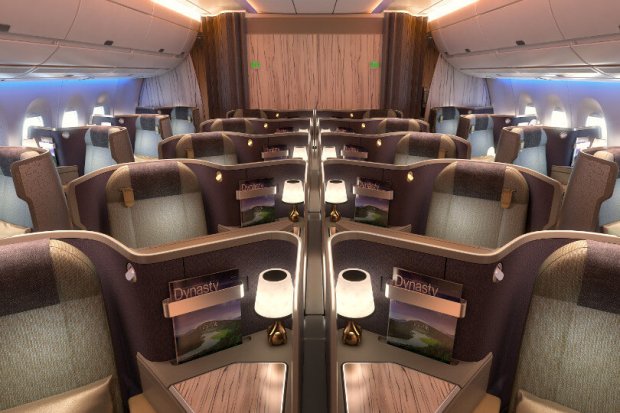
And here’s a stock photo of what you can expect for your 80,000 miles:

chinaairlines_a350_businessclass_810_540_72_tiny-810x540

The A350 is the plane I most want to fly on, and this configuration is one of the nicest I’ve seen. I think I prefer the Finnair cabin due to my affinity for Scandinavian things, but now we’re getting off-topic.

Checking other West Coast cities brings up itineraries that feed domestic connections into the SFO route, so unfortunately it’s not a bonanza up and down the coast. Still, a short flight followed by some lounge time at SFO and then 13 hours on this A350 sounds pretty damn agreeable to me.

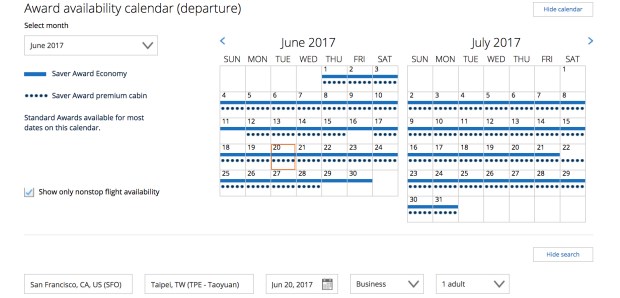
Looking at Star Alliance, EVA is similarly available, although not quite as open as China Airlines:

unitedtpe

Despite the “nonstop” filter being checked, not all of these flights are nonstop SFO-TPE. However, the days with connections are feeding you into long-haul routes into TPE from either LAX or Vancouver – so still pretty good. If you look at the above graphic as showing general transpacific availability on EVA with a possible domestic connection, then it’s accurate.

Here’s a picture of EVA’s cabin, which was strangely hard to find, by the way. (Not that pics are hard to find in general, it’s just really hard to find an official photo from EVA and not one from One Mile at a Time.) This photo sucks, but basically it’s a clean-looking reverse herringbone seat, and given the width of the 777, it gives you about as much room as you’re going to get outside of first class.

evaair-77a-rl-herringbone-layout-2_tcm35-26942

If I had to choose, I’d pick the China Airlines flight because of the A350 factor and the fact that I’m sitting on more Delta miles than I’d like to be. However, it’s hard to argue against either of these. I just opened up a new distributor for my company’s products in Taiwan, so maybe I should go visit them in person. Hmm…