Lounge Life (Part 1)

Aside from a trip to the Admirals Club when I was in high school, I had never been to an airline lounge before this year. What a year of firsts! My current lounge credentials are obtained through credit cards: Priority pass lounges and American Admirals Club access through the Citi Prestige and Delta Sky Club and Centurion lounge access (plus a redundant and guestless Priority Pass membership) through the Amex platinum. I also get two United Club visits per year via the annual free passes that are included with the Mileage Plus Explorer card. You want reviews? I know you do. Every travel blog reviews stuff – I even found a review for a fucking bag of snack mix the other day. Conclusion: if you want readers, you gotta review. So here you go.

Overall, I think lounges are funny, in that (at least in the US, and I haven’t visited any of the fancy international lounges yet), their only value is determined relative to the rest of the airport. Most lounges would make shitty hotel lobbies, for instance. Pretty much any mid-level hotel will have nicer seating and furnishings in its lobby than you’ll find in the average airport lounge, but given that waiting out a 2-hour delay in a crowded terminal is a soul-suckingly awful experience, even a shitty hotel lobby is preferable. Therefore, I’m not reviewing a random Admirals club as it compares to the Emirates first class lounge in Dubai. Instead, my ratings are based on the following criteria, each worth ten points: furnishings, cookies, other non-cookie snacks, alcohol, views, bathrooms, outlets, and other amenities.

Alaska Airlines Board Room, SEA
Furnishing
s: worn down and could use a refresh, but overall comfortable for waiting out a layover. 6/10
Cookies: cinnamon animal crackers. Will do in a pinch, but disappointing. 2/10
Snacks: pancake printer is nice for the novelty, but it prints fairly rubbery pancakes. Maybe it needs new toner (AKA dough). Salads always look gross. Haven’t tried the soup, because I’m not generally a soup fan, AND WHY DO LOUNGES ALWAYS SERVE SOUP? 4/10
Alcohol: actually I haven’t had any alcohol here, but you get good beer and cocktails for free, so I’ll give this one a high score. 9/10
Views: great tarmac views, although you only see Alaska’s planes, so it gets a little repetitive after a while. 7/10
Bathrooms: clean, fairly private. Didn’t smell like piss the few times I’ve used it. 8/10
Outlets: most seats have outlets available. Why every lounge isn’t just a sea of power strips is beyond me, but whatever. 10/10
Other amenities: nothing really jumps out at me here. I’ll give it a few points for having a good division between the quiet area downstairs and the party atmosphere upstairs. 3/10
Final score: 49/80

I couldn’t find any pictures of the United Club at SFO, so you get this graphic instead. The United Club SFO is not this nice, so don’t get excited.

United Club, SFO (International Gates)
Furnishings:
worn down and could use a refresh, but overall comfortable for waiting out a layover. (Yes, I copied and pasted this from the last one. It’s a pretty universal description of most lounges.) 6/10
Cookies: some weird brownie crunch stuff. Not bad, but still lower-tier. 4/10
Snacks: Good hummus, and I like that there are Skittles. Don’t Skittles seem like the kind of food that kids eat? It’s fun watching all these distinguished looking business people chomp down on some Skittles, reminding them of the childhood they lost and will never get back. This gets a high score for that alone. 7/10
Alcohol: Piss beer for free, everything else you pay for. Don’t insult me with your Coors Light, United. $600 per year for a membership and you can’t even give me Sam Adams? Fuck you. 1/10
Views: some good angles, but heavily obscured by its position in the terminal. 5/10
Bathrooms: Didn’t use, but this lounge gets really crowded, so I’m skeptical. 6/10
Outlets: One section has good access, the other doesn’t. 6/10
Other amenities: The lobby of this lounge is really nice. In fact, the first time I went to this lounge, I was really excited for what I’d find simply due to how nice the lobby is. The resulting disappointment could either be viewed as a positive or a negative. 4/10
Final score: 39/80

Unlike the United Club banner, this actually is the Admirals Club at SFO.

Admirals Club, SFO (International Gates)
Furnishings:
 Newer than the other two, but surprisingly worn given that it was refreshed recently. Looks like it gets a lot of use, even though it was pretty empty while I was there.  7/10
Cookies: Excellent chocolate chip cookies. Not “artisanal” or anything fancy, but a good, utilitarian cookie can really hit the spot. 9/10
Snacks: Not great once you’re done with the cookie. Yogurt pretzels and dry fruit mix abound, and the food for purchase is way worse than what’s out in the concourse. Also, the dried fruit has a really high banana chips to everything else ratio – personally, I hate banana chips and adjusted the score accordingly, but you may want to take this into account. 7/10
Alcohol: Same deal as United. 1/10
Views: Very nice, and a good amount of window seating, too. Although you mostly look out at United planes (ironically), you can still catch the big boys taxiing by. I saw an Emirates A380, which was pretty impressive next to a bunch of 737s and the like. 8/10
Bathrooms: Pretty decent, but Terminal 2 at SFO has strangely clean bathrooms, so it isn’t a huge benefit. 6/10
Outlets: Good overall access. 8/10
Other amenities: From an ambience perspective, I like this lounge. They tried to do something different with the fake trees and the circular layout in the middle, so it doesn’t feel as generic as some of the other lounges. Especially given some reviews I’ve read of other Admirals Clubs, I have a feeling this is one of the nicer ones around. 7/10
Final score: 53/80

Stay tuned for more lounge reviews in part two of this gripping post!

Requisite question designed to spur a flurry of responses in the comments section: What’s YOUR least favorite lounge in the US?


Ambivalent Ambassador

Earlier this year, I paid $200 to get Ambassador status at Intercontinental hotels. I did it on a whim, since I had sold a bunch of stuff on eBay and had used the money to book a couple weekend trips to IC hotels in Monterey and San Francisco (“staycations” as they’re called by insufferable people). I’m still trying to decide if it was a good deal, and, more importantly, if I’ll pay $150 to renew it next year.

First, though… seriously, fuck the name of this “status.” One, it doesn’t count as elite status if you can just buy it. Whenever I check in at an IC hotel, they always go out of their way to thank me for being an ambassador, and it seems hollow, since they aren’t thanking me for being a frequent guest or whatever, just for forking over $200 in hopes that I can wring more than $200 in value out of them over the next year. Two, what am I ambassading? Am I going out into the world and representing the Intercontinental in a positive light? (Probably not, given the number of f-bombs on this blog.) And if I stay at IC hotels every night for a year, I may be invited to be a Royal Ambassador, which is roughly the same thing, except you get a bejeweled crown upon check-in and free drinks from the minibar.

Okay, so with that out of the way, let’s take a look at the value I’ve gotten out of my Ambassador membership this year. This is a mix of quantitative and qualitative, since (in general) I really like Intercontinental hotels. I like that they’re all different, so you don’t get that “what city am I waking up in” feeling you get from business-friendly hotels blending together in your mind. Plus, they’re pretty nice across the board, so it’s always fun to go to a new one. So overall, I do like getting upgraded on check-in, and that alone may be worth $150 to keep my membership next year.

Stay #1 – Intercontinental Monterey
-Upgraded from standard room with king size bed to one-bedroom suite with balcony and bay view. This is a huge upgrade, since the standard rooms at this hotel face a parking garage. The price difference was around $180 for the night, although I wouldn’t have sprung for the suite at the normal rate. I would have probably paid for a room one or two categories above the standard room, though, so I’m gonna say this upgrade was worth $40.
-Fruit upon check in: $0. I did eat it, but only because I eat whatever is in front of me. I didn’t want the fruit, per se, so it gets a big fat goose egg.
-Welcome amenity (a chocolate bar): $0. I ate this too, but it wasn’t very good.
-Movie: While We’re Young. We usually rent movies in hotels, so I’m gonna give this one the full list price of $15.95.
-Late check-out. Oh man, I LOVE late check-out. Justine and I sat around in bathrobes watching Ink Master on SpikeTV and looking at otters frolic in the bay until well into the afternoon. I probably wouldn’t pay for late check-out, but getting it for free is a pretty huge perk.
Total value: $55.95 plus loving the late checkout lifestyle.

Stay #2 – Intercontinental San Francisco
– Booked junior suite and declined an upgrade to a one-bedroom suite, even though the difference in price between the two rooms was over $300. We were only going to be there one night, so a one-bedroom suite was wholly unnecessary. Instead, we got free breakfast and club lounge access. The club lounge at this hotel is pretty lame, but the breakfast is AMAZING. We’d have definitely paid for breakfast, so the value here is pretty easy to determine: $65.
-Fruit upon check in: they didn’t bring the fruit at first, and I called down to complain, even though I didn’t want the fruit. I’m a terrible person. Value: negative $1,000,000 value due to me being an asshole.
-Welcome amenity (some discount cards for stores at the nearby mall): $0. I buy everything online, anyway.
-Movie: Blackhat. Again, we’d have rented a movie no matter what, so this gets the list price: $15.95
-Late check-out: This was the nicest hotel room either of us had ever stayed in, so we stayed until right around 4PM, grabbed some drinks from the club lounge and left. Value: $1,000,000.
Total value: $80.95 plus more late-checkout luxury.

Stay #3 was supposed to be at the Intercontinental Chicago, but I canceled at the last minute so that I could book a Rocketmiles stay instead. That brings us to the Intercontinental Austin, where I’ll be staying tomorrow through Wednesday for a business trip. Because I’ll be there on business, I really only care about what upgrade I get, since the standard rooms are pretty small. If I only get upgraded to a room with a better view or something, I won’t really feel like I got any value out of the Ambassador membership on this stay.

Update: While the upgrade perk is only technically supposed to bump you up one room category, I found out upon check-in that I got moved from a standard room all the way up to a one-bedroom suite (that’s at least three categories higher). This is an example where there isnt really a monetary value, since my standard room is reimbursed by work and I wouldn’t have paid anything to move to a better room. However, it does make my trip much nicer to have a suite vs. a small room with only a bed and a small desk. For this year, it definitely adds value to my Ambassador membership, helping to justify the $200 fee. For next year, I’m not sure, since it’s uncommon for me to travel to Austin on business, and there aren’t Intercontinentals in most of the locations I routinely visit for work.

Stay #4 is coming up in December at the Venetian. Since this is a partner hotel, I’m not really sure what to expect in terms of benefits. We have a late flight out, so late check-out would be nice, and I’d love to parlay an upgrade into free breakfast again. The big thing here is that I used the Ambassador free night certificate to book this stay. One nice thing about the certificate is that it is good for any room, not just rooms with award availability. The downside is that you have to book the refundable rate, which is often much more expensive. If I had booked two nights here at the best available rate, the total would have been around $650 with resort fee and tax. At the refundable rate, the total is $810 with resort fee and tax, and due to the disparity between the cost of the room on Saturday vs Sunday night, I’ll get about $300 knocked off by using the certificate. That comes out to around $140 in savings, which isn’t bad, but it isn’t really a “free night” either.

Overall, if you add up the benefits through three stays, it’s well over $200, and that’s without counting the 6000 IHG points I got for signing up (5000 as a bonus and 1000 from using the IHG credit card). Plus, there’s the late check-out, which massively improved both of our overnight trips. I’m still on the fence about renewing for next year, though… especially now that I have mid-tier status in some other hotel programs as well and can get room upgrades and late checkout at Hyatts, SPG hotels, and anything booked through Amex Fine Hotels & Resorts.

Requisite question designed to spur a flurry of responses in the comments section: Do YOU cringe when you have to say “Ambassador” status?

Starstruck!

Okay, so Gary Leff is a god in the points/miles world, and I read his blog religiously. I even listened to his entire podcast with Roberth Wuhl while waiting in an insane line at a sandwich shop near my office. It was a nice way to pass the time, especially since I’m a fan of Robert Wuhl as well. (Fun fact: my dad works for a corporate advertising company that used to put on big, elaborate investor productions, and Robert Wuhl’s agent sent his reel to the company back when Wuhl was just starting out. My dad thought it was funny and brought it home for me – this was probably 10-15 years before Arliss.)

My point in bringing up Gary Leff is that I’m about to quibble with one of his blog posts, and I want to make clear that it’s less about being agonistic for the sake of it, or trying to point out where he’s wrong, and more about trying to understand people’s fascination with Starwood. Here’s the post. The gist of it is that a reader emailed to ask which is a better limited-time bonus between the Citi Prestige (50,000 points instead of 30,000) and the SPG Amex (30,000 points instead of 25,000). Now, assuming the 50,000 point bonus on the Citi Prestige is actually limited-time (they say it is, but it has been around for months already), I don’t understand how the answer to the question could possibly be the SPG card. I get that Gary wants to flesh out the overall value proposition of each card, but in what world are Starpoints worth FOUR TIMES Citibank Thank You points? In certain situations, like if you only ever fly airlines that SPG transfers to, and you only care about a card that can transfer to them, then sure, SPG is the card for you. However, if you’re that person, you probably aren’t even bothering to ask which is the better limited time offer, since even 500,000 Thank You points wouldn’t be worth it to you. So for the casual enthusiast, I can’t understand why anyone would passing on the Prestige’s offer in order to get 5,000 extra Starpoints.

And, in Gary’s defense, he does tell the guy to just get both cards if he can hit the spending requirements, which is sound advice. Still, it’s just more evidence of the Starwood Lust I wrote about previously, and I still don’t get it. I suppose I should just get the card to see what the fuss is all about. I’m not one to cling to my opinions so strongly that I won’t allow my mind to be changed, so maybe that’s what has to happen.

Requisite question designed to spur a flurry of responses in the comments section: Do YOU ever disagree with Gary Leff, and if so, where the hell do you get off?

Fuel Surcharges + Forfeited Cash and the Value of Award Redemptions

In this post, I described how I choose to value redemptions relative to how difficult they would be to earn with a cash back card. I wanted to go into pretty fine detail, since I often see people argue that if an annual fee is X and a cash back card pays Y, then every redemption has to be at least Z pennies per point or you’re losing money. And most of the time that people make this argument, they do so in the context of travel rewards cards ultimately being less lucrative than cash back cards. My goal, therefore, was to test whether this idea that cash back cards are usually better is true for me by creating a calculator that would help me value each individual redemption.

However, since I wrote that post, two additional points came to mind that I wanted to address. First is the issue of “forfeited cash,” which is cash that I’d get from using a cash back card if I never took trips and instead put it in my investment account. Clearly the most frugal strategy would be to use cash back cards exclusively and invest the money, since even the most wildly valuable redemption wouldn’t outperform 2% of all credit card spend invested in dividend-paying stocks over a 40 year period. However, I do kind of want to see the world before I retire, so that option is out. Still, I should at least account for the cash that I’m forfeiting by using a travel rewards card when I value redemptions. This is difficult, however, since it’s really tough to pin down points per dollar that I earn. (And that figure is necessary, since I’d use it to determine the amount of credit card spend I needed in order to earn enough points for the reward.) First of all, it changes every month, and second, most redemptions are made using a combination of points from different programs, plus points I earned “for free” (AKA through a shopping portal or some other method not mutually exclusive with using a cash back card). So, I can ballpark it, but it’s incredibly difficult to know for sure. Overall, I view it as one of the costs of trying to redeem points for premium travel that I couldn’t afford with cash, although it doesn’t ultimately factor into my valuation of an individual award redemption.

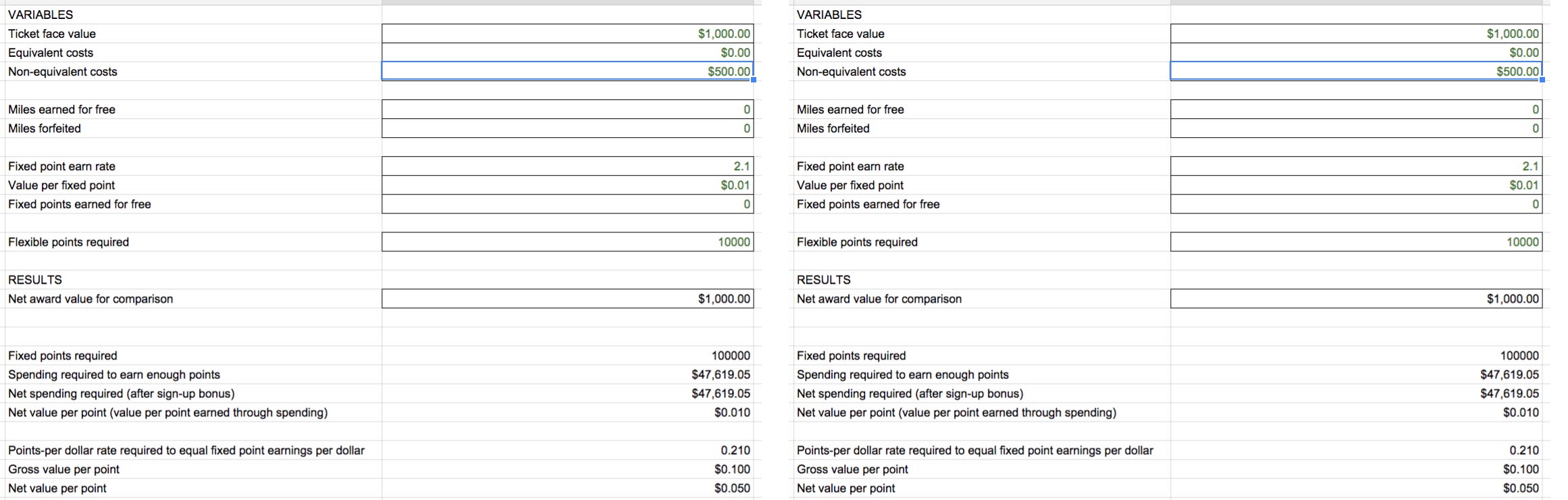
Fuel surcharges, on the other hand, are tricky to account for. I’ve gone back and forth on this, trying to figure out where to account for them. Here’s where I get hung up: fuel surcharges are paid on a revenue ticket or an award ticket (assuming the carrier doesn’t waive them on the award ticket), so right off the bat, it seems like they’d be equivalent costs. However, in reality most people don’t redeem fixed value points just for the fare portion of a ticket; since the airline bundles all the fees together, the flexible points award uses enough flexible points to cover the total price. In my calculator, I identify the “net value for comparison,” which includes the equivalent costs, but not the non-equivalent costs. My thinking was that it’s an apples-to-oranges comparison if you’re looking at the amount of fixed value points required to pay for an entire ticket, since only the award redeemed with miles would have a cash component as well. This is open to debate, though, since you *can* pay for fuel surcharges with fixed value points, but you can’t with flexible points.

I played around with the calculator a little bit to run some different scenarios to see which produced better data. Here are two scenarios:

comparison

This is a fairly simple hypothetical redemption, with the only difference being whether the $500 fuel surcharge goes into equivalent or non-equivalent costs. The net value per point is the same, since that value takes into account all costs. However, putting the fuel surcharge into non-equivalent costs distorts the point-per-dollar rate required metric in an undesirable way. Since non-equivalent costs don’t deduct from the net value for comparison, the fixed value redemption is for a higher amount. And, if the net spending required amount goes up, the points per dollar rate goes down (because each dollar can earn fewer points if there are more total dollars to spend in order to reach a fixed number of points). So, after looking at it this way, it becomes clear that fuel surcharges should be accounted for as equivalent costs, since doing so has no effect on the net value per point metric and it presents a more accurate picture of whether the points-per-dollar rate of the travel rewards card is actually beating the cash back card.

Requisite question designed to spur a flurry of responses in the comments section: Do YOU give a shit about any of this?

Dutch Crunch

I’ve been pretty excited to fly SFO to Amsterdam on KLM’s new business class, which looks fantastic. The seats actually look pretty similar to United’s trans-con BusinessFirst, but the whole aesthetic is taken up a notch, and they’re in a dedicated mini-cabin on the upper floor of the 747 (or in the nose, if you prefer that). They’re not as good as reverse-herringbone seats if you’re traveling alone (since you’ll need to climb over your seatmate to use the bathroom), although since Justine and I will be traveling together, it’s not as much of a concern.

The plan was to use FlyingBlue miles, since I easily earned 100,000 Citi Thank You points from sign-up bonuses earlier this year, and those transfer 1:1 to FlyingBlue. Then I learned that you can often book the same seats using Delta SkyCents, and since partner awards haven’t been sent through the wood-chipper yet, you can get a whole lot of value out of them. Plus, with Delta you avoid fuel surcharges on the outbound route, which saves around $500 for two tickets.

Nothing’s ever permanent, though, which makes planning for trips over a year away pretty difficult. To wit: I just noticed that while AMS-SFO has traditionally been served by the 747, KLM also uses an A330 around half the time. While that normally wouldn’t matter, it turns out that the floor of the A330 can’t support the weight of the new business class seats, which means that they still sport the old seats (affectionately dubbed “slip n’ slide” seats on FlyerTalk because they don’t recline all the way, and you end up sliding down toward the foot rest).

Now, nothing is inherently wrong with these seats… and to be honest, flying in this cabin would still be the nicest trans-atlantic flight I ever took. The problem is that it costs the same 62,500 miles to fly the A330 as the 747, meaning I’d be paying the same amount for an inferior product. Looking out into the future, it looks like the A330 is mostly used in the winter when (I’d guess) demand to go to cold and rainy cities in Europe isn’t at its peak. Still, given the frequency of aircraft swaps, it now gives me pause to build my strategy around KLM now that I know that I could pay for a flat bed seat on a 747 and get downgraded to a slip n’ slide on an A330.

Requisite question designed to spur a flurry of responses in the comments section: How did YOU handle the rage the last time an airline swapped planes and downgraded your seat?

What do Alaska, Hong Kong, New York, and Vancouver Have in Common?

EDIT 1/18/17: This post is pretty outdated now… like how I talk about crediting miles to AAdvantage instead of Alaska? What a moran! Oh, and I never did end up taking the NYC-VAN flight on Cathay with my younger brother, although I’m sure I’ll get around to it at some point. Anyway, now that this post has been linked from higher-traffic pastures, I figured I’d mention this at the beginning so you know that I’ve matured as a Windbag Miler in the year and a half since this was originally written.

Disclaimer: I wrote most of this post longhand while I was flying last weekend, since the guy in front of me reclined his seat, and I didn’t have enough room to open my laptop. Due to my issues with flying (which I’m sure I’ll talk about at some point), my mind is kind of weird when I’m on a plane, and that’s reflected here… although I swear I kind of meant this to be tongue-in-cheek. Enjoy!

Looking at all the airlines, popular routes, mileage programs, and credit card options for earning points, a complex tapestry emerges. I’m reminded of Deleuze and Guattari’s essay on smooth vs. striated space, and how points/mileage enthusiasts find themselves wedged between the two (or, more accurately, lost in the fluidity between the two). It’s tough to think of any space smoother than the sky, but the way we traverse it in direct lines overseen and organized by a vast traffic control infrastructure converts what was previously thought to be smooth into striated space. In the same vein, the rules, terms, conditions, charts, redemption amounts, and everything else I try to memorize (or at least familiarize myself with) takes the freewheeling act of travel and imposes a rigid set of steps I have to follow in order to undertake a trip. However, in the sheer volume of information, including counterintuitive or contradictory rules and policies — that’s where the fun lies. And so, the mess of numbers, programs, the whole ball of wires that makes up “the hobby” starts to feel like Deleuze and Guattari’s famous quilt, which simultaneously consists of the orderly arrangement of fibers at the same time that it expands outward until the wide-angle view reveals a structure that doesn’t seem to follow any defined rule or pattern.

See what I mean? I wasn’t on drugs or anything, but my mind was going in a bizarre direction. Sure, it’s a great book, but I’m not convinced it belongs here…

Okay, that was a long, probably boring way to make two points. First, it’s really fun to dig into all these programs to try to find hidden gems, and second, you’re never going to know all there is to know, so the best thing to do is just to never stop digging. With that in mind, I started digging into Alaska’s Mileage Plan program, since I fly to Seattle on Alaska at least a few times a year. (I choose Alaska mostly for the occasional $50 upgrade and the fact that Alaska flies out of SFO’s international terminal, so the plane spotting opportunities are much better.) I always credit my flights to Amercan, since one of my longer-term plans is to bank AAdvantage miles slowly and then augment my balance with a big sign-up bonus before using my miles for a long-haul business class redemption of some kind. It goes against the conventional wisdom of earn and burn, but truthfully, I’m not earning enough for the inevitable devaluation to really hurt that bad.

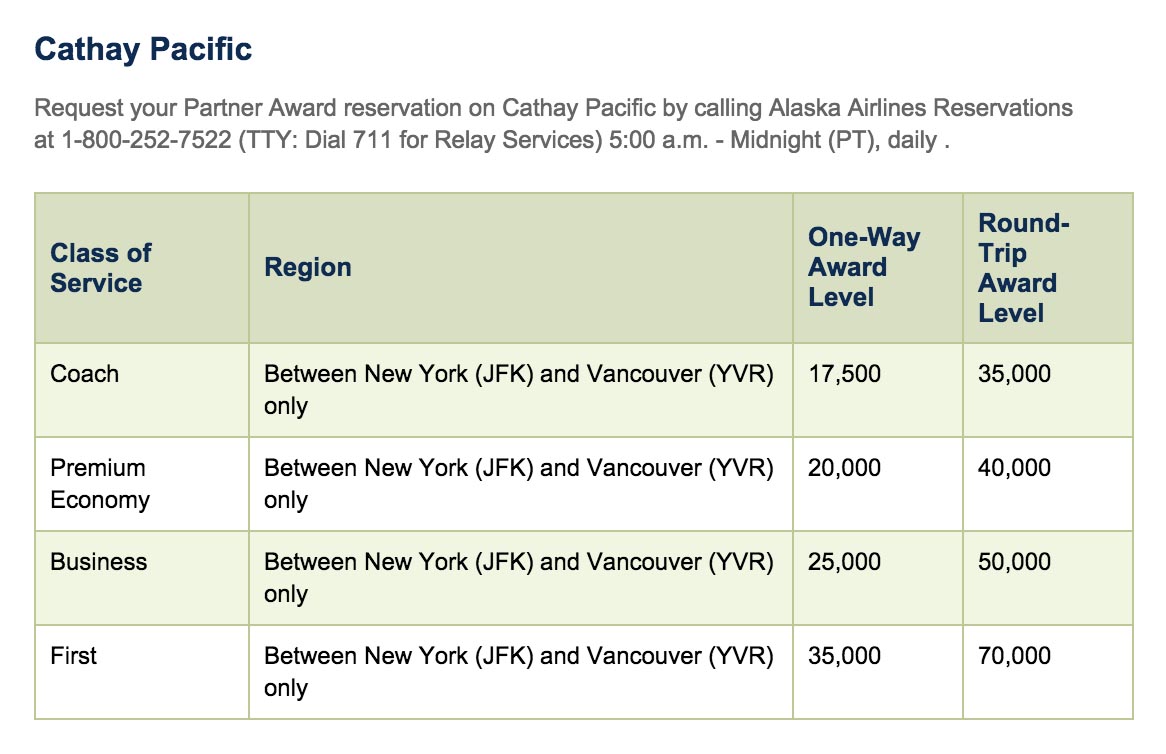
But, I wanted to see what I was missing out on with Mileage Plan, since it’s so highly regarded in the points and miles world. Plus, it was on my mind after writing that post about Starpoints. Most of Alaska’s more interesting redemptions are on carriers I don’t really have occasion to use, specifically because I don’t have any immediate plans to fly to Asia or the middle east. However, when looking through their partner award chart, a particular redemption caught my eye:mileageplan

Cathay Pacific first class is one of those products that gets reviewed amazingly well from just about everybody. They don’t have an on-board bar or shower suite, but the seat looks divinely comfortable, and the service is supposed to be pretty good too. (Also, I know everyone raves about the novelty of showering on a plane, but I’m severely put off by the not-unlikely prospect of hitting turbulence and sitting belted-in on the shower’s safety bench nude and dripping wet while the plane lurches to and fro.) Plus, true first class is kind of a forbidden fruit for me, since I have very eurocentric travel goals, and one of the bummers about flying to Europe is that first class is tougher and tougher to come by… and when first class cabins do exist, it’s either difficult or prohibitively expensive to book awards in them.

So, imagine my delight when I found that Cathay Pacific runs a fifth freedom route (a route on which neither the origin nor the terminus is in a carrier’s registered country) between JFK and Vancouver. Cities I love and would happily travel to in order to enjoy a premium cabin I otherwise wouldn’t get to experience. (Fifth freedom routes are pretty cool in general, and at some point my goal is to fly in first class on both Emirates (NYC to Milan) and Singapore (NYC to Frankfurt).)

You know what I just realized? None of these premium cabins have overhead bins!

After some more research, I realized that both Lucky and The Points Guy have written about this route, but I missed it – again, due to the sheer volume of information that’s out there. Then, once I realized that the route exists, I found out that I can book it with Asia Miles (for 40,000 miles), which I can earn via transfers from Citi or Amex (meaning that the whole detour into Alaska miles wasn’t even necessary). Given the ease of earning Thank You/Membership Rewards points, it’s probably easier to book this way, although I’m hoarding points in those programs right now. As a result, I decided to do a Mileage Plan blitz and found myself with 39,000 Mileage Plan points almost overnight. (How did I do this? 25,000 points came from getting the Alaska Airlines Visa card, which awards the miles without requiring a minimum spend. Then I got the other 14,000 from my Chicago hotel stay, which I booked on Rocketmiles. Almost 40,000 Alaska miles in a weekend, and nary an SPG Amex in sight!)

I’m planning the trip for next June, and I’ll be traveling with my younger brother, since he’s the only person I know who appreciates premium cabins as much as I do. He’s based in Chicago, so we’ll meet in New York (which I’ll probably fly to on a paid Jetblue ticket so I can check out their Mint class), travel to Vancouver on Cathay, and then hang out in the Pacific Northwest for a while before returning home. It seems kind of crazy to fly to Vancouver via New York, but I’m the guy who started a blog post on points and miles by talking about French poststructuralists, so crazy is more or less the unifying theme here.

Requisite question designed to spur a flurry of responses in the comments section: What’s the most ridiculous routing YOU’D take just to fly a product you’ve never tried before?

American Horror Story (Part 2)

I wanted to add a few additional thoughts on American Airlines, especially given some criticism I encountered from the imaginary blog readers in my head.

1 – As you may have read in my post on premium cabins, I almost never fly first class. When I do, it’s a special treat, not a matter of course. So, I really do have a lot of experience with economy class seats, which is why I feel qualified to say that American Airlines seats are absolutely terrible. Just to provide a point of contrast, I recently flew United’s revamped A320 to and from Seattle, and the new seat design is clean and efficient, if not particularly impressive in any one area. They have an additional literature pocket where the IFE would go (since short haul planes don’t need IFE, and United offers direct-to-device entertainment), and the seats make great use of thin-line padding so that the seat feels comparatively roomy, even in the non-Economy Plus rows. A couple weeks ago, I was on Southwest to and from Salt Lake City, and their new seats are similar – thin, stiff (supportive) padding, reasonable leg room, and a generic, unremarkable economy experience. And let’s be clear: the point of economy is to be as painless as possible. No one is going to step off an economy class flight and rave about how amazing the seat was – the best economy can hope for is for a passenger to not be miserable during the flight. Most domestic economy classes accomplish this, while some add some nice touches, like Virgin’s on-demand food and drink options or Alaska’s Inuit-themed decorations.

2 – Apparently, I was way off base in talking about how old the American seats were. See, I sent a complaint to American Airlines about the terrible seats, since I really was annoyed at how terrible the flight was. I even asked for a refund on my Main Cabin Extra purchase, since, due to the aircraft swap, my row wasn’t even in Main Cabin extra anymore. To American’s credit, they responded quickly and positively, which I can’t say about too many other airline customer service departments. However, they did add that the seats are “relatively new” (relative to what?) and that they’re made with “high quality leather and wool fabrics.” Remember what I said yesterday about it maybe being worse that American chose these seats on purpose? Well.

3 – Customer service also cited “literally thousands of hours of research” that went into the design of the new seats, and I don’t doubt it, given the complexities of designing anything that goes on a plane. What sticks out, though, is how anyone could look at the final product that resulted from these thousands of hours and somehow think it represented a competitive product.

Good thing a photographer was there in the lab to document the moment the new seats were conceived after a 737 fucked an old couch behind a dumpster.

Luckily for passengers, there is a newer version of the 737 interior that American is rolling out (at the same time that it is retiring those MD-80s I was ragging on yesterday). The problem is figuring out which version is on which route. Given the wide disparity in quality (assuming that the new interior represents a step up, which – from photos at least – it seems to), I’m still going to hold off flying American on anything but the A321T that they run from SFO to NYC. Maybe I’ll check back in five more years to see where they’re at.

American Horror Story

For years, I refused to fly American Airlines, because they are terrible. They’re terrible in a can’t-quite-put-your-finger-on-it way, but every flight I’ve ever had on American was always just a little more unpleasant than any other flight I’ve ever had. I even hated American when I was a kid (and my brother and I thought we were clever when we called the Super-80 the “Super-Sucky”). Those MD-80s are still in American’s fleet, by the way.

Life begins at 40?

I was motivated to start flying American again by two things: first, I can access the Admiral’s Club when flying American via my Citi Prestige card, so I thought that, all other things being equal, I might as well fly the shitty skies and get some free yogurt-covered pretzels. And, despite my overall disgust with how terrible American Airlines is, the Admirals Club at SFO is pretty nice – it even has some fake trees in it. Plus, it’s quiet, and Terminal 2 at SFO — which has been remodeled to feature upscale shopping and dining — does that “put all the gates in one place with an enormous waiting area that serves all of them at once” thing, making the at-gate experience a test of one’s nerves.

Pretty sweet lounge selfie.

Second, American advertises on its website that it’s building “a younger, more modern fleet” and that they take delivery of an average of one plane per week. So, I thought to myself, maybe it’s time to give up my prejudice against American and take advantages of the things they do offer, including a loyalty program that actually awards miles at a rate that earns you a free ticket more than once a decade.

So, full of anticipation, I set out for Chicago flying American from SFO to ORD. Then, unfortunately, I stepped onto one of their planes, and that all went out the window. What. A. Shitbox. It’s almost appalling that American charges the same amount for their flights as other airlines, given their in-flight product. In first class, they’re proud to offer you “the worn-out chair your grandfather farted in 100,000 times before he died in it,” and in economy, you can enjoy American’s signature “Imagine the worst airplane seat you’ve ever sat on, only 10% worse, and you’ll still be ahead of these pieces of shit” class. I paid (!) for extra legroom, which on American is called, “give us $60 and we’ll spare you permanent knee injury.” And thank fuck I checked Seatguru beforehand, since 1/3 of the premium seats are in rows WITHOUT WINDOWS. Presumably this is so you don’t see the Scotch tape and staples holding the wings on.

Abandon all hope ye who enter here.

Okay, that was a cheap shot. American Airlines is clearly safe, both of my flights arrived early, and the pilots were very friendly both over the intercom and saying good-bye to passengers after the flight. Little things like that go a long way, especially when your butt cheeks are numb from sitting on seats whose padding gave out during Reagan’s second term. Oh, and if you tell me that I’m exaggerating and that these interiors aren’t that old, consider for a second what you’re really saying: that American Airlines recently chose these interiors on purpose. I think that might even be worse.

Also, here’s a weird thing that I’ve never really noticed before. The fuselage walls on American’s 737s are scalloped in such a way that the windows are deeply recessed from the rest of the wall. For most seats, this doesn’t really matter, since most of the wall next to the seat is comprised of one of these recessed areas. Here’s a good photo, which also happens to show the ultra-luxury of American Airlines first class. Look at how far the ribs in between the window panels stick out:

However, should you be lucky enough to sit in one of the rows without windows (which I was treated to on my return flight due to a happy switcheroo between different versions of the 737), you don’t get the recessed window panel, just the wall jutting out very uncomfortably so that you end up leaning on the person in the middle seat the whole flight. I’ve flown economy class all over the world, including configurations that people always rag on for being overly tight (like 10 hours seated in a 9-across 787), and I have NEVER been so cramped on a plane. And this was in a seat I paid extra money for, which was both insulting and infuriating.

Never again. I’m done with American, and I’m going to dump my Citi Prestige card while I’m at it, since the Admiral’s Club access benefit (one of the main reasons I got the card) is totally worthless to me. (Yeah yeah, I know the Prestige has tons of other benefits, but I’d rather get the Amex Platinum and hang at the SFO Centurion Lounge before comparatively living it up on a United.) Maybe I’ll come back in five years when the fleet renovation is done, but until then, I’ll fly literally any other airline and enjoy it more.

Requisite question designed to spur a flurry of responses in the comments section: How sore on a scale of 1-10 has YOUR butt become after flying on American?

Starwood Lust

Okay, let’s just get this out of the way. Every time someone talks about Starwood points, all I can think about is the episode of Broad City where Abbi accidentally gets super high and charges $1000+ of groceries at Whole Foods to her Starwood credit card that she got because she thought it would make her feel more like an adult. To be honest, it seems weird that all these serious points blogs write endlessly about the Starwood card, because I associate it with Abbi’s giant blue imaginary friend named Bingo Bronson.

Anyway, aside from strange pop culture associations, I guess I don’t really get the big deal about this card. I understand all the benefits – chief among them that you get a 5000 point transfer bonus when you transfer 20,000 Starpoints to airlines (for an average earning rate of 1.25 points per dollar), and I realize that they have really good transfer partners, including Alaska and American. Still, though, the card is kind of weak in a lot of ways, isn’t it? First of all (and the Devil’s Advocate guy on Travel Codex already mentioned this), you aren’t *really* earning 1.25 points per dollar, just like points aren’t *really* worth actual money. You have to get 20,000 points first in order to get the 5000 point bonus, and since the card only earns 1 point per dollar, that’s gonna take a long time. You’re “earning” that extra 1/4 point per dollar in the form of a futures contract on a transfer that you’ll make at an unspecified point. You don’t have it until you hit the 20,000 threshold, which means your entire earning and redemption strategy has to conform to 20,000 point increments. And the minute you top off an account with an odd number of Starpoints, you just blew up the entire value proposition people cite with this card.

Here’s the thing: last month, I earned well over two points per dollar on my Everyday Preferred card, meaning that I could earn 25,000 points on this card WAAAAAY faster than I could earn 20,000 Starpoints. It’s not as if Amex’s travel partners are super shitty either – you get reasonable business class awards to Europe via Aeroplan (though some – but not all – include fuel surcharges), other Star Alliance awards with ANA or Singapore, OneWorld redemptions via British Airways, and even competitive partner awards with Delta (which still has some value for Skyteam partner redemptions). Everyone’s all up in arms about Amex’s British Airways devaluation, but when they make it *so* easy to earn points, it doesn’t sting that bad. I could stick with Starpoints or Ultimate Rewards if a 1:1 transfer rate were important to me on principle, but given the earning potential of an Amex card portfolio (especially if you combine the Gold and Everday Preferred cards), you’ll earn circles around either of those other cards, more than offsetting the devaluation.

I suppose I sound like a Membership Rewards fanboy, and I should admit that I am… and also that I recognize that part of that might be due to being very heavily invested in MR right now, meaning I may have an instinct to defend it. I’m not denying that fact, especially since it’s really easy to find bitter message board comments about how MR has lost a lot of value as a program. But I don’t think that makes any of my arguments untrue (such is the advantage of having a blog with no readers).

But anyway, back to Starpoints. I think it’s significant that the sign-up bonus kinda sucks. You get 25,000 (or [GASP] 30,000 for the next month), which means that after your first amazing transfer bonus, you’ll have 5000 orphaned points for months while you build up another 15,000 points. Compared to a farily-easy-to-find sign-up bonus on the Amex Gold Card of 50,000 points, I can’t see how this card stacks up. Are Starpoints really worth 2x Membership Reward points? For big spenders who want to have skin in multiple programs, it certainly doesn’t make sense to ignore the Starwood program, but for most people making less than $100,000 year, it’s just too hard to put enough spend on the card to get meaningful rewards (unless you’re aggressively manufacturing spend, which most people don’t do – and the people who tout the Starwood card don’t just recommend it for MSers). The most common argument for this card is that it’s best for spending that doesn’t fit into other bonus categories, but (big surprise) I still don’t agree with that. Most point valuations peg the Starpoints as around 10% more valuable than MR points. So if you’re earning 1.25 Starpoints per dollar, that equates to 1.375 MR points, which is still less than the 1.5 minimum earning rate on the Everyday Preferred.

Purple is the new black?

Okay, okay – the transfer partners. They’re the best. I’m not going to argue that point… but if you can’t earn enough points to redeem, what’s the use? There’s more water in the ocean than there is in a lake, but if you can’t drink saltwater, what good is it? And one other thing: if it’s so damn important to be able to transfer to American and Alaska, why not just sign up for their co-brand cards and collect a bunch of miles that way? You can get 25,000 Alaska miles just for opening the card (plus a $100 credit), and Citi has an offer for 75,000 miles on their American Airlines premium card. What’s more, those bonuses are recurring, whereas you only get your precious 30,000 Starpoints once between now and when you die.

Okay, so obviously every program has its high and low points. I just don’t agree that Starpoints are the best currency for most people, given that anyone who isn’t a big spender is going to have a super hard time racking up points the way it’s possible to do in other programs. Lucky had a curious argument about the value of Starpoints recently, saying that the difficulty of earning them actually makes them more valuable due to laws of supply & demand. I’m not sure I agree with that (and I’m a bigger fanboy for Lucky than I am for Membership Rewards), since Starpoints aren’t tradeable like other commodities whose values are dictated by supply and demand. In the world of points, “value” doesn’t mean what something is worth in a resale transaction; instead, a point’s value lies in what it can get you, and unless you’re putting over $100,000/year spend on your SPG card, it ain’t gonna get you much. I’m not anti-SPG by any means, and I’ll probably pick up the card at some point in my life if I need 25,000 miles quickly for a program that doesn’t have other transfer partners. But the way people talk about this card, you’d think it could give you a reach-around from your back pocket, and I just don’t see it.

Requisite question designed to spur a flurry of responses in the comments section: Do YOU think Abbi made the right choice to use her SPG Amex at Whole Foods when she was high out of her mind? 

SkyEthnocentrism

Delta’s increasingly less-rewarding frequent flyer rewards program isn’t news to people who follow points and miles. SkyMiles have seen an overall decrease in value as the program has become more and more like a fixed currency (with redemption rates dependent on flight prices, hence Delta’s removal of award charts). Most of the time, SkyMiles end up being worth about one penny, which is why it annoys me that people derisively call them “SkyPesos.”

Someone somewhere thought this was a good way of highlighting just how junky and worthless SkyMiles are, since [uses “sarcastic guy” voice] everyone knows that the peso is a near-worthless unit of currency used in a country inferior to America. But, in the interest of fairness, let’s unpack that for a minute… First of all, pesos are actually worth about 1.6 cents each, meaning that they are in fact more valuable than SkyMiles. Given this, a much more accurate name would be SkyPennies or SkyCents. (You could also make some funny slogans, like “It’s NonSense to accumulate SkyCents!”) I know that people who call them SkyPesos aren’t doing it to be overtly mean to Mexico or to look down on Mexicans, but the implicit notion is that the peso is less valuable and more deserving of mockery than the penny, which just happens to be one of the most useless units of currency in the world.

This came up when I googled “Pennies are stupid.”

I guess you could compare SkyMiles to pesos solely on how much their value has decreased recently, but if you’re looking at rapidly devaluing currencies (at least relative to the dollar), then the yen has the peso beat many times over. Ditto the Euro. Unfortunately, “SkyYen” doesn’t have the same ring to it as SkyPesos, so that comparison is out. Consider, though, that 1.6 cents each is around where most points blogs peg the value of Citi ThankYou points, meaning Citi points (which are almost universally more popular than SkyMiles) are the real pesos in the points and miles world. Have some SkySense: stop saying SkyPesos and start saying SkyCents.

Requisite question designed to spur a flurry of responses in the comments section: Have YOU thought about the social implications of the names you give various points and miles currencies?