I saw an interesting promotion at the bottom of the monthly newsletter that Amex sends me for my Blue for Business card: “Fee-free international wire payments @ earn up to 30K points.” The link brought me to a landing page not otherwise accessible from the Amex site (at least as far as I could find). (The link had a referral code in it, so I don’t want to share it here. The main address is at fxipreferral.americanexpress.com, but that doesn’t work as a URL without the other junk. I’m not sure if this was targeted to me or not.)
I wish I could take advantage of this, but you need a business checking account and a tax ID number (not a social security number). It’s a separate service with a much more involved application than what I had to complete in order to get the business card in the first place, and it’s clearly not for hobby businesses like mine. The annoying thing is that I do sometimes need to make foreign wire transfers when buying things from Europe, since PayPal is nowhere near as common as it is here. Even without the bonus, a fee-free option for wire transfers (for a limited time, $10 thereafter) is way better than $45 from Chase, even if Amex gouges me on the exchange rates. The bonus offer is really good, too – 15,000 points after the first transfer and 30,000 after three more. There isn’t even a minimum amount required to trigger the bonus. You also earn points for the actual transfer, but at 1 point per 30 dollars transferred, it’s not exactly an undiscovered manufactured-spend goldmine.
Anyway, anyone with a business card through Amex and a “real” business should check if they’re targeted for this. It’s also a good reason not to opt out of the mostly useless monthly newsletters, since they do sometimes contain interesting offers. Has anyone had experience with this? Is there a catch, like Travelex-level gouging on the exchange rates or other hidden fees? It did almost sound too good to be true, even if I could have made it all the way through the application.
I love reading flight reviews, and while I didn’t really plan to write reviews on this blog, the pages that consistently get traffic are the ones where I’m reviewing something. Planes are pretty easy to review, and in general the experience within a class of service is pretty uniform for all the passengers on that particular flight. That’s why a single person’s review is mostly representative of what others can expect if they fly that same product. Service and food quality vary from flight to flight, although you should have a pretty good idea what you’re getting after reading a well-written review.
Hotel reviews are different, for a couple reasons. First, hotels are tough to photograph. Even reviewers who are good at taking photographs usually end up positioning themselves in a way that captures as much of the room as possible in a given photo, which makes the room look bigger than it actually is. Second, most frequent travel bloggers also have top-tier status at hotel chains, meaning their experience at that hotel is only representative of what other top-tier elites can expect to receive. I realize that top-tier elites probably comprise a disproportionate chunk of those blogs’ readership, so it’s not like those reviews are worthless. That said, I don’t really give a crap how great the “free” breakfast is, because there’s no way in fuck I’m paying $80 for the breakfast buffet at the J.W. Park Regis Whogivesacrap. I’m also gonna be stuck in one of the worst rooms in the hotel, because I’m probably redeeming points for any hotel that’s over a few hundred bucks a night, so your description of the Presidential Suite you were triple-upgraded into on account of spending 425 nights per year in a Starwood is meaningless to me.
Finally, I pretty much think all chain hotels are fine. As long as the rooms don’t open to the outside and people aren’t arranging meet-ups with their meth dealer in the parking lot, it’s probably going to get the job done. It’s not like economy vs first class on a plane in that a basic Holiday Inn Express is perfectly comfortable, where as economy on a plane is actively uncomfortable for anything longer than an hour or two. The only hotel review I’ve ever read that I truly love was a review on Tripadvisor of the Intercontinental San Francisco that complained about a used butt plug on the floor next to the bed, along with multiple pictures of said butt plug. I tried really hard to find a photo to post here, but there are over 1200 pictures of that hotel, and it was like looking for a butt plug in a haystack.
With all of that out of the way, I think I’m going to start adding hotel reviews to the blog (LOL). One of my coworkers asked me the other day why I never review any of the hotels I stay in (with the exception of the Park Hyatt Vendûmb), and after talking about it, I realized that I could probably start including reviews if I used the same useless 80-point scale format like I do for my very famous and extremely popularloungereviews. Obviously it couldn’t be exactly the same scale, but I figured I could come up with something similar, as long as it included categories that are only really useful to me. I’m going to do a trial run with a review my recent stay at the EVEN Hotels Times Square South in New York. Tripadvisor currently rates this hotel as the #13th best hotel out of 467 in all of New York. While I didn’t hate it, I find that ranking absurdly generous. Here’s my review.
Photo from IHG.com
Bed comfort: This is the #1 thing I care about in a hotel room. It doesn’t matter how nice the room is; without a comfortable bed, it’s a den of shit. And fancy hotels sometimes have surprisingly uncomfortable beds. The EVEN was decent enough – it was fine, but I was very aware I was on a hotel bed, whereas a great bed would make me think I was floating in a peaceful cloud. (For reference, the most comfortable hotel bed I’ve ever slept in was at the Maxwell Hotel in Seattle.) 7/10
Water situation: You gotta stay hydrated. I drink tons of water, and if I skimp, I get headaches, heartburn, and all kinds of other ill feelings. I feel anxious if I don’t go to sleep with a full bottle of water by the bed. Some hotels have surprisingly drinkable tap water; others give you high-quality bottled water for free. Bad hotels have nasty tap water or give you gross swimming-pool water like Evian. Bad water access can ruin a good hotel stay for me. The EVEN gives you a free water bottle and has a bottle filling station on the bottom floor. However, since the hotel’s horizontal footprint is tiny (the floor I was on had only 4 rooms), it’s a quick trip from the room to the filling station. I’d give an extra point if there were a filling station on each floor. 9/10
Climate control: Another thing that can absolutely tank a hotel. If I can’t make the room 65 degrees at all times, I’ll be too warm, and it will make me hate the hotel. Not having to deal with a window unit is a real plus – even an effective window unit is only going to get a 5 or so. The EVEN had central air that took a while to cool the room down, but it got there eventually. I’d prefer a quieter system, though. 6/10
Sleep quality: This is a combination of two main things – sound insulation and shit that blinks in the room. Does anyone else hate hotel rooms with 15 different devices that blink and flash and ruin the darkness? It drives me crazy. Aside from the smoke detector, the EVEN room didn’t blink that much. However, the walls are pretty thin. Since every room is close to the elevator, it’s hard to get away from the associated sounds, although with only four rooms on a floor, it doesn’t get that much use. Unfortunately, I was woken up one morning to the sounds of a woman being vigorously plowed in an adjoining room, which was annoying. I usually sleep with earplugs anyway, but I still appreciate walls that block out whatever gross, depraved things my neighbors are getting up to. 4/10
Room size: Self-explanatory. This hotel room was pretty small, but it was laid out well enough that it didn’t feel claustrophobic. 5/10
Bathroom: No tub, but there’s a rainforest shower and two sinks, so I’d say that’s pretty nice. However, the toiletries in the shower are in refillable containers affixed to the wall, and these are a pet peeve of mine. Why, you ask? It’s because I can’t get the thought out of my head that the last hotel guest spit in them as a prank. Sorry if I just ruined them for you too. 7/10
Food options: For a hotel this relentlessly focused on health and fitness, the restaurant is annoyingly light on vegan options. That’s one of the things I was most excited about, although my best option ended up being a platter with some dumb flaxseed chips and some remoulade or tapanade or whatever you call thick, umami-flavored spreads. I did like the options available in the 24-hour grab-n-go market, though, so I’m not totally dissatisfied. Oh, and there’s no room service (boo). 4/10
Fancy shit: This is the true measure of luxury. A nice hotel should score a ten here. The EVEN isn’t really fancy, although it does a good job with the whole “modern, clean, and cheap” aesthetic that’s becoming more popular in mid-market hotels. Notably, there’s an LED light display behind the headboard that changes colors with a remote, and it was pretty fun to mess around with. I liked a nice bluish-green personally, although if you’re in the same mood as my neighbors, you can bathe the room in a rich crimson glow while you get your fuck on. 6/10
Annoying shit: This is a catch-all for whatever gripes I have about the hotel. The EVEN’s whole brand is built around fitness, and so I shouldn’t ding it too much for how it barfs hot yoga all over everything, since I knew that going in. Still, the rooms are pretty small, and I didn’t need the exercise ball or foam rollers taking up space. Also, fuck people who are so motivated to stay fit that they need shit like this in their hotel rooms. IT’S A VACATION – BLOB OUT WITH SOME BEN & JERRY’S AND WATCH A MOVIE YOU FREAK. Sorry, EVEN hotels – I should be more generous here, but I kind of hate you. 3/10
Location: The last piece of the puzzle! This location was okay I guess. I don’t know New York that well, but I was happy not to be all that close to Times Square. The street it’s on is pretty quiet, and it’s close to Penn Station. There’s plenty of stuff to do nearby as well. 7/10
Total score: 59/100
That’s all for now – I reserve the right to add or delete categories while I iron out this system. For the time being, I think I have a pretty solid 100-point scale that covers all the necessary aspects of a hotel. I hope you enjoyed my review, and feel free to suggest other categories I should consider.
I learned something tonight – United doesn’t offer vegan meals on domestic flights. Did everyone already know this? Does any airline offer vegan meals (transcon service excluded)? I guess I usually don’t eat on domestic flights, so I never really noticed. I needed to request one for an upcoming transatlantic flight, and I figured I might as well request one on my domestic positioning flight – that’s when I was informed that it’s MEAT ONLY. Now would be a hilarious time for Ingrid Newkirk to kick up a viral shitstorm and release a bunch of spray painted cows onto the runway at SFO or something. Wouldn’t that be funny?
I’m too outraged over this Comey business to care that much. (Oops, there I go again “slipping” my politics into my posts. I can’t help it! The commenters on Doctor of Credit were right after all – I’m insatiable!) However, I did decide to annoy the United customer service rep who was helping me, which I admit was a dick move since he was only trying to help. Still, this convo…
UPDATE (May 16th): This article just got linked on Airliners.net, which is a site I enjoy reading… unfortunately it isn’t mutual! In the interest of presenting a fair and balanced website (which longtime readers will know is my main concern), I’d like to present some… er… let’s call them “counter-opinions.” All quotes used without permission because I’m just an overly-dramatic pimply kid who doesn’t understand how that stuff works.
@wjcandee writes: Idiotic snarky response. Makes so many false deductions from the original article. The article authori is likely just an overly-dramatic pimply kid in his parents’ basement who has nothing better to do. It’s the kind of “article” that reflects the worst of the social media world, where people who nobody would bother listening to suddenly have followers, because they say mean stuff. NOBODY at Airbus was “laughing”, nothing was “embarrassing”. This airline makes boatloads of money, and in the business world, folks would STUDY — rather than mock — companies that make this kind of money by doing things differently.
@fraspotter opines: Please tell me that this is satire because the person that wrote that response “article” is an absolute idiot. “Windbag” indeed.
@gatibosgru maintains: The follow-up article, however, was cringy and tough to finish. Allegiant has never claimed to be at the same level as the “big boys”, and they have plenty of opportunities to learn. This was their first time buying a new aircraft, you have to expect that a first time buyer is learning and doesn’t know anything.
Now back to the original post…
This article by Brian Sumers on Skift may be the most bonkers thing I’ve ever read about commercial air travel. I was going to try to write an article responding to it, but it’s so off-the-wall insane that I can’t even string my thoughts into a coherent narrative. If you haven’t read it yet, go do so immediately (although not if you have any air travel scheduled on Allegiant anytime soon).
Allegiant put more effort into decorating this cake than they do into their planes. (Image courtesy of Allegiant’s Instagram feed.)
Since you really owe it to yourself to read the whole article, I’m not going to go into great detail summarizing it. For those of you who just want the top-level overview, Allegiant mostly buys used planes and is so focused on cutting costs that they don’t bother to rebrand the interior, meaning the inside of the plane looks like whichever airline they bought it from. However, due to demand, they now have to buy new planes, and they had no idea how complicated buying a plane is. THEY ARE AN AIRLINE WHO JUST LEARNED THAT PLANES ARE COMPLICATED. I guess the thing that I find so bananas is how willing Allegiant is to admit that they have no idea what the fuck they’re doing. Well, in some ways they straight-up admit they don’t know what they’re doing, and in other ways, they’re clearly just batshit insane.
Let’s take the example of the orange stripe that runs across the bottom of the overhead bins on most of their planes. The orange stripe comes from EasyJet in the UK, which has a specific Pantone color for their orange, because they – like most public-facing companies – try to present a consistent-looking brand to their customers. Since Allegiant is a frequent customer of EasyJet’s sloppy seconds, a lot of Allegiant planes have the orange stripe. So I guess when Allegiant went to Airbus to get brand new planes, they thought that those planes should also have the stripe? This is mind-boggling from a branding perspective: “Our customers are used to seeing another company’s branding in our planes, so we have to make sure we continue to deliver that.” And they got really oddly particular about matching EasyJet’s shade of orange as closely as possible EVEN THOUGH ALLEGIANT HAS ORANGE IN THEIR LOGO. They had a chance to put an orange stripe in the cabin and specifically chose NOT to match their own logo, instead copying another brand’s signature color.
It gets even better: at first, Airbus wouldn’t duplicate the EasyJet color, because they (naturally) didn’t want to use another customer’s signature color. So the Allegiant people called EasyJet and had them send a letter to Airbus authorizing the use of that particular orange. Can you imagine the look on the EasyJet people’s faces when they got this request? And do you think Allegiant knew how incompetent they sounded, or did this seem to them like a normal thing that one commercial airline would ask another?
Or how about the fact that their livery is applied so cheaply on the outside of the planes that Airbus didn’t want to paint the new planes to Allegiant’s specs because they thought it would reflect badly on them!!! As one of the big two airplane manufacturers, Airbus doesn’t really seem all that picky about which airlines they will and won’t sell to, but I have to imagine this is the first time an airline has asked them to make the paint job shittier so that it would match their other shitty planes. (Also, they suddenly care about visual consistency while at the same time saying that their customers don’t care that the interiors of their planes are all different.)
Moving on, check out this quotation: “They kind of walk you through the process and say, ‘Now its time to make these 14 decisions,”‘ Davis [VP of Marketing] said. “That’s when we open the catalogue and say, ‘Oh, shit, there are many, many options.’” OH SHIT? YOU REALLY WALKED INTO TO AIRBUS AND SAID “OH SHIT”??? I can’t get over the image of the Airbus executives looking at each other and then looking around the room for the cameras that are surely hidden somewhere, because the only natural reaction to this level of incompetence from an actual, functioning airline would be to assume you were being punked. This Davis guy may just be my favorite airline executive of all time. Here’s another gem from him: “Or, as Davis put it, “If you said, ‘I want purple elephants on my side walls, they would do that for you.'” Like it’s a fucking trapper keeper!
One of the hilarious things in the article is that, while most airlines send entire teams to Toulouse to spec out new planes, Allegiant figured it would be okay just to send their PR manager. One of the tasks she had was to figure out how long the water would run in the bathroom, about which she provided the following: “I just flew back yesterday from Dallas on American on an A321,” Schaefer said. “Their water seems to run a little longer. It’s so weird. I have the weirdest job.” THE WEIRDEST JOB! Just so we’re clear, this is a PR exec at a commercial airline who thinks she has the weirdest job because airplanes are weird.
I could keep going, but you get the point. What I’m sure about is that I’ll never set foot on Allegiant for as long as I live. I’ve read about their substandard safety record, but this honestly is more concerning than that. I can forgive a loose bolt here and there, but C-suite executives being bewildered by airplanes’ complexity is a deal-breaker. A prerequisite for me to get on a plane is that the company who operates the plane didn’t say “Oh shit, there are so many options” when they bought it.
I’m sure some readers have flown Allegiant before… was it just like any other shitty flight on an ultra-low cost carrier? Were you aware before you took off that a PR exec was the one who made sure the inside of the plane looked like an EasyJet plane so that you wouldn’t get confused? Finally, I want to express my undying gratitude to Brian Sumers for writing this article. He’s already one of my favorite aviation journalists, but he has now ascended to hero status for bringing Allegiant’s insanity into my life. Also, the fact that he was able to conduct the interview without doubling over laughing is pretty impressive.
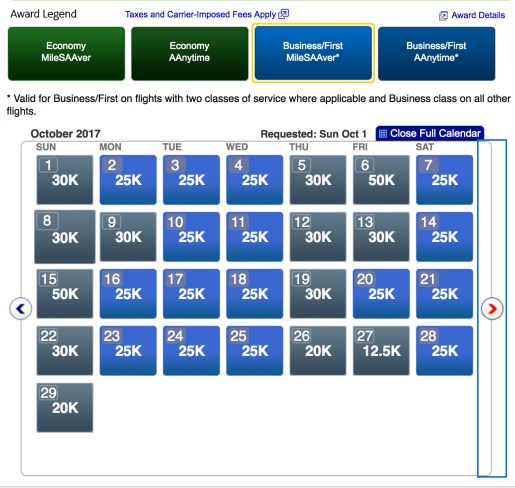
I booked an American flight from SFO to Chicago today for a cool 22,500 miles (well, 25,000 miles before the 10% rebate I get via Citi’s co-brand card). I had been led to believe such a thing wasn’t possible, that American had the worst saver availability on its own flights of any US carrier. At least in this situation, I’m not so sure that’s the case. It’s late and I want to go to sleep, so I’m not going to write too much about this – I’ll let the screen shots do most of the talking.
Here’s AA from SFO to Chicago in October:
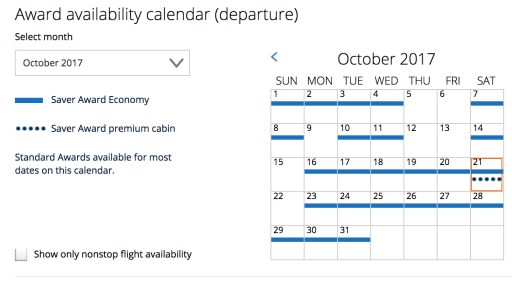
And here’s United: not a single day of availability, unless you count October 21st, on which United is generously offering you the chance to ride on an ERJ-175 from SFO to Boise to Chicago for the low, low price of 25,000 miles.
This is only one route, so I don’t know if it signifies a trend, or if American is uncharacteristically generous here. I will say that I have had a terrible time finding United saver first class awards domestically (both for myself and for other people I’ve helped with award bookings), and when I do find availability, it’s never on a direct flight. In general, I don’t love redeeming miles for domestic awards in the first place, although I have a bunch of AAdvantage miles earned through credit card sign-ups and no plan to use them. As a result, it seemed like a decent way to avoid four hours in economy, and the value per point wasn’t terrible either (around 1.78 cents per point after the 10% rebate if you peg the value of the ticket at $400, which is the lowest fare I could find on any carrier). I’m not excited about the flight by any stretch (given my last experience on American), although for all the bluster I kicked up the other day regarding aspirational redemptions, I’m still grab a utilitarian redemption when it makes sense (ie: I have the points and no plans to use them, I don’t want to fly economy to Chicago, and I don’t have $400 lying around).
I’ve written a few times now about my upcoming flight on Swiss, first about whether I wanted to book it in the first place, and then about getting a quasi-upgrade to a bulkhead “throne” seat. Well, I checked my booking online after reading about weird issues with SWISS tickets booked through Aeroplan being mysteriously canceled, and while I luckily still have a ticket (for now), Swiss did take the liberty of booting me out of my precious bulkhead throne seat and into a seat in the middle section.
This is a bummer, since I was super excited about getting the double-benefit of the extra room in the throne seat (basically exactly the same seat as the JetBlue Mint Suite I just reviewed a couple days ago) and also the additional leg room and foot room provided by the bulkhead. I thought I was so clever nabbing the seat as soon as it became available (thanks to an alert from ExpertFlyer), although I suppose I was too clever for my own good, since I was never supposed to get that seat in the first place. Instead, when I looked at the seat map, I saw that they had changed all the throne seats to paid upgrades (as they said they were going to do), and then blocked off a bunch of seats in the middle section for frequent flyers.
To recap, in the past, Swiss blocked off most of the throne seats for frequent flyers, leaving a few toward the back of the business class cabin available for booking. Now, all the throne seats require a payment 199CHF (at least on the route I’m flying), and certain seats in the middle section are blocked. (Basically, half the seats in the middle section are right on the aisle and offer the same amount of space as the paired window seats. The other half have a console that sets the seat off from the aisle, meaning that these seats take up around 60% of the total space of the middle pair. These 60% seats are the ones that are no longer possible to book if you don’t have status with Swiss.)
In the end, I’m pretty cheesed off that Swiss made me pay $200 essentially to downgrade my seat from the bulkhead throne seat in the mini-cabin to a standard throne seat in the main business cabin. I understand that seat reservations aren’t guaranteed, blah blah blah, but I also think it sucks that I reserved the seat before they started charging (and booked the flight months before they started charging) only to get booted out of it and forced to pay my way back in. As I mentioned in the last post I wrote about this, I’m not in principle opposed to paying for a seat that’s so demonstrably better than the other seats in the cabin. Also, since Aeroplan doesn’t add fuel surcharges to Swiss award tickets, the net out-of-pocket for this flight is still less than if I had booked Air France or KLM. Still, it’s $200 I wasn’t thinking I’d have to pay, and it hasn’t given me a very good impression of Swiss’s operation going into the flight. I was really excited about it, but after seeing these seats’ drawbacks first-hand on JetBlue last month and feeling nickel-and-dimed by the airline, I’m less enthused. It’s still a trip across the Atlantic in a flat bed with tons of personal space, so I can’t complain too much about the flight… assuming I have a flight at all, given this worrisome trend of Aeroplan-issued Swiss tickets going up in smoke.
Edited to add: I mentioned my frustration on Twitter and was advised to email their customer service department. I did, and this is what they wrote back:
Thanks for your email, and for expressing your concerns in relation to seats. In accordance with expressing your concerns. We would like to convey our sincere apologies for any inconvenience that this may have caused you. Please note that before purchasing any seats with SWISS.
Seats are non dedicated. Meaning that in general, our flight schedule may vary between the date of publication and your travel date. In such cases, we immediately inform our passengers about the changes. For cases like this we are obliged to move you to a similar type of seat, if you are not happy we can then refund back the amount that you have purchased the seat for.
We cannot guarantee flight schedules to you and they are not part of your contractual agreement with us. Please note that our privacy seats in business is charged going at USD199.00 and is subject to availability.
If we make substantial schedule changes that are not acceptable to you and we cannot find a suitable alternative, you are entitled to a full refund. A reimbursement of any additional costs, such as car hire, is denied as per the aforementioned reasons.
We regret that we are unable to give you a more favorable answer and hope that our explanation meets with your understanding.
Would you be satisfied with this? I’m not going to push it any further, since I didn’t really expect anything in the first place (as I mentioned, Swiss is entirely within their rights to do what they did). I asked for a refund on my seat selection fee, because it never hurts to ask… although I was expecting to be refunded exactly $0.00, and that’s what I got.
I read a couple articles today that caught my interest, since they were about the actual value of travel credits on high annual fee cards. I generally follow the conventional wisdom that subtracts the amount of the travel credit from the annual fee to obtain a “net” annual fee. On the Sapphire Reserve, for example, the math would be: $450 annual fee minus $300 travel credit = $150 net fee.
Not everyone agrees with this, including the these twoarticles which I highly recommend. I disagree with them, ultimately, but this is still something that people should be aware of, because it’s really easy to find yourself paying $2000+ in annual fees while saying “well it’s really only $750 after travel credits”… meanwhile, there’s still $2000+ dollars missing from your checking account when you go to pay your bills.
I see both sides of this, because I do value the Chase Sapphire Reserve travel credit like cash, whereas I canceled my City National card because I didn’t want to cough up $400 — even though I could have earned $500 in travel credits over the course of the year. Here’s they key difference that everyone needs to figure out for themselves: would you have spent the money anyway?
As the Joe Flies makes the argument that travel credits force you to pay cash for your traveling, whereas you should spend points, since presumably you’re paying that high annual fee at least in part to earn those points. However, I see it a little differently, since I always have a few hundred bucks of ticky-tack airline spend each year that would not be a good use of points. My whole goal is to use my points on aspirational redemptions, and flying to Salt Lake City for work or to Vegas for the weekend is not very aspirational. In other words, I want to use points for things I can’t afford – not for things I can. Having the travel credit in my back pocket frees up my points for aspirational redemptions.
That said, it’s not exactly free money. Running with Miles presents a more realistic take on the annual fee math above: $450 annual fee PLUS $300 in travel spending minus $300 travel credit = $450 that isn’t in your bank account anymore. You don’t just get the $300 handed to you – you have to spend money to earn it, so you aren’t exactly coming out ahead. Or are you?
If you’re absolutely positive that you would have spent $300 on travel over the course of the the year, then the math needs to take that into account. So, if you’re going to argue that the net fee is $450, you need to look at how your finances would look if you didn’t get the card: $300 in travel spending minus no travel credit = $300 that isn’t in your bank account anymore. If you add those two equations together, that’s how you get to the claim that the net fee on the Sapphire Reserve is $150. Yes, you’re prepaying your travel expenses, but if those expenses would have been incurred anyway, as long as you aren’t putting too much of a strain on your cash flow, there’s not really much of a downside. However, if you weren’t going to spend that money anyway, then the math starts to fall apart, and you end up spending money on things you wouldn’t otherwise have needed because they’re “free” (in quotation marks because they aren’t free at all – you paid $450 for them).
Running with Miles uses an analogy of paying for your friend’s meal and then having the friend pay for a future meal of yours; the takeaway is that the second meal isn’t free, since you only earned it as a result of buying his meal the first time around. And while that may be true, it sidesteps the reason why people pay any money for annual fees at all – that there are benefits associated with having the card. That second meal wasn’t a freebie since you paid up front for it, but if your friend said that he’d let you sit shotgun every time you rode in his car with your 6-deep crew in exchange for paying for his meal, then you’re coming out ahead because you weren’t ultimately out any money AND you got a benefit out of it.
Of course, that’s why it’s important to put a realistic value on benefits as well as travel credits. I never play golf and rarely fly American Airlines, so getting lounge access and golf benefits from the Citi Prestige card didn’t matter to me (and I didn’t care when Citi nerfed them). People who aren’t frequent travelers don’t really benefit much from Priority Pass memberships, so the Sapphire Reserve may not even be worth $150 for them. Following that line of thinking, anyone who wouldn’t spend $300 on travel in a normal year very likely doesn’t travel enough for the card to make sense for them either. The card is geared toward people who travel often, and it’s those people who incur $300 (if not $30,000) in everyday travel expenses; likewise, those are the people who benefit most from lounge access, 3x points on dining and travel, and maybe even a concierge. If you’re worried about organically spending $300 per year on travel, it isn’t the card for you, regardless of the economics of the travel credit.
Let’s look at the new Amex Platinum card, which just raised the fee to $550 but added a new $200 per year Uber credit. I use Uber a lot, so I think I will get all $200 of that as a cash-equivalent fee mitigation (since I currently spend over $200 on Uber in a year). Additionally, I will get $200 in United Gift Registry credit that I will probably use on flights to Las Vegas for my wife’s birthday, since that has become an annual trip that we’ll take regardless of which credit cards we hold. Over with Chase, given the range of things that qualify for the $300 fee credit, I’ll probably use up the entire credit within a month or two just on everyday spending (and it doesn’t hurt that I have a work trip every January). Therefore, I don’t consider it a stretch to look at the net fee across these two cards as $300 – provided I don’t forget to pay myself back for the annual fees I paid up front. (However, there’s also a limit to how much United gift registry credit I can use in a year, which is why the additional $500 I could have wrung from my City National card wasn’t enough to offset the $400 fee I didn’t want to pay.)
That brings up another point touched on by both of the articles I linked, which is the mental energy to manage all this shit. The net monetary fee may be some dollar amount, but there’s the cost of my time as well, and I have to decide whether that time is worth the benefits I get from the cards (in both cases I do, but you may not). For instance, in January when my Sapphire Reserve fee credits start rolling in, it’s really easy for me to look at my budget spreadsheet and think “Wow, I have $300 of extra money this month,” when in reality I need to remember to save it for when the fee comes due nine months later. Ditto the Amex Platinum stuff – the credits on Uber are great, but I responded to that benefit by setting up automatic monthly $15 transfers to my savings account that I will use to pay the fee when it comes due in the fall.
At the end of the day, I do think it’s legitimate to compute the net fee on these cards as I did at the very top of this post (that is to say, by subtracting the credit amount from the total fee). However, there is a lot that goes into that determination, which is why I think articles articulating why those credits may not be cash equivalents are important to consider.
Earlier this month I was in New York for a weekend, and I decided to try out JetBlue’s “Mint” service on my way home. If you remember, last summer JetBlue offered easily the most generous promotion I’ve seen in my (few) years in this hobby: matching the frequent flyer balances of Virgin America eleVAte members by giving out tons of free JetBlue points in exchange for taking one measly round-trip flight. You can read about my experiences with the promotion and getting shit on by a bird here. As a result of that promo, I had a little over 75,000 JetBlue points, which meant I had plenty to burn on a Mint flight from JFK to SFO.
First, a note about booking the flight: because JetBlue’s award program is revenue-based, you don’t need to worry about availability, just finding flights with low fares. Mint fares usually start at $499, but I couldn’t find any of those. The best I could do was $649, which was around 49,000 points – not ideal but not bad either. Also, the conventional wisdom is that JetBlue points are worth 1.4 cents each, but that’s only in some circumstances. They’re not fixed-value like Virgin points, so you won’t know the cost of your flight in points simply by looking at cash fares. I was fine spending 49k for the flight, though, so I went ahead and booked it, choosing one of the Mint suites as my seat. (It’s pretty cool that JetBlue doesn’t charge extra for these.)
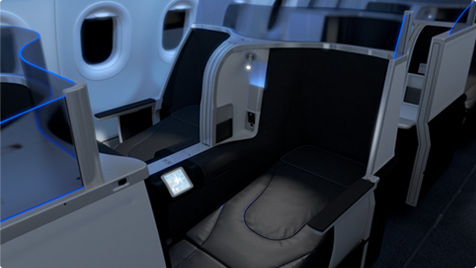
I’m going to assume that you know what JetBlue’s Mint cabin looks like by now, but if not, here’s a photo from JetBlue’s website:
But first, let’s talk about flying out of JFK T5, which is JetBlue’s flagship terminal. I kind of felt like shit all day, and my shoulder bag weighed around 40 pounds, so I wasn’t in a great mood when I got there. JFK did offer some pretty great plane-spotting opportunities, including a Finnair A330 (I think) that passed right overhead while I was on the AirTrain, as well as a bunch of planes I have never seen in person, like Aerolineas Argentinas. I stopped at the Mint check-in area to get a printed boarding pass, since my phone loves nothing more than to freeze as soon as I try to show my mobile boarding pass. They were perfectly nice and directed me to the Pre-Check security line, which was completely empty. Once, through I made my way to the Airspace lounge, since I was a couple hours early and wanted to relax before the flight.
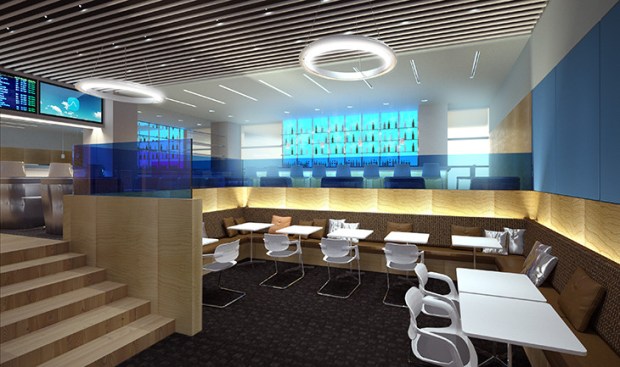
While I was walking there, I was thinking about how the Airspace lounge is another example of the Amex Platinum’s incremental benefit over other premium cards, since any other card wouldn’t have given me any lounge access in this terminal. Then I got to the lounge, and I realized that it didn’t really matter either way, because it was easily the shittiest lounge I’ve ever been in. First, it’s tiny. Second, it’s dirty. Third, the snack selection consists of a tower of snack mix and that’s it. Fourth, it sucks. Seriously 1/3 of the lounge is the fucking bathroom. The entire capacity of the lounge could have taken a shower at the same time if they wanted to. I was starving, but they weren’t serving any food at the bar (do they normally? I thought they did, but maybe they never serve food), so I did some work and then went off in search of food. This lounge isn’t worth the time it takes to walk there. Unless your gate is literally across from it, don’t bother.
This looks pretty nice, right? Well, think of how nice a McDonald’s hamburger looks on the menu. Then think of a McDonald’s hamburger. Then eat that hamburger, and after that just go to your gate, because this lounge sucks.
JFK T5 is one of the handful terminals operated by OTG Management (along with EWR terminal C and a bunch of others), which is great. You’ll know you’re in an OTG terminal if every table in every restaurant has an iPad that you order from. The other OTG hallmark is Cibo Express markets, which always have interesting food options. I was able to find decent food and then headed to my gate to finish waiting for my flight. Much to my horror, around 20 minutes before the flight, the gate was FLOODED with rambunctious high school students heading home from a choir competition. I went pale, thinking about how annoying they were going to be all flight. However, it turns out I’m an ageist prejudicial piece of shit, because the kids made nary a peep once they boarded the plane.
First impressions of the cabin: sleek, but not super luxurious, which fits in with what JetBlue is trying to offer. It’s utilitarian – black fabric and gray plastic – which didn’t have quite the elegance of the United Polaris cabin I flew on the way over (but certainly equivalent to United’s p.s. cabin on the 757 that would normally fly that route). The suite was as large as advertised, with enormous consoles on both sides. Unfortunately, it’s an air-cushioned seat, which I realize I don’t really like. It’s not horrible, but I generally prefer seats that require less tinkering, since I end up spending way too much time trying to get the seat just right. Plus, both here and on SAS (who also has air cushioned seats), I found that they don’t always re-inflate if you’re sitting on them, so you end up having to stand up, inflate the seat, sit down and test it, stand up again, etc.
The flight attendants were awesome, by the way. Everyone says that about JetBlue Mint crews, which is great, since it means that Mint service is consistently top-notch. I arrived at my seat to find a card welcoming me, and after I sat down, the lead flight attendant came over to give me a “tour” of the seat, showing me all the features, storage compartments, etc. She then brought me one of their signature cocktails (which I ordered without alcohol), and it was fantastic. She was also cool about dealing with my weird refusal to eat during turbulence, which I have to imagine is annoying for flight attendants, since it messes up the service flow. However, she said that after two hours, she could no longer serve me any food (not sure why, but I figured it had to do with food safety and I preferred not get food poisoning, so I didn’t argue with it). Unfortunately, it was pretty bumpy for the first two hours of the flight, so I didn’t end up getting to eat my dinner. I bet it was good, though. Later in the flight after it smoothed out, she brought me a bunch of snacks and an apple, which was nice. All in all, the service was the best part of the flight – miles ahead of United, who were fine but didn’t really seem all that concerned about going above and beyond. The JetBlue flight attendants seemed genuinely concerned about making sure everyone had a great flight, and I really appreciated it.
Other stuff: they recently changed up the amenity kit, so it’s no longer from Birchbox. Now it’s a canvas pouch from “Hopper,” a new brand celebrating Dennis Hopper, since there’s nothing a cultural icon and multitalented person like Dennis Hopper would like more than having his name emblazoned on travel pouches. The contents of the kit were pretty good – eye mask, ear plugs, a mint, some lip balm, and maybe some other stuff that I can’t remember, since I threw it all away and gave the pouch to my wife. (I know, I know – I’m amazing at writing reviews.)
It was pretty cool to have a door to the suite, which was a brand new experience for me. However, the gap between the seat and the aisle is pretty small, so the door doesn’t provide that much more privacy. It’s neat, but it’s not a game-changing feature in my opinion. Here’s my problem with the Mint suite – the seat is really uncomfortable as a bed. This has to do with the tiny foot cubby, which is an issue people often cite about these throne seats, whether on Mint or other airlines that use the same configuration, like Brussels Airlines. I hope it’s better when I fly business class on Swiss in a couple months, since they also use these seats, although on that flight I’ll at least be sitting in a bulkhead seat. I didn’t want to take off my shoes, since I was pretty sure my feet were nasty after traipsing around New York all day, and with shoes on I could barely get my feet all the way into the foot cubby. Once in, I couldn’t move them side to side, which meant I had to lay on my back. Also, the seat is kind of a sarcophagus, so while the suite itself is very wide, the seat still feels pretty narrow. You can’t lay on your back with your arms at your sides, for instance. This hasn’t been a problem in any other lie-flat seat I’ve been on, but here it was definitely an issue. I can’t imagine how all six-feet-seven-inches of The Points Guy manages to feel comfortable in this seat, but he professes to love it, so maybe I’m an outlier. Anyway, sleeping was out, since it was just plain uncomfortable to lie in the seat in bed mode. That’s fine, since I can barely sleep on planes anyway, so I moved the seat into a comfortable reclining position and watched some TV. I started with an on-demand movie, and the resolution on the screen was horrible. I eventually switched to DirecTV and watched “Wanderlust,” which does not fare well with its profanity overdubbed. If you’ve seen this movie, you no doubt remember the iconic and supremely uncomfortable scene with Paul Rudd in front of the mirror, and let me just tell you that hearing him say “WITH MY STICK” over and over just doesn’t work.
An odd note on which to end my review, but there you go. Here are my final thoughts about JetBlue Mint: the more experience I have with premium products like this, the more I realize that the attribute I care most about is all-aisle access. Since I always sit by the window, it’s a real treat to be able to get up at my leisure, especially since I stay very hydrated and usually need to use the bathroom every hour or so. (Now you know that about me.) Unless you’re on a Delta 767, the Mint suite and American Airlines A321 first class are the the only all-aisle transcon options (aside from exceptions like United flying Polaris-equipped 777s for a limited time). Overall I find the normal United p.s. seat (also used by Delta on 757s and American in the A321’s business class cabin) to be a more comfortable seat, although I’d rather have more restricted foot room and deal with my annoyance around the air cushioning and the low-res video screen in order to fly JetBlue. It’s also a tiny fraction of the price of a Delta One transcon or first class on American’s A321 – neither of which have very much (if any) saver awards. So while it’s not my favorite seat in the sky, the overall product would still be my first choice for future transcons.
A couple final things I wanted to note: first, I can’t help but compare this to United’s Polaris cabin, since I flew that on the outbound leg. Despite not having the excessive personal space around me that I got on JetBlue, I preferred it. I guess the refined design of the cabin helped contribute to a pleasant flight, the seat was more comfortable, and I like flying on widebody planes more than single-aisles. The JetBlue service was clearly better, and the food probably would have been better too, had I had the chance to eat it. It’s not a fair comparison, since that United 777 won’t be on the route much longer, but I wanted to point it out anyway. Second, as I was de-boarding, I noticed that the foot cubbies in the bulkhead row were huge, so I would probably book these two seats if I were flying with a companion, rather than booking opposing suites for the two of us. While the extra space is nice, I’d prefer to have the option of laying down comfortably, even if that means having to *gasp* sit next to my wife for six hours.
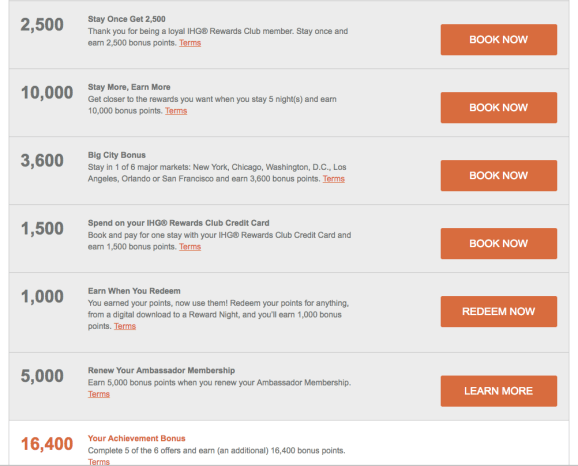
I love IHG’s quarterly “Accelerate” promotions, given how random the challenges are. Hyatt and Hilton may offer you double points on stays for a limited time; IHG instead wants you to dance a jig in the lobby of six different Holidays Inn in order to earn 9000 bonus points. I also like how you can knock out multiple challenges in one stay – I only spent five total nights in IHG hotels last quarter, but I completed 3 of my challenges all at once.
Here’s my list of challenges for this quarter:
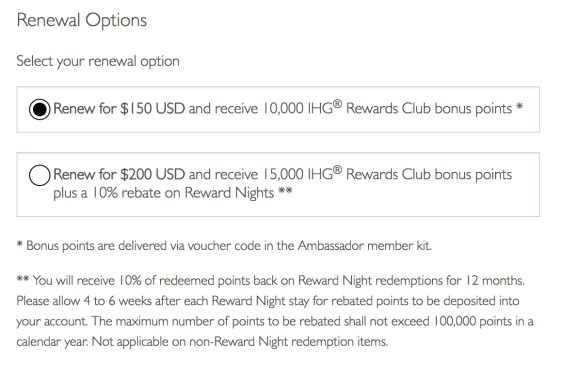
Again, some of these are pretty easy. I’ll definitely stay once, and I booked my stay with my IHG card already. That’s 4000 bonus points for a $90 night at a Candlewood Suites, which is nothing to sneeze at. The Ambassador membership incentive is interesting, since I’ve been pretty set on canceling my Ambassador membership this year. I have an offer for 10,000 bonus points to renew my membership, and even with this additional 5000-point bonus, I’d still be paying 1 cent per point, which is way too expensive for IHG points. However, I can probably sell the free night certificate for $75 or so, which would cut the cost per point in half, down to a reasonable 0.5 cents, plus any benefits gained during surprise Intercontinental stays.
(On a tangent, I do have another renewal option that I didn’t see last year: $50 more for an extra 5000 points plus 10% redeemed points back for 12 months. If this stacks with the 10% point redemption I get through my IHG credit card, that could be interesting. My feeling is that it doesn’t, though. Plus, I just cashed out all my IHG points in New York, so I don’t think I’ll earn enough points in the next 12 months to meaningfully benefit from this offer.)
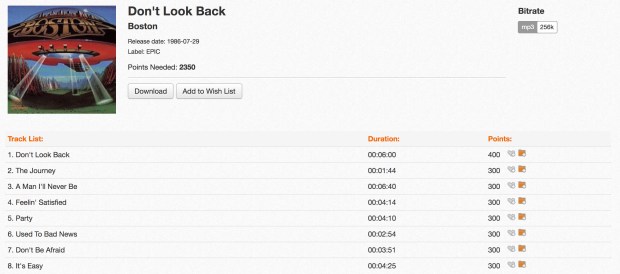
Okay, so back to the point of this post. The 1000 bonus points for any redemption caught my attention, because it includes things like IHG digital downloads (which I didn’t realize were a thing before today). Since I don’t have many points, it was unlikely that I’d redeem for an award night this quarter, but I’m intrigued by these digital downloads. And so I followed my curiosity and found a bunch of Boston songs available for 300 points each. Normally that would be a terrible deal – at a value of 0.5 cents per point (which may even be high for IHG points), that’s $1.50 per song. However, factor in the 700 bonus points that I wouldn’t have earned otherwise, and I’ve got MORE THAN A FEELING that this deal is SMOKIN‘!
You get a prize if you can guess which song I picked.
This could also come into play down the road if I’m close to hitting my achievement bonus, since it knocks down a challenge for a very minimal investment, which could pay off in a big way if I can nab the 16,400 bonus points. I’ve mentioned this in the past, but while IHG points aren’t very valuable, I like having a stash of them around, because their properties are so ubiquitous. That’s why I’ll go out of my way to pick up IHG points where I can – especially since it’s not a good deal to transfer Chase points to IHG under any circumstances. These Accelerate promotions are great for that, since you can earn a bunch of points for one or two stays if you play your cards right.
I’ll admit it, I was pretty excited about the new Altitude Reserve card from US Bank. Here’s a photo of it: you can tell it’s a big deal, because it’s black and it’s made out of metal.
The feature set on the card alternates between intriguing and head-scratchingly subpar. For instance, it earns 3 points per dollar on all mobile wallet transactions, which – assuming it doesn’t get nerfed – could translate into 3x on all spending as more and more merchants start accepting it. That’s innovative, to the point that a lot of people are saying that it’s unsustainable out of the gate. Then, you have the Priority Pass membership, which offers four free lounge visits per year and $27-per-visit thereafter. For a card to credibly take on the Sapphire Reserve, it can’t skimp on stuff like this – especially with so many cards offering unlimited memberships with free guest access.
Another weird restriction is that the card will originally be for USBank customers only. They’re claiming to take on the Sapphire Reserve, but they’re actively trying not to poach Chase’s existing customers. Makes sense? I just happen to have recently opened up a USBank card (the Korean Air Skypass Visa), so I’ll actually be eligible for the Altitude Reserve when it comes out on May 1st. Up until yesterday, my plan was to apply for it as soon as possible, but I’ve cooled on it after thinking about it further, and I have decided to wait for a while. Here’s why… and most of this is specific to me, but I’m also writing this out to enumerate why calling this card a GAME CHANGER may be premature.
1. The rewards program seems half-baked. USBank already has a convoluted rewards program in FlexPerks, which sets fixed-point redemption amounts across price bands, varying the value per point you get based on how close your redemption was to the top of its price band. (I don’t want to go into a detailed discussion of FlexPerks – if this doesn’t make sense, then my point about it being convoluted is correct.) This card will have an entirely new rewards currency that… wait for it… can be redeemed for 1 cent per point for cash or 1.5 cents per point for travel. Basically, they’re copying Chase’s Sapphire Reserve program, only without the transfer partners. If they’re going to be this non-innovative in the rewards space, earning 3x points per dollar doesn’t really matter that much.
2. I don’t have a phone that supports NFC payments. This is a big one – the main benefit of the card is entirely lost on me, except for things like in-app purchases, which I’ve spent maybe $15 on in the past year. I realized it doesn’t make sense to pay a $400 annual fee right now if I won’t be able to take advantage of the card’s main competitive advantage at least until November when my phone contract rolls over and I can get an iPhone 6.
3. Speaking of the $400 fee, despite all the perks and the $325 travel credit, the card isn’t fee-negative the first year (since the travel credit can only be used once per cardmember year). This is another disadvantage compared to the Chase/Amex/Citis of the world, all of whose cards have annual credits that can be redeemed twice in the first calendar year. While I certainly agree that these credits probably should be limited to one per cardmember year (at least from a revenue management perspective), the fact is that most premium cards offer an extended free trial period, and this one doesn’t. I know I could recoup most of the fee right away, but it’s still $400 I have to spend out-of-pocket right now, and that throws off my annual fee budget.
4. The minimum spend is high, and the sign-up bonus isn’t great: $4500 in three months for 50,000 bonus points (up to $750 in travel). Including the $325 travel credit and annual fee, the net is $675 toward travel for $4500 in spend. That’s good, but it isn’t other-worldly good. Barclay will give you $500 toward travel for $3000 spend and a waived annual fee. Capital One will give you $400. Neither is as good as USBank, but we’re pretty far from Sapphire Reserve 100k bonus territory here.
5. Getting back to the rewards program: the value of the 50,000 points depends on USBank’s booking engine. I happen to be planning a trip right now, so I’ve been using Chase’s Ultimate Rewards portal to look up prices for intra-Europe travel, and one thing I have noticed is that Norwegian doesn’t come up in the search results. That’s a big deal, based on this math:
Norwegian flight (AMS to CPH): $69 including bulkhead seat selection and checked bag
KLM flight: $126, plus $15 for a checked bag and $5 for a seat.
Assuming flying KLM doesn’t hold any benefit vs flying Norwegian (and in fact it’s worse, because I wouldn’t get a bulkhead seat on an economy fare), the actual value of the points I’d redeem is less than the 1.5 cents that Chase advertises. Given that I’d pay $20 in cash either way, the net value of the 8400 points I’d redeem for the KLM flight equals the difference between the Norwegian fare and $20, or $49. That drops the value from 1.5 cents per point to .058 cents.
Now, I realize this is a very specific example, but it underscores how proprietary rewards currencies – even when they have a fixed value – don’t always match that value in the real world.
6. Since I’m planning a trip right now, I also have to consider how my spending over the next few months can improve that trip – preferably through aspirational redemptions. Remember those? I got so wrapped up with this 1.5 cents-per-point bullshit that I forgot my travel philosophy, which is not necessarily to maximize return on spend to earn “free” travel, but rather to use points to unlock travel experiences that would otherwise be out of reach. Therefore, I find myself able to justify paying outright for piddly little positioning flights in economy if I can put $4500 of spend toward an aspirational redemption on the same trip. I’m not sure which direction I’m going to go here, but one option would be to open the Citi Hilton Reserve and the Amex Hilton – between the two (after exactly $4500 in spend), I could get three nights at the Waldorf Astoria Amsterdam, assuming there was availability (and there is, at least as of now). A few free flights around Europe or staying in the #1-rated hotel in Amsterdam? For me it’s the latter by a wide margin. I’m not 100% going to do that, but it’s a good example of how the USBank card doesn’t fully align with my immediate travel goals – at least not when I’m also required to drop $400 on an annual fee.
7. That leads me to the last reason I’m avoiding this card for now, which is that I’m betting on USBank improving the rewards program at some point. To wit: in interviews with travel bloggers, the USBank exec in charge of the card has repeatedly said that they’re considering transfer partners in the future. That’s quite different than saying that they will do it, but notice that he isn’t trying to defend Altitude points on their own merit either. There’s none of that “well, our points offer superior flexibility, they never expire, blah blah blah” doublespeak, suggesting that he realizes Altitude is a half-baked program and they’re going to have to add some features to it to really compete. Now, let’s say they do add a couple transfer partners in six months or a year – given that they’ve been very clear that the 50k bonus is a one-time deal, how pissed would I be if I pissed away my points pissing around Europe on short haul economy flights? PRETTY PISSED!
So, given all these factors – waiting to get a new iPhone, waiting to see if they improve the rewards program, and waiting until I’m not at a point where I’m deliberately focusing my spend toward aspirational redemptions in the immediate term – it definitely makes sense for me to wait for this card.
What about you, you hyper-intelligent commenters? Are you rushing out to get the card? Are you opening USBank accounts like mad so you can be eligible for it? Are you polishing your mobile wallet to prepare it for prime time? I’m curious what others (besides proficient manufactured spenders who are going to clean up with mobile wallet transactions) think about this card.
Oh right, I promised other musings about credit cards:
I will admit that part of my decision on the USBank card has to do with ongoing reservations about the aforementioned Korean Air card, which I still don’t know if I should have opened. I’m still working off the $3000 minimum spend on that one, and I have no use in mind at all for the miles I’ll get. As I’ve said repeatedly, if it’s a good deal and unlikely to be repeated, it’s probably worth doing, and I’m sure I’ll appreciate the points when I’m hanging with The Points Guy, Gary Leff, Lucky, and that guy with the stuffed monkey in Korean Air first class, but for now that remains my least thought-out mileage play. There aren’t any significant negative repercussions, but my takeaway from it is to think a little longer about where my spend could be going rather than toward bonuses for miles I don’t need and won’t use for a long time.
I closed my SPG Amex after trying a bunch of times to get a retention bonus and coming up empty. I don’t regret it (yet), although I will if they discontinue the card tomorrow and transition everyone over to a secret card that gives you Marriott lifetime platinum status or something.
I also closed my Citi Prestige card today, since I’ve had it for two years and never stayed at a hotel four nights in a row (that wasn’t an award stay). There goes the value proposition on that one! Plus, I’m not a huge fan of Thank You points (BUT THEY JUST ADDED JET AIRWAYS AS A TRANSFER PARTNER!!!!!!!!!!!!!!!), so the earn rate on the card wasn’t very exciting. Oh, and they’re slashing bennies right as Chase, Amex, and USBank are making the premium card space more competitive. The funny thing about my call to cancel, though, is that I was sure I wanted to get rid of it, so I tried to bypass the retention department. I remember this used to be an issue, where people would call in for retention bonuses and have their cards closed by the first-line rep. I got a retention bonus on it last year, and I had to do a very delicate dance in which I appeared serious about canceling it but really interested in maybe keeping it open if I got the right bonus. This time, the rep transferred me to retention without me asking, and the retention rep offered me something despite my saying I wasn’t interested. Not that it would have changed my mind – the offer was a $200 statement credit for an eye-watering $12,000 in spending (4k per month for 3 months). And then, when I canceled the card, she told me that I’d get around $75 back as a pro-rated refund of my annual fee. First, if I had known that Citi offered this, I would have canceled months ago. Second, think about the choice there: $12,000 spend for $200 off an annual fee for a card I didn’t want… or $75 free money to close it. SAD!




 Windbag Miles